President Kennedy and the New Frontier
- John F Kennedy was president from January 1961 until his Murder for religious or political reasons. in November 1963.
- The name given to the reform policies of President John F Kennedy in the early 1960s. was the phrase he used to describe the challenges Americans faced at this time.
The New Frontier
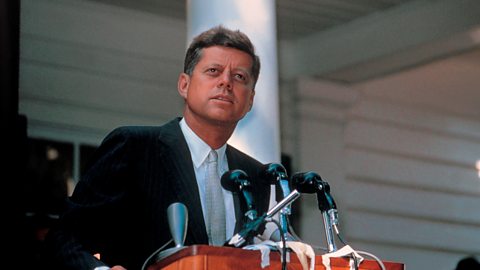
We stand today on the edge of a new frontier, the frontier of unknown opportunities and perils … Beyond that frontier are uncharted areas of science and space, unsolved problems of peace and war, unconquered problems of ignorance and prejudice, unanswered questions of poverty and surplus.
New Frontier was originally Kennedy’s campaign slogan. It represented a series of challenges in the USA that he promised to deal with. By the time he had become president, this idea had started to become a programme to improve the lives of the American people, especially black Americans, people from low-income backgrounds and the elderly.
Turning these ideas into actions proved to be very difficult for Kennedy. He had only won the 1960 election by a very narrow margin and there was a lot of opposition towards him in The legislative body of the US government, made up of the Senate and the House of Representatives.Often:
- older politicians thought Kennedy was too young and inexperienced
- politicians from the South objected to his support for Rights everyone is entitled to regardless of the colour of their skin, their beliefs, sexuality, gender or other personal characteristics. These rights could include the right to vote, or the right to a good education etc. even though many of them were members of the Political party in the United States. Democrats tend to hold a more liberal viewpoint on politics and society. just like Kennedy was
- Christians who broke away from the Roman Catholic Church during the Reformation. They believe in the teachings of the Bible but reject the authority of the Pope. politicians did not trust him because he was the first A group of Christians who accept the Pope in Rome as their leader. president and many saw his proposals as being too extreme
As a result, many of the A proposed new law. When a bill is approved by Congress and the president, it becomes an act and is now the law. Kennedy supported - proposing new laws - were not passed by Congress while he was alive. Kennedy did achieve some success with Payments and other benefits, such as education, health care, and unemployment payments, given to a population free at the point of use, although paid for by general taxation. reforms. He was assassinated before he was able to finish the New Frontier programme.
Civil rights
President Kennedy was an open supporter of civil rights. For example, he appointed Thurgood Marshall, one of the National Association for the Advancement of Colored People (The National Association for the Advancement of Colored People is a civil rights organisation in the USA. Set up in 1909, it works to bring about racial equality.) lawyers involved in the Brown v Topeka case, to be a senior Part of the government of the USA as a whole rather than relating to an individual state. judge. He was prepared to intervene when there was evidence of individual states trying to avoid implementing civil rights rulings.
In 1962, he sent large numbers of Armed forces controlled by the president in Washington, DC. and Officers in the USA who enforce federal laws and respond to crisis situations. to protect a black American student, James Meredith, as he attended the University of Mississippi. The university had only allowed white students to study there and Meredith faced a lot of opposition to his application.
In 1963, Kennedy began the process of getting Congress to pass a law to end segregation and To treat someone differently or unfairly because they belong to a particular group. against black Americans. However, this was only passed by his successor, Lyndon B Johnson, after Kennedy’s assassination.
Medicare
People in the USA were expected to pay for their health care. As this was very expensive, people needed Bought protection against unfortunate events that may cost money, eg car insurance is paid so that damage is paid for in the event of an accident. to cover the costs of any treatment. This cost a lot of money, so many American citizens were unable to afford it. President Harry Truman had planned to provide government insurance for people, but Congress had blocked his idea.
In 1961, Kennedy started looking at providing free health care for people over the age of 65. Many people could not afford health insurance after they retired. In 1962, his proposal was blocked by Congress, but it continued to be discussed until it was eventually passed in 1965.
Housing and welfare reforms
While he failed to make any progress on health care, Kennedy was able to introduce reforms to help Americans from low-income backgrounds:
- He increased the The minimum amount a business can legally pay an employee whilst working. by 25 per cent to $1.25 an hour.
- Public welfare amendments in 1962 - commonly known as the 1962 Social Security Act - provided money to help support elderly people, unemployed people and children whose fathers were unemployed.
- There were also measures to help unemployed people. For example, the 1962 Manpower Development and Training Act helped people without jobs to get training.
- The 1961 Area Redevelopment Act provided money to states to support unemployed people.
- The 1961 Housing Act helped to improve living condition by providing cheap loans for developers to build better housing in towns and cities.
