The contribution of black Americans to the war effort
- The treatment of black Americans during World War Two showed that there was still racial To treat someone differently or unfairly because they belong to a particular group. in the USA.
- Black Americans were involved in the war effort both in the armed forces and in the factories on the This term refers to the civilian population and the activities they undertake in their home country while their armed forces fight in a war with another country.
- They hoped that Rights everyone is entitled to regardless of the colour of their skin, their beliefs, sexuality, gender or other personal characteristics. These rights could include the right to vote, or the right to a good education etc. for black Americans would improve during the war.
Jim Crow Army
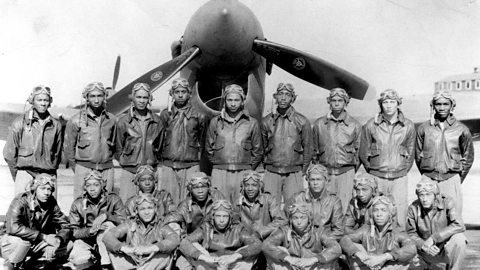
The US armed forces were This meant that white people and black people had to live separately. The areas of society affected by segregation included churches, hospitals, theatres and schools. just like transport and education were in the southern states of the USA. The segregated units were known as the Jim Crow Army - they were named after the The laws that introduced segregation in the US South (the laws that kept black people and white people apart).
To begin with, black people were only allowed to serve in supporting roles, working in kitchens or carrying messages rather than fighting on the The furthest point during a war that an advancing army has reached. The same was true in the navy and the air force. However, this changed later in the war, as black Americans were needed to fill positions in the forces as troop numbers fell when white Americans were wounded or killed. By 1945, almost 750,000 black Americans were serving in the armed forces. Initially, there were only white officers in charge of these segregated units.
Black Americans in the armed forces were not just discriminated against in terms of the jobs they were allowed to do. Additionally, there were segregated blood supplies for treating the wounded, as many white troops refused to accept blood transfusions from black Americans. Also, the many black women who served as nurses in the armed forces were only allowed to treat black servicemen.
Active service
Dwight D Eisenhower, the Supreme Commander of the During World War One, from 1917, the Allies were Great Britain, France, Russia, Italy, Japan and the USA. In World War Two the Allies initially included France, Poland and the UK but they were joined by USSR and USA. France was defeated in 1940 and further nations joined the group. However, Italy and Japan were enemies. forces in Europe, supported the idea of integrated units of black and white soldiers fighting together. In 1944, as the war progressed and casualties increased, black American soldiers were sent to fight in combat units on the front lines.
The 761st Tank Battalion was a predominantly black unit and became known as the Black Panthers (not to be confused with the Black Panthers of the 1960s). The battalion was highly praised by General George Patton during the An important turning point in World War Two as the final attempt by German forces to attack the Allies was defeated. By the end of the war, many black Americans serving in both the army and the navy had been promoted to be officers.
There were also fighter squadrons of black American pilots. For example, the A squadron of black American pilots whose job was to protect Allied bombers flying missions against Germany in World War Two. served in Europe and were very successful at protecting bombers from German fighters.
On the home front
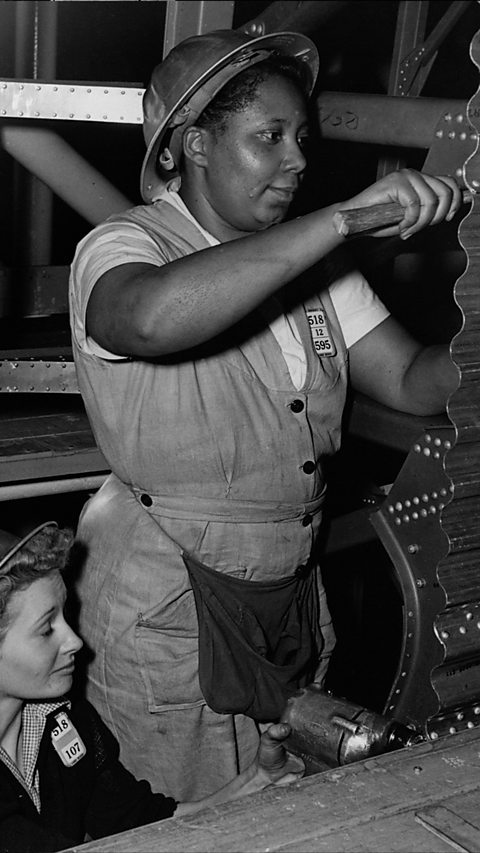
The war meant a huge increase in demand for workers in factories on the home front to produce weapons. The black American men and women who moved across the USA to work in these factories found that they were discriminated against, especially when it came to pay. To avoid a protest by black Americans, President Franklin D Roosevelt issued An order signed by the US president directing government departments to do certain things. Executive orders do not require approval from Congress. 8802, which banned discrimination against black Americans in work. He also set up the Fair Employment Practices Committee (FEPC) to make sure these policies were carried out.
During the war, the number of black Americans working for the US government rose from around 50,000 to 200,000, and roughly another 2 million black Americans worked in the war industries. Many of the roles in the war industries demanded technical knowledge and skills - black Americans would not have been allowed to carry out these roles before the war. When entering these roles for the first time, they received a higher level of training than they would previously have been able to access.
Even with some improvements, however, discrimination was still common. It led to an increase in racial tension that culminated in race riots in many cities across the US. The worst example was in Detroit in 1943, where 34 people were killed, 700 more were injured and $2 million worth of damage was caused. There were even riots at black army training camps where black soldiers were angry at unequal treatment.
