The impact of Black Power
Black Power
Black Power was a phrase used to describe the idea that black Americans should be more direct and aggressive in dealing with the violence, discrimination and poverty they faced. Even after the 1964 Civil Rights Act and 1965 Voting Rights Act, The separation or isolation of a race, class, or ethnic group. and discrimination continued. Neither of these laws did anything to improve the terrible conditions many black Americans lived in or solved the problem of poor job opportunities for black Americans, especially in the cities in the northern states.
Explore civil rights and the origins of Black Power through animation and archive footage.
Race riots
One way that black Americans showed their frustration with the continuing discrimination was through race riots. The most serious of these were in the Watts district of Los Angeles, California, in 1965 and in Newark, New Jersey, in 1967. There were also widespread race riots across the USA following the assassination of King in 1968.
The riots resulted in hundreds of deaths, thousands of serious injuries and hundreds of millions of dollars worth of damage. The Kerner Report, published in 1968, said this was due to racism and the use of violence by the police.
Stokely Carmichael
The Black Power movement in the 1960s developed as a response to these problems. One of its leaders was Stokely Carmichael. At the beginning of the 1960s, Carmichael had been a member of the A student group initially set up in 1960 to peacefully campaign for civil rights. It was known by the abbreviation SNCC., which had organised When protesters sit inside or outside a business to protest against its rules., To refuse to take part in, buy or use something in order to show disapproval or bring about a change., marches and voter registration campaigns. However, he became increasingly angry at the violence and intimidation campaigners faced. He argued that black Americans should be solving problems for themselves without needing the help of white people. This was what he meant by Black Power.
No man can give anybody his freedom. A man is born free. You may enslave a man after he is born free, and that is in fact what this country does. It enslaves black people after they’re born, so that the only acts that white people can do is to stop denying black people their freedom.
Inspired by Malcolm X, Carmichael encouraged black Americans to be proud of who they were and to celebrate their African heritage. Eventually he left the SNCC, became involved with the An African American organisation founded in 1966 that aimed to protect black communities from racist violence and help people within the community to live better lives, changed his name to Kwame Ture and went to live out the rest of his life in Guinea in Africa.
1968 Olympics
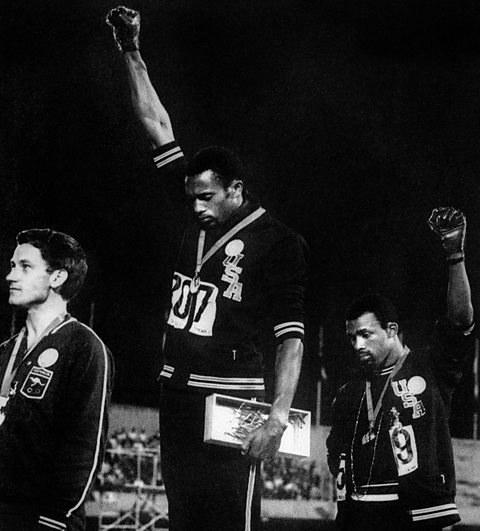
The television audience for the 1968 Olympics in Mexico was 1 billion people. This presented a great opportunity for black American athletes to get publicity by making a Black Power protest.
When Tommie Smith and John Carlos stepped onto the podium to receive their medals for coming first and third in their event, they made a Black Power protest. They held up their right hands in black gloves clenched into fists - the Black Power salute. They also wore black handkerchiefs around their necks to symbolise pride in their black American heritage and wore black socks without shoes to symbolise the poverty of black Americans.
Both men were accused of bringing politics into sport and sent home, where they received death threats for their actions. The whole world now knew what the Black Power movement was.
Impact of Black Power
Black Power was blamed for the race riots, and many white Americans were To make someone feel isolated from others. by the movement’s ideas and approach. However, it did persuade some civil rights organisations, such as the Southern Christian Leadership Conference. A civil rights organisation set up in 1957 based on Christian values that peacefully campaigned against segregation in the USA., to turn their focus away from passing laws and more towards improving the living conditions and economic circumstances of black Americans. Indeed, Dr King was speaking on this theme when he was assassinated in Memphis in 1968.
Black Power also persuaded President Johnson that more needed to be done to help black Americans, especially in terms of education. He supported bussing, which meant using buses to take students from the black American parts of a town to schools in the white American parts. He also began the policy of affirmative action, which meant encouraging employers and colleges to give opportunities to as many black Americans as they could, even if they did not have the same qualifications as white Americans.
Black Panthers
The Black Panthers was a black American organisation that was set up by Bobby Seale and Huey Newton in Oakland, California, in 1966. Members dressed in black and carried guns to protect themselves from the police and white racists. They also monitored the police to make sure they were not mistreating black Americans.
Inspired by Malcolm X, they got a lot of publicity, even though there were only ever a few thousand members (around 5,000 at the organisation’s height). The Federal Bureau of Investigation. An agency set up by the US federal government to investigate criminal cases, where federal laws may have been broken. considered them to be enough of a threat that the Black Panthers were kept under surveillance.
The Black Panthers believed that black Americans would be better off living in a A person who believes all possessions should be owned by the community and everyone receives only what they need. society rather than a The economic idea that countries should be run based on private business, trade, stocks and shares, and profit. one. They developed a Ten-Point Programme that demanded decent jobs, houses and education for black Americans. They also wanted the police to stop harassing members of black American communities.
The Black Panthers did a lot of good for the black American communities they supported, by:
- creating free medical clinics for black Americans
- starting breakfast clubs to make sure children would not be hungry at school
- organising courses on black American history
- reducing levels of gang violence
- providing guidance and support for people struggling with drug addiction
However, there were a number of scandals and arguments within the group. For example, in a clash with police in 1969, 27 members died and 700 were injured. Such events led to a reduction in support for the Black Panthers at the end of the 1960s. The group formally disbanded in 1982.
