Civil rights legislation
Southern politicians, especially the Political party in the United States. Democrats tend to hold a more liberal viewpoint on politics and society. in the A chamber of the United States Congress, which together with the House of Representatives, makes up the legislature of the United States., who, at the time, were opposed to laws that would improve Rights everyone is entitled to regardless of the colour of their skin, their beliefs, sexuality, gender or other personal characteristics. These rights could include the right to vote, or the right to a good education etc. for black Americans. President Dwight D Eisenhower supported civil rights but he did not think that The legislative body of the US government, made up of the Senate and the House of Representatives. in Washington, DC, should tell individual states what to do.
1957 and 1960 Civil Rights Acts
A civil rights A proposed new law. When a bill is approved by Congress and the president, it becomes an act and is now the law. was discussed in Congress in 1957. It eventually passed through the Senate and became a law. However, this was only after a lot of changes were made to the bill which weakened some of powers that would have been given to the The central government in the USA, including the president, Congress and the Supreme Court. to enforce the law. It established a commission to investigate how some states prevented black Americans from voting and gave federal courts the power to prosecute states if they allowed voting To treat someone differently or unfairly because they belong to a particular group. The right to vote had been guaranteed by the 15th amendment to the A set of laws by which a country is governed. in 1870.
The 1957 act did not bring about much change. When states were prosecuted, the juries declared those accused to be not guilty. A second Civil Rights Act was passed in 1960. This introduced inspections of the voting process and made the punishments for stopping people from voting clearer. However, it still did little to change the situation as it was difficult to get the necessary evidence for a prosecution.
1963 Equal Pay Act
- The Equal Pay Act became law on 10 June 1963.
- It stated that it was illegal to pay men and women different wages if they were doing the same job.
- The act was the result of a long campaign that had started during World War Two, when more women had joined the workforce.
- Many men had become worried that employers would replace men (to whom they paid higher wages) with women (whom they could pay less).
- This law was important in the development of civil rights for black Americans as it established the idea that the federal government supported laws that promoted equality.
1964 Civil Rights Act
President John F Kennedy had started work on a new civil rights bill in 1963 but it faced a lot of opposition in Congress from the southern politicians. After Kennedy’s Murder for religious or political reasons., the new president, Lyndon B Johnson, persuaded Congress to pass the civil rights bill into law in Kennedy’s memory. It was very divisive - some black Americans thought it was too little, too late, while many people in the southern states hated it as they thought it went too far.
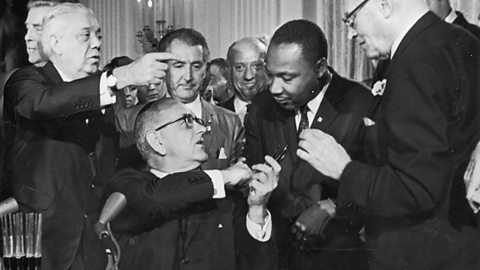
The 1964 Civil Rights Act included provisions that did the following:
- banned The separation or isolation of a race, class, or ethnic group. in public places, businesses (such as restaurants and hotels) and education
- made the federal government responsible for bringing prosecutions against people and businesses that were accused of discrimination
- put the Fair Employment Practices Committee (FEPC) in charge of making sure that people were not being discriminated against at work
- created the Equal Employment Opportunity Commission (EEOC) to enforce the act
My fellow citizens, we have come now to a time of testing. We must not fail. Let us close the springs of racial poison. Let us pray for wise and understanding hearts. Let us lay aside irrelevant differences and make our Nation whole.
1965 Voting Rights Act
Black Americans had been given the right to vote in 1870, but a number of states had prevented them from voting. They did this by telling black Americans to pay electoral taxes that they could not afford or requiring them to take a number of tests that were designed to be almost impossible to pass. Workers from the Student Nonviolent Coordinating Committee (SNCC) had been travelling through the southern states in the early 1960s helping people to register to vote where they faced a lot of intimidation and violence. Some of those who registered to vote lost their jobs or were evicted from their farms.
The most common way to prevent black Americans from voting was to say that they had failed a The ability to read and write. test. People were also intimidated into not registering to vote. The campaign to increase voting rights focused on the town of Selma in Alabama, where Dr Martin Luther King Jnr and the Southern Christian Leadership Conference. A civil rights organisation set up in 1957 based on Christian values that peacefully campaigned against segregation in the USA. had been invited to join a local protest in March 1965.
During the Selma march, protesters were beaten by the police, and this was broadcast on television. The march and the publicity it received persuaded President Johnson and The legislative body of the US government, made up of the Senate and the House of Representatives. to act quickly and the Voting Rights Act was passed in August 1965.
The 1965 Voting Rights Act meant:
- literacy tests were ended
- states now had to ask the federal government for permission to use different voting qualifications from those used by other states
- federal agents were used to make sure that there was no voting discrimination, especially in places where fewer than half of black Americans were registered to vote
The act led to huge increases in the number of black Americans registered to vote - 250,000 had registered by the end of 1965 and 750,000 by 1968. In Mississippi, for example, there was a 1,000 per cent increase in the number of black Americans registered to vote.
This in turn led to an increase in the number of black political representatives, including local councillors, mayors and eventually members of Congress. It also meant that politicians had to pay more attention to what black voters wanted if they were going to win elections. Black Americans became an important group of voters whose support politicians had to win.
Further civil rights reforms
There were several other civil rights reforms that occurred while Johnson was president:
- Loving v Virginia - in 1967, the The highest court in the USA. It has the power over all courts in the country. unanimously ruled that it was illegal for states to have laws that stopped people from different races marrying each other. This was after a black woman, Mildred Loving, and her husband, Richard Loving, a white man, were each sentenced to one year in prison for marrying each other.
- 1968 Fair Housing Act - this law said that discrimination in the buying, selling or renting of housing on the grounds of race, gender, disability or religion was illegal.
