Dr Martin Luther King Jnr and civil rights marches
Dr Martin Luther King Jnr
Dr Martin Luther King Jnr promoted the idea that peaceful non-violent protests would gain public attention and sympathy, which would persuade courts, presidents and law-makers to end To treat someone differently or unfairly because they belong to a particular group.
Dr Martin Luther King Jnr was born in 1929 in Atlanta, Georgia, and grew up in a middle-class home. His father was a Baptist Christian preacher. When King obtained his doctorate degree from Boston University he decided to become a preacher too. He had only been preaching for a short time in Montgomery, Alabama, when the Montgomery Improvement Association (MIA) was formed to organise the bus boycott. He is most well known for his Christian values, his support for non-violent methods of protest and his inspirational speeches.
Dr King also helped to found the Southern Christian Leadership Conference Southern Christian Leadership Conference. A civil rights organisation set up in 1957 based on Christian values that peacefully campaigned against segregation in the USA. to encourage non-violent campaigns for civil rights. The SCLC particularly aimed to increase the number of black Americans who were registered to vote. His contribution as an important civil rights leader was recognised when he was awarded the Prestigious international award given yearly for an outstanding contribution to peace. in 1964.
Birmingham march, 1963
By the spring of 1963, Birmingham, Alabama, had become the focus of civil rights protests. This was because the authorities had done nothing to Removal of laws that separate people from different races in public places and day-to-day life. public facilities and nearly half the population were black Americans. The civil rights leaders in Birmingham realised that there were two factors that could help them to get publicity for their protests:
- the local commissioner for public safety, Eugene ‘Bull’ Connor, held racist views
- many members of the Ku Klux Klan lived in Birmingham
If these people reacted violently to the protestors, then this would generate a lot of media coverage that was sympathetic to the civil rights cause.
The first civil rights march, in April 1963, ended with Dr King and other leaders of the march being arrested and put in prison. While in prison, King wrote ‘Letter from Birmingham Jail’, which clearly explained the case for continuing to protest and for an end to discrimination.
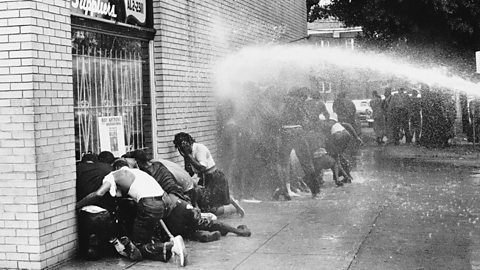
At the beginning of May, a second set of marches began. Many of the marchers were young people, mostly teenagers, but some were as young as six. The marches were referred to as the ‘children’s crusade’. The police arrested so many protesters that the prisons were full, so they used police dogs and water cannons to force the protesters off the streets. This was shown on television and in photographs around the world. It created a lot of sympathy for the protesters.
President John F Kennedy sent a representative to negotiate for an end to the protests. George Wallace (the A person who is elected to lead a state’s government in the USA. of Alabama) and the Ku Klux Klan tried to stop this from happening, but the white Americans who owned businesses wanted the protests to end. Birmingham began to desegregate and the protests ended. President Kennedy was now convinced that the United States needed a Civil Rights Act to make sure these protests did not happen again.
March on Washington, 1963
In August 1963, The legislative body of the US government, made up of the Senate and the House of Representatives. was debating President Kennedy’s civil rights A proposed new law. When a bill is approved by Congress and the president, it becomes an act and is now the law. Many of the civil rights organisations - including the NAACP, An American civil rights group founded in 1942 known for its use of non-violent protest. the SNCC and the Southern Christian Leadership Conference. A civil rights organisation set up in 1957 based on Christian values that peacefully campaigned against segregation in the USA. - organised a joint march in Washington, DC, to show their support for the bill. Some worried that this would lead to violent clashes with protesters. Kennedy asked for the march to be called off in case it damaged the chances of the bill being passed.
The Lincoln Memorial commemorates the life of Abraham Lincoln, the president who introduced the 1863 Emancipation Proclamation. In front of it, around 250,000 people gathered to hear speeches and music about the need to improve civil rights. It is estimated that between 20 and 25 per cent of the people marching were white. The final speech of the day was by King. In this complex speech, known as ‘I Have a Dream’, he explained how he hoped that black and white Americans could live together as equals, linking his beliefs to the American dream and the US A set of laws by which a country is governed.
Despite the profile of women in the civil rights movement, like Rosa Parks and Ella Baker, women were given limited roles. For example, they sang or introduced male speakers at the event. Prominent women were instructed to walk in a group behind the male leaders, meaning King’s wife, Coretta Scott King, couldn’t walk beside her husband. The limited role of women at this event highlighted the inequalities in both race and gender in the USA.
The March on Washington further raised the profile of the civil rights movement and increased awareness if the effectiveness of peaceful protest. However, there was still a lot of resistance to equality in Congress, and violence against black Americans continued. President Kennedy was Murder for religious or political reasons. in November 1963, but his successor, Lyndon B Johnson, managed to get Kennedy’s civil rights law passed in 1964.
Selma March, 1963
President Johnson had to take voting rights out of the Civil Rights Act to get it passed through Congress in 1964. If he had not, there would have been too much opposition to the act from southern politicians. In order to get a new law guaranteeing voting rights, civil rights campaigners focused on Selma in Alabama. King organised another non-violent march from Selma to the state capital of Montgomery to present a petition to the governor asking for equal voting rights.
Not long after the march from Selma began, on 7 March 1965, the police attacked the marchers by the Edmund Pettus Bridge with dogs, whips and tear gas. This became known as Bloody Sunday and was shown all around the world in newspapers and on television. King initially called off another march to avoid further violence. However, the second march did eventually go ahead and led to President Johnson getting a Voting Rights Act through Congress in August 1965.
Assassination
After the 1965 Voting Rights Act, King became involved in a number of other campaigns against poverty and against the A war between communist North Vietnam and non-communist South Vietnam for control of the whole of Vietnam; the USA sent American troops to protect South Vietnam. In April 1968, he was visiting Memphis to support black American workers who wanted equal treatment when he was assassinated at his hotel by James Earl Ray, a white American. There was rioting in over a hundred American cities in response to King’s assassination.
