Education and civil rights
The The laws that introduced segregation in the US South (the laws that kept black people and white people apart). confirmed by the The ultimate court of appeal in the USA. It makes the final decision on whether a law is permitted by the US Constitution. in the 1890s, said that black and white Americans could be kept ‘separate but equal’. In education, this meant that as long as they could both go to a school, they were equal. In reality, this meant that schools for black Americans had much larger classes with far fewer resources. In states with This meant that white people and black people had to live separately. The areas of society affected by segregation included churches, hospitals, theatres and schools. schools (which were mostly in the South), black American children were not allowed to go to a school that was attended by white children, even if it was near to where they lived.
Brown v Topeka, Kansas
A significant court case that challenged segregated education involved a black American girl called Linda Brown, who lived in Topeka, in the state of Kansas. In 1951, her parents asked for her to be moved to the school that was nearest to where they lived. The local school board said she could not go there as the school was for white Americans only. Linda’s parents asked the The National Association for the Advancement of Colored People is a civil rights organisation in the USA. Set up in 1909, it works to bring about racial equality. for help and its lawyers took the court case all the way to the Supreme Court in Washington, DC. They argued that segregated education was damaging to black American children.
In May 1954, the Supreme Court, led by Chief Justice Earl Warren, ruled unanimously, that segregation in education went against the US A set of laws by which a country is governed. This was an important victory for education, and it also gave Rights everyone is entitled to regardless of the colour of their skin, their beliefs, sexuality, gender or other personal characteristics. These rights could include the right to vote, or the right to a good education etc. activists an argument to use against To treat someone differently or unfairly because they belong to a particular group. in other settings.
We conclude that in the field of public education the doctrine of ‘separate but equal’ has no place. Separate educational facilities are inherently unequal.
- There was a lot of resistance to implementing the judgement in the southern states.
- Sometimes politicians passed laws to try to stop it, and sometimes people used violence and intimidation.
- By 1957, while there were 300,000 black children in Removal of laws that separate people from different races in public places and day-to-day life. schools, there were still 2.4 million in segregated schools.
- By the 1970s, there were still black American children in segregated schools.
Little Rock High School
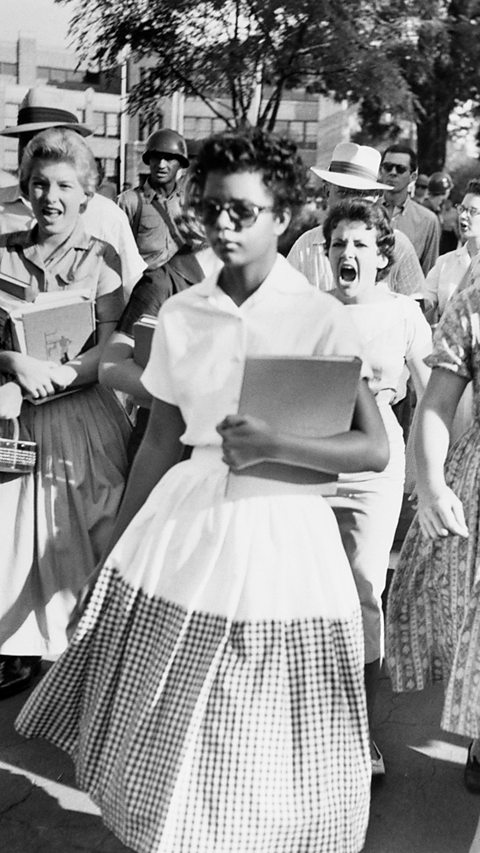
Events at Little Rock High School in Arkansas convinced President Dwight D Eisenhower to take a more active role in supporting school integration.
Nine black American children tried to attend Central High School in Little Rock, Arkansas, in 1957. This was part of a campaign organised by Daisy Bates, president of the Arkansas NAACP group. Before this, no black students had attended the school. A person who is elected to lead a state’s government in the USA. Orval Faubus ordered state troopers to stop these students from attending the school, saying that he was doing this for their own safety.
When the Little Rock Nine turned up for school, they were faced by an angry crowd of white Americans and Armed forces controlled by the governor of a state. trying to stop them. The children were escorted home by the police in full view of the media.
A photograph was taken of 15-year-old Elizabeth Eckford being shouted at by a mob of angry people as she tried to pass through to Little Rock High School. This became one of the defining images of the civil rights campaign.
President Eisenhower tried to persuade Governor Faubus to back down and allow the students to attend the school. After riots escalated outside the school, Eisenhower sent in 1,200 Armed forces controlled by the president in Washington, DC. to protect the children. They were finally able to attend the school. The troops stayed for a year but the Little Rock Nine still faced abuse inside and outside the school. Minnijean Brown, one of the Little Rock Nine, was expelled for reacting to the abuse she received.
In 1958, Governor Faubus shut all schools in Arkansas to avoid having to desegregate them. The Supreme Court ordered him to reopen and desegregate all schools in Arkansas, although this did not begin until 1961. Schools in the state were not fully integrated until the 1970s.
The events at Little Rock were important because this was the first time a president had intervened in the desegregation of schools. The events also showed that the president and Supreme Court could overrule civil rights decisions made by states if they wanted to. Using the media to embarrass the government into action became an important element of future civil rights protests.
James Meredith and Ole Miss
Desegregation of universities took longer than it did in schools. In 1962, Ole Miss (a name given to the University of Mississippi) was ordered by the Supreme Court to allow James Meredith, a black American student, to study there. The state governor, Ross Barnett, had a law passed that barred any convicted criminals from attending university in the state - Meredith had a conviction for falsely registering as a voter.
President John F Kennedy sent 300 Officers in the USA who enforce federal laws and respond to crisis situations. to protect Meredith after white American students at Ole Miss rioted. Later, 2,000 federal troops were sent in after there was further rioting. Meredith was protected by 300 state troopers until he graduated with a political science degree.
Black American students faced similar problems at universities in other southern states. However, they were able to attend and study as the law and the The central government in the USA, including the president, Congress and the Supreme Court., through the example of James Meredith, were proven to be supportive of their attendance.
