The Montgomery Bus Boycott and the Freedom Rides
The separation or isolation of a race, class, or ethnic group. in public transport had become widespread in the southern states following the The highest court in the USA. It has the power over all courts in the country. judgement in the 1896 Plessy v Ferguson was a US Supreme Court ruling in 1896 that said that racial segregation on public transport was acceptable because people were being kept ‘separate but equal’ as they still had access to transport. case. There had been many attempts to challenge this. However, it was only in the 1950s that there was significant success as people began to challenge the To treat someone differently or unfairly because they belong to a particular group. of the bus laws in particular. In March 1955, 15-year-old Claudette Colvin was arrested and spent hours in an adult jail for refusing to give up her seat on the bus for a white American passenger.
Explore the origins of the US civil rights movement through animation and archive footage.
Rosa Parks
Rosa Parks had been involved in Rights everyone is entitled to regardless of the colour of their skin, their beliefs, sexuality, gender or other personal characteristics. These rights could include the right to vote, or the right to a good education etc. campaigns for most of her adult life. In 1932, she worked with her husband to help free a group of black American teenagers falsely accused of rape. As a member of the Montgomery branch of the The National Association for the Advancement of Colored People is a civil rights organisation in the USA. Set up in 1909, it works to bring about racial equality., she helped to get legal representation for black Americans facing discrimination and false accusations.
In the summer of 1955, Parks was horrified by the murder of black American teenager Emmett Till, who was tortured, mutilated and shot in Mississippi in an act of racist violence. She also attended a workshop about how to Removal of laws that separate people from different races in public places and day-to-day life. schools, and went to a talk about the Till murder where she saw Dr Martin Luther King Jnr speak for the first time.
On 1 December 1955, Parks was arrested for refusing to give up her seat on a bus for a white American passenger. The Montgomery branch of the NAACP and the Montgomery Women’s Political Council, led by Jo Ann Robinson, immediately called for a To refuse to take part in, buy or use something in order to show disapproval or bring about a change. of the buses to try to force the bus companies to end discrimination. In Montgomery, around 70 per cent of bus passengers were black and many could not afford to own a car. On 5 December 1955, the day of Parks’s trial, around 90 per cent of black Americans in Montgomery refused to travel on a bus.
It wasn’t at all pre-arranged. It just happened that the driver made a demand and I just didn’t feel like obeying his demand.
Dr Martin Luther King Jnr and the Montgomery Improvement Association
Civil rights campaigners in Montgomery, Alabama, met at the Holt Street Baptist Church on the night of 5 December 1955 to form the Montgomery Improvement Association The Montgomery Improvement Association was founded to organise the 1955 bus boycott.
The MIA was led by Dr Martin Luther King Jnr. They decided they wanted to continue the boycott of buses. When the bus companies refused to compromise, they decided to demand complete desegregation of the buses in Alabama.
There was a lot of opposition to the boycott. The MIA organised a scheme where people could get lifts in cars so they did not need to use the bus. However, some black Americans queuing for a car were arrested or attacked by people who opposed their stance. Around 90 leading figures of the boycott, including Rosa Parks and Dr King were arrested. Many only avoided prison by paying fines. Churches and the houses of people who supported the boycott were burned down, including Dr King’s house. The boycott lasted for 381 days.
Browder v Gayle
The NAACP challenged the Alabama bus laws in court by arguing that four black American people, including Claudette Colvin, had been discriminated against on the buses. They hoped for another judgement like the Linda Brown case, that would apply to all buses in America and not just in Alabama. The case of Browder v Gayle went to the Supreme Court in Washington, DC, in February 1956. The NAACP argued that segregation broke the right to equal treatment granted to all Americans by the 14th A change made to the US Constitution after it came into force in 1789. to the US A set of laws by which a country is governed. The Supreme Court agreed and in December 1956 the Alabama buses were desegregated. The bus boycott finally ended.
The boycott showed civil rights campaigners that segregation could be challenged in court, especially if that challenge was backed up by large numbers of campaigners using non-violent means to win public support.
Freedom rides
As with schools, there was a lot of resistance to desegregating buses and bus stations. In May 1961, the An American civil rights group founded in 1942 known for its use of non-violent protest. organised freedom rides. On these rides, black Americans would deliberately break segregation laws on buses and in bus stations to highlight that the Browder v Gayle ruling was not being enforced.
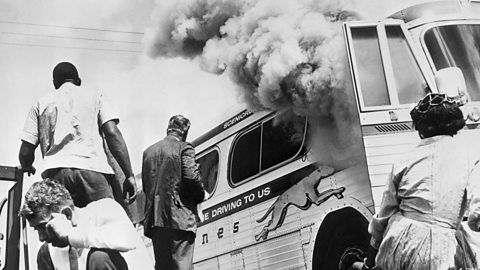
The first freedom ride was on 4 May 1961 and it went from Washington, DC, to New Orleans. It travelled through many of the southern states.
- In Anniston, Alabama, one bus had its windows smashed and a petrol bomb thrown into it, but the passengers escaped unharmed.
- When the next bus reached Anniston, the passengers were taken off the bus and attacked by an angry mob of white Americans.
- Civil rights activists who travelled on public transport between states to show desegregation had not been achieved. were also attacked in Birmingham and Montgomery, in Alabama. Others were arrested in Jackson, Mississippi.
The police did little to help the Freedom Riders, so President John F Kennedy sent Officers in the USA who enforce federal laws and respond to crisis situations. to protect them. In September 1961, the Interstate Commerce Commission ordered that buses and bus stations must be desegregated immediately.
