Changes under President George HW Bush
- The 1989 presidential election was won by Ronald Reagan’s vice president, George HW Bush.
- The A set of laws by which a country is governed. prevented Reagan from running for president for a third time.
- Bush was seen as someone who would carry on Reagan’s policies.
Taxes, the budget deficit and unemployment
By 1990 the government’s When a government spends more money than it earns through taxes. had grown to $220 billion. This was three times what it had been in 1980. Bush had been elected on the promise of cutting taxes, just as Reagan had when he first became president. To try to deal with the deficit, however, Bush was forced to increase taxes on luxury goods and on people who were very rich, at the same time as cutting spending on the military. Breaking the promise on taxes would come back to haunt him in the 1992 presidential election.
But raising taxes was not enough, because the economic A time of temporary economic decline when trade and industrial activity are reduced. had increased the number of people without a job. This, in turn, had increased the number of people the government had to pay to support at the same time as reducing the amount of tax being paid. As a result, the government’s budget deficit rose to $300 billion.
By the time that Bush’s term as president was over, American unemployment was the highest it had been since 1984, at 7.8 per cent. The The federal government agency responsible for keeping data about the people living in the USA. said that 14.2 per cent of Americans were living in poverty.
Civil rights
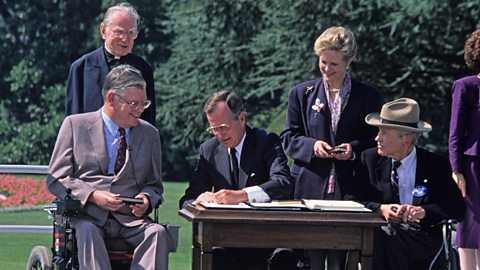
Bush had a mixed record on Rights everyone is entitled to regardless of the colour of their skin, their beliefs, sexuality, gender or other personal characteristics. These rights could include the right to vote, or the right to a good education etc. He signed the 1990 Americans with Disabilities Act into law. This made it illegal to To treat someone differently or unfairly because they belong to a particular group. against anyone with any form of disability in work places, in public places or on transport. It was an important piece of legislation for many people with disabilities. It is considered by some to be the most important anti-discrimination legislation since the 1960s.
However, Bush vetoed a Civil Rights Act that had been passed by The legislative body of the US government, made up of the Senate and the House of Representatives. in 1990 and that would have made it easier for workers to sue their bosses for discrimination. Eventually, though, he signed an almost identical proposal into law in the 1991 Civil Rights Act. Bush also caused some controversy by replacing Thurgood Marshall, a The highest court in the USA. It has the power over all courts in the country. justice who was a strong supporter of equal rights, with Clarence Thomas, who was not a supporter of increasing civil rights. Any legal cases involving civil rights could eventually be decided by the Supreme Court.
The Americans with Disabilities Act presents us all with an historic opportunity. It signals the end to the unjustified segregation and exclusion of persons with disabilities from the mainstream of American life.
The environment
When George HW Bush became president, there was a growing focus on tackling a number of environmental concerns. One particular concern was the increasing problem of acid rain. Acid rain had been destroying forests. Combined with increased air pollution, the widespread loss of forests was causing the hole in the earth’s protective ozone layer to increase further.
The Clean Air Act had originally been passed in 1970 and required states to take various measures to reduce pollution and improve air quality. Later, in 1990, specific requirements were added to this act that called for factories and businesses to reduce their sulphur dioxide emissions. This was done to reduce the amount of acid rain, as well as the volume of CFC gases being released into the air, which were directly damaging the ozone layer. It also aimed to reduce exhaust emissions from cars, which were causing poor air quality in towns and cities.
Bush also signed the 1990 Global Change Research Act to ensure that environmental damage was being researched. Every four years, a report on this research would be given to the president.
Bush considered his work on improving the environment to be the most important legacy of his time as president.
Every American expects and deserves to breathe clean air, and as President, it is my mission to guarantee it - for this generation and for the generations to come.
Race riots
In the summer of 1992, Rodney King, a black American, was beaten by police officers and had to be hospitalised. This resulted in widespread rioting in Los Angeles and other cities. The incident had been caught on camera but a mostly white American jury had decided that the police officers were not guilty.
In Los Angeles, 64 people died during the riots, which also left nearly $1 billion of damage to be repaired. Bush said that the court’s verdict was wrong but that the rioters were just criminals. However, his Political party in the United States. Democrats tend to hold a more liberal viewpoint on politics and society. rival in the 1992 presidential election, Bill Clinton, claimed that the riots resulted from widespread poverty in Los Angeles due to One of the two major American political parties. Republicans tend to hold a more conservative viewpoint on politics and society. spending cuts, which had taken opportunities away from cities like Los Angeles.
