Changes under President Reagan
- Ronald Reagan was a Hollywood movie star who went into politics and became A person who is elected to lead a state’s government in the USA. of California from 1967 to 1975.
- In 1980, he ran as the One of the two major American political parties. Republicans tend to hold a more conservative viewpoint on politics and society. candidate for president and was elected.
- He was re-elected in 1984.
Reaganomics
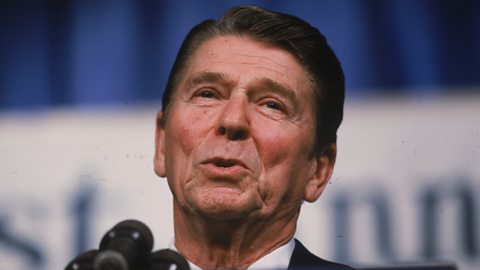
When Reagan became president, problems with world trade, especially because of the rising price of oil, were having serious effects on America. Factories were closing, 7.5 per cent of Americans were unemployed and Rapidly rising prices or the falling value of a currency. was causing prices to rise by 15 per cent. At the same time, the Part of the government of the USA as a whole rather than relating to an individual state. government was running up huge debts as it was spending a lot more than it was earning through taxes.
President Ronald Reagan’s plan to get Americans back to work by cutting taxes and welfare spending. was the name given to Reagan’s solution to this problem.
- He decided to cut taxes for businesses and the wealthiest 25 per cent of Americans.
- He believed that they would then spend this extra money on buying more goods, providing more jobs or paying higher wages for their workers.
- He hoped that this money would ‘trickle down’ through Based on earnings, the people who are higher than working class, but lower than upper class. Americans to those on the lowest incomes.
- He believed that as this would make all Americans richer, the government would not need to pay for Payments and other benefits, such as education, health care, and unemployment payments, given to a population free at the point of use, although paid for by general taxation. programmes for the most disadvantaged members of society.
Getting Americans back to work is an urgent priority for all of us and especially for this administration. But remember, you can’t solve unemployment without solving the things that caused it, the out-of-control government spending, the skyrocketing inflation and interest rates that led to unemployment in the first place.
Cuts to welfare and taxes
Reagan’s tax cut in the 1981 Economic Recovery Tax Act was the biggest tax cut in American history, lowering taxes by $33 billion. This severely reduced the amount of money the federal government was getting from taxation. At the same time, Reagan introduced cuts in welfare spending valued at $20 billion a year. This change particularly affected people on low incomes in a variety of different circumstances. It also forced elderly people to pay more towards their health care.
National debt, stock market crash and recession
- The government was struggling to pay for the services it provided because it did not get enough money from taxes.
- At the same time that Reagan had cut the government’s income by reducing taxes, he had also increased government spending in other areas. For example, defence spending doubled between 1981 and 1987.
- The government had to borrow more money each year to make up the difference between what it was spending and what it was earning in taxes.
- During Reagan’s presidency, this amount - called the The amount of money that a country has to pay back. - reached almost $1 trillion. This was higher than it had ever been before.
The A stock market crash that occurred on 19 October 1987.A term which can refer to stocks and shares and stock exchange, buying and selling shares, the overall value of shares sold in a stock exchange. crash of 1987 was almost as bad as the Wall Street crashin 1929. The stock market value of many American companies was affected by the mass selling of their shares because Reaganomics had created a huge When a country is not making enough money from the goods it trades. as well as a huge national debt. This meant that America was importing a lot more goods than it was making. As a result, economic growth slowed and businesses started to struggle.
Unemployment increased rapidly along with inflation, beginning another A time of temporary economic decline when trade and industrial activity are reduced. just like the one Reagan had tried to solve when he first became president. Reagan’s When a government spends more money than it earns through taxes. was greater than that of every other American president up to that point added together. In 1987, The legislative body of the US government, made up of the Senate and the House of Representatives. rejected Reagan’s proposed budget because he was asking for another large increase in defence spending.
Other issues for President Reagan
Space programme
America had continued to develop its space programme following the Apollo space missions throughout the 1960s and 1970s. America also had a successful space shuttle programme, which employed a series of reusable space vehicles so that launches could be made more frequently.
However, there were a number of problems with this programme and they came to a head in 1986. At the beginning of the year, the space shuttle Challenger exploded just after launching, killing all of the crew. Several other unmanned rockets also exploded in a similar circumastances. This led to an interruption in launches, which meant that the USA’s planned piloted space station could not be built. Also, Reagan’s proposals for space-based weapons, known as the Star Wars programme, were proving to be very expensive and difficult to develop.
Environment
There was mounting evidence that industries were causing global environmental damage. However, Reagan argued that it was more important for industries and businesses to be giving jobs to people than to introduce restrictions on the damage the industries were causing. He did not believe companies should be forced to protect the environment.
He began to gradually reduce the budget for the Environmental Protection Agency (EPA) as well as reducing the number of EPA employees and making sure that people who agreed with him were in charge of the agency. Opinion polls, however, showed that two-thirds of Americans disagreed with this. The polls revealed that Americans would willingly pay higher prices if there were more controls on pollution.
Civil rights
Reagan had been opposed to the Rights everyone is entitled to regardless of the colour of their skin, their beliefs, sexuality, gender or other personal characteristics. These rights could include the right to vote, or the right to a good education etc. laws of the 1960s. He argued that they interfered too much in the rights of states, businesses and churches to conduct their business how they wanted. However, he was reluctantly forced by public opinion and Congress to renew the terms of these civil rights laws:
- In 1982 he extended the Voting Rights Act for another 25 years.
- In 1988 he expanded the Fair Housing Act, which prevented To treat someone differently or unfairly because they belong to a particular group. in housing.
- In 1988 he tried to stop the Civil Rights Restoration Act being passed, but his Ability to stop new laws being passed. was over-ridden by Congress. The act ensured that any business that took money from the federal government had to comply with the civil rights laws.
Reagan was also forced by Congress to make A Christian minister who believed in peaceful protest without using violence and who was a key figure in the US civil rights movement. birthday a national holiday.
AIDS
During the 1980s, an outbreak of Human Immunodeficiency Virus, a disease which damages cells in the immune system. which causes Acquired Immune Deficiency Syndrome – a disease of the human immune system caused by infection with Human Immunodeficiency Virus (HIV). swept across America, affecting thousands of people. By 1985, almost 4,000 people had died. By 1989, this number had risen to over 46,000, with an estimated 800,000 other Americans infected.
Reagan was very heavily criticised for doing nothing about this when the problem was first revealed. However, by the end of his term as president, he had made around $2 billion a year available for HIV and AIDS research and prevention. Reagan was criticised by some people for doing too much in supporting research into the disease, while others criticised him for not doing enough.
War on drugs
In 1982 President Reagan said that illegal drugs were a threat to American society. His response to this became known as the ‘war on drugs’. The budget for the Federal Bureau of Investigation. An agency set up by the US federal government to investigate criminal cases, where federal laws may have been broken.’s division that dealt with drug offences increased from $8 million a year to $95 million a year between 1980 and 1984. The 1984 Comprehensive Crime Control Act increased punishments for possession of cannabis and was part of Reagan’s approach to criminalising all of those involved in drug-dealing and drug-taking.
There was particular concern around the increased use of crack cocaine. The 1988 National Narcotics Leadership Act set up the Office of National Drug Control Policy to coordinate the ‘war on drugs’, but it also established campaigns to educate young people about the dangers of drug-taking.
