The Truman Doctrine and the Marshall Plan
Learn more about the the Truman Doctrine and the Marshall Plan in this podcast.
Listen to the full series on BBC Sounds.
Truman Doctrine
Former British prime minister Winston Churchill pointed out the increasing divisions in Europe between The economic idea that countries should be run based on private business, trade, stocks and shares, and profit. countries in Western Europe and Supporters of the communist movement or party. countries in Eastern Europe in a speech he made in America in 1946. He described the division as being an A phrase used by Winston Churchill to describe the division in Europe between the communist east and capitalist west.
From Stettin in the Baltic to Trieste in the Adriatic, an iron curtain has descended across the continent.
President Harry Truman was increasingly concerned that The group of 15 communist republics formed from the Russian Empire after the revolution of 1917. leader Joseph Stalin planned to spread communism to other countries in Europe. He believed in the An American idea that if one country fell to communism, others would follow - like a row of dominoes. - the idea that communism would spread from country to country until it was stopped.
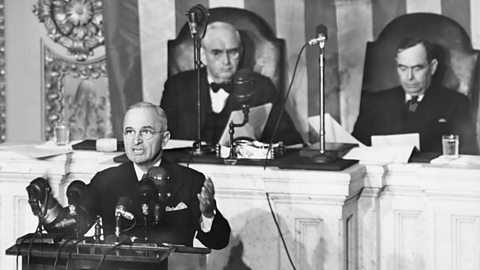
Truman’s response was the policy of An American policy to try and stop communism from spreading, to restrict it from spreading to other countries. This was about ensuring that communism did not spread to any more countries. When the USA began to give Greece money to prevent it falling to communists in 1947, Truman made a speech. He explained that his policy was to give military and financial support to countries threatened by armed groups or outside pressures. Although he did not call them communists, this was who he was talking about. This became known as the Established in 1947 by President Harry S Truman, this policy provided US military and financial aid to countries that were at risk of being taken over by communists.
I believe that it must be the policy of the United States to support free peoples who are resisting attempted subjugation by armed minorities or by outside pressures.
Marshall Plan
As part of his plan to contain the spread of communism, Truman decided to give large amounts of money and aid to the capitalist countries of Western Europe. This was intended to help them to rebuild their economies after the destruction of the war. He believed that this would tackle the problems of unemployment and poverty. He feared that if these problems were not solved by a capitalist government, the countries’ people might choose a communist government instead.
This aid was delivered via the European Recovery Program. This is more commonly known as the Nickname for the European Recovery Program, in which aid was given by the USA to European countries in 1948 to help them rebuild after World War Two and to stop the spread of communism. after General George Marshall, the US Secretary of State who was put in charge of it in June 1948.
- Aid was provided in cash, machinery, food and technological assistance.
- In return, countries who received aid would agree to buy US goods and allow US companies to invest The money and equipment invested into a business. in their industries.
- Between 1948 and 1953, the USA gave 16 Western European countries over $13 billion in aid.
- This aid included machinery for factories and farms, improvements to transport systems, and money to make and buy weapons.
The impact of the Truman Doctrine and the Marshall Plan
While the Truman Doctrine and the Marshall Plan did help to stop the spread of communism in Europe, they also increased tensions with the Soviet Union. This was because the countries of Eastern Europe were given nothing under the Marshall Plan. Stalin became convinced the USA was trying to win countries over to its side with offers of money.
