US involvement in Vietnam
Learn more about the Vietnam War in this podcast.
Listen to the full series on BBC Sounds.
By the 1950s, the USA was becoming increasingly concerned about the spread of An economic system in which all means of production such as tools, factories and raw materials, are owned by the community as a whole. Each individual contributes according to their ability and receives according to their needs. This means there is no hierarchy of social class. in Asia. China had become a communist country in 1949 and South Korea was only prevented from becoming a communist country when the USA and its allies intervened in the Korean War in the early 1950s. To prevent the predictions of An American idea that if one country fell to communism, others would follow - like a row of dominoes. becoming a reality in Asia, the government of the USA felt that it was necessary to intervene in Vietnam to stop communism from spreading.
There were various causes of the Vietnam War itself, originating from problems that had built up over a number of years.
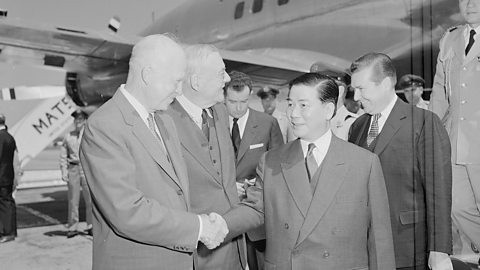
The division of Vietnam
Vietnam had been part of the French Empire until the Freedom fighters who fought for Vietnamese independence from Japan and France Vietnamese communist Soldiers who do not fight in the open but stay hidden and attack using ambushes and booby traps. won their war for independence in 1954. In July 1954, the Geneva Agreement resulted in Vietnam being temporarily divided in two - the communist Ho Chi Minh would lead North Vietnam and the non-communist Ngo Dinh Diem would lead South Vietnam.
The USA did not want there to be elections in the South or reunification between the two parts of Vietnam. This was because they knew that in either case, the communists would take power. To contain communism in Asia and stop communism from spreading to other countries, the US government believed Vietnam would have to stay divided.
The Viet Cong
The Viet Minh now became the Communist guerrilla fighters from North Vietnam. fighting for the reunification of North and South Vietnam. They began a Someone who uses violence for political reasons, usually to spread fear. campaign in 1959 against the government of South Vietnam and tried to raise support among the people for the communist government in the North.
The USA supported the government in the South firstly with money and then with weapons. Later, they sent A US organisation used to gather information on the country’s opponents and enemies. advisers to help South Vietnam defend itself against Viet Cong attacks. Some of the South Vietnamese people were moved out of their homes into fortified villages known as Fortified villages created by the USA in South Vietnam to protect people from Viet Cong attacks. to prevent communist influence.
The Diem regime in South Vietnam
The problem for the USA was that the Diem’s government in South Vietnam was very unpopular. Vietnamese peasants worked very hard to pay rent to their wealthy landlords and realised that their government had no interest in improving their lives. The Viet Cong promised that communism would get rid of the landlords and land would be shared out among the people fairly.
Diem was a A group of Christians who accept the Pope in Rome as their leader. French-speaking ruler who had no interest in the problems faced by the majority of the population of South Vietnam, who were poor Vietnamese-speaking Buddhists. In November 1963, Diem was Murder for religious or political reasons. From that point, there was no stable government in South Vietnam, just at the time when Viet Cong attacks were intensifying.
Gulf of Tonkin incident
- In August 1964 the USS Maddox, an American warship, was fired at by North Vietnamese boats as it patrolled the Vietnamese coast in the Gulf of Tonkin.
- The legislative body of the US government, made up of the Senate and the House of Representatives. immediately passed the Tonkin Resolution, giving President Lyndon B Johnson the power to increase the American military intervention in South Vietnam.
- The goal was to prevent South Vietnam, and neighbouring Laos and Cambodia, from becoming communist.
- Large numbers of US troops, ships and planes were sent to support the government of South Vietnam.
