Cuban Missile Crisis
Learn more about the Cuban Missile crisis in this podcast.
Listen to the full series on BBC Sounds.
After the first A powerful and destructive bomb that gets its power from the energy released when atoms are split. were dropped on Japan in 1945, the USA and the The group of 15 communist republics formed from the Russian Empire after the revolution of 1917. ended up in a nuclear A competition between America and the USSR to build more destructive and a higher number of nuclear weapons. building more and more atomic bombs. The Cuban Missile Crisis in 1962 was the closest the USA and the Soviet Union came to using these powerful weapons.
Cuban revolution
- The island of Cuba is about 100 miles away from the coast of the American state of Florida.
- Its main exports were sugar and tobacco.
- By the 1950s, it was run by the A ruler with complete power. Fulgencio Batista
- It was referred to as the ‘rich Americans playground’.
- This was because American companies controlled most of Cuba’s businesses and cities like Havana were full of American tourists spending money.
In 1959 a revolution led by the Someone who believes that society should be classless and that all property and wealth should be owned by the whole community and not by individuals. Fidel Castro overthrew the government of Batista. Castro took control of American businesses in Cuba, so the USA stopped trading with Cuba. The Soviet Union stepped in and started trading with Cuba instead. Nikita Khrushchev, the Soviet leader, hoped to be able to gain an advantage over the USA in this part of the world.
Bay of Pigs
Some Cubans escaped the island after the revolution. Many of them ended up in the USA and planned to take back control of the island. America’s A US organisation used to gather information on the country’s opponents and enemies. helped them to plan their invasion and persuaded President John F Kennedy that their plan would work.
However, the invasion of Cuba at the Bay of Pigs in April 1961 was disastrous. Most of the Cuban When someone is away from their home country and is refused permission to return. involved ended up dead or imprisoned. Castro’s forces were waiting for the invaders. The CIA had misunderstood how popular Castro was so there was no general uprising in support of the invaders. The events persuaded Khrushchev that he could take advantage of Kennedy’s inexperience.
U-2 spy plane photographs
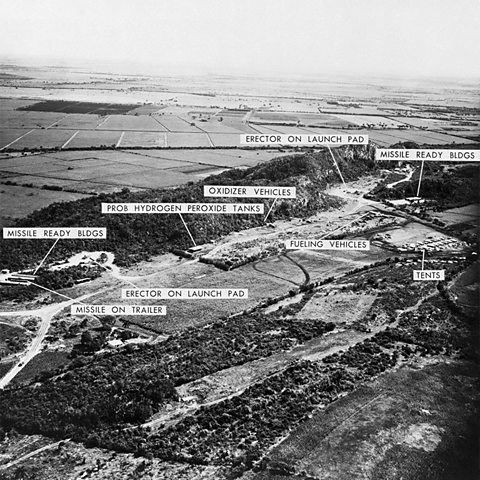
Castro asked the Soviet Union for military support to protect himself from possible future attacks supported by the USA. By August 1962, the Soviet Union had started to build sites on Cuba for missiles that could launch An explosive device used as a weapon. The most deadly and destructive weapon developed by humankind. These missiles would be able to destroy most cities in the USA. The USA already had missiles based in Turkey, which had joined the North Atlantic Treaty Organization A military alliance of western powers that was originally created to provide a counterforce to the Soviet armies of Eastern Europe. in 1952. These missiles could destroy most of the cities in the Soviet Union.
Question
How did the USA gather intelligence about activities in Cuba?
One method was to use spy planes. The A plane designed to fly too high to be detected by radar so it can secretly take photographs of the ground. spy plane could fly very high - to avoid detection. Spy planes take photographs of things that the Soviet Union was trying to keep secret. On 14 October 1962, the CIA sent a U-2 spy plane to photograph some of the missile bases that were being built in Cuba.
Blockade and resolution of the crisis
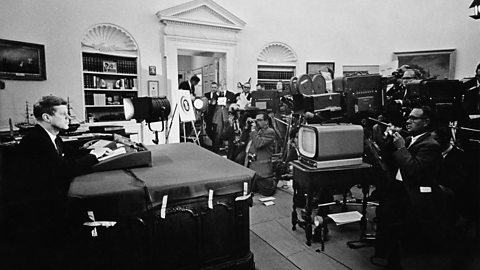
President Kennedy could not ignore the threat that missiles on Cuba preesented to the USA. The best way to respond was not clear and Kennedy was cautious after the events at the Bay of Pigs. He discussed with The group of national security advisers who worked with President John F Kennedy during the Cuban Missile Crisis. possible responses to the threat from Cuba. He wanted to deal with the problem but not in a way that would result in a nuclear war, which would do terrible damage to the Soviet Union as well as the USA and its allies. However, not all the members of ExComm agreed with this position, as some wanted an aggressive response to show US strength.
Kennedy decided to use the US Navy to A barrier created to stop something getting through to the other side. the island, to prevent the Soviet ships from delivering their supplies. On 22 October 1962, he went on television to explain why he supported the blockade rather than an invasion of Cuba.
We will not prematurely or unnecessarily risk the costs of worldwide nuclear war in which even the fruits of victory would be ashes in our mouth - but neither will we shrink from that risk at any time it must be faced.
What happened during the blockade and how did it end?
- The blockade of Cuba began on 24 October 1962.
- As it began, US armed forces were also put on alert to prepare for an invasion of Cuba if necessary.
- The representative to the The successor to the League of Nations, the United Nations was established in 1945 as an international organisation designed to keep peace, uphold international law and set standards in human rights. from the Soviet Union reacted - saying it was only giving Cuba the means to defend itself from attacks by the USA.
- A few ships were stopped and searched on their way to Cuba, but none of them were found to be carrying weapons.
- Soviet ships that were suspected of carrying weapons were either stopped in the Atlantic to wait and see what happened or turned back
- There was a A deadlock situation where no side can act or win. and the world waited to see what would happen next.
- On 26 and 27 October, Kennedy received messages from Khrushchev. The first agreed to remove Soviet missiles from Cuba as long as the USA promised not to invade. The second said Soviet missiles would be removed from Cuba if the USA removed its missiles from Turkey.
- Kennedy responded to the first message and ignored the second one.
- On 28 October, Khrushchev ordered the Soviet ships bound for Cuba to return to base and said that the missile bases on Cuba would be dismantled.
- In public this seemed like a great victory for Kennedy, although in secret he ordered the US missiles to be removed from Turkey as well. Castro remained the ruler of Cuba until 2008.
Hotline and Test Ban Treaty
One of the lessons for both sides in the Cuban Missile Crisis was that A tactic to get what you want by pushing a situation to the most dangerous point to influence negotiations. which in this case had meant risking a nuclear war to force the other side to back down in an argument, was too dangerous. It also showed that a more direct form of communication between the US president and the Soviet leader might have prevented such crises from developing in the first place.
As a result, a direct telephone line, known as the In the 1960s, a telephone line that directly connected the US president and the leader of the Soviet Union. was created to link the White House in Washington and the Kremlin in Moscow. It was intended to make sure that the two leaders could communicate with each other directly and quickly, rather than waiting for letters and A message sent by a machine called a telegraph. This would then be printed off and delivered by hand. to be delivered.
The process of slowing down the nuclear arms race also began. In 1963 both sides agreed to the A 1963 agreement involving the USA and Soviet Union in which they agreed to limit the testing of nuclear weapons. which ended When nuclear weapons are detonated between the ground and the upper atmosphere, in order to test their effectiveness. of nuclear weapons.
