Sugar production
Raw materials
The most efficient method of growing sugar was on large plantations with many workers. The sugar plantation system became the main industry of the Caribbean.
Because of the lack of labour in the Caribbean, vast numbers of African people were forcibly transported to work on the sugar plantations throughout the 18th century. Every enslaved person was expected to work – even women, children and the elderly.
Life on the plantations was extremely hard with a third of enslaved Africans dying within three years of arriving in the Caribbean. This created a constant demand for new enslaved people to replace them.
Producing the crop
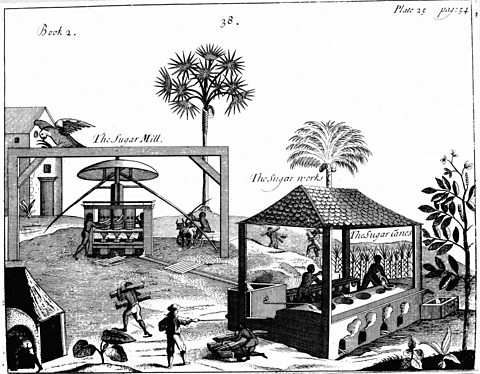
Between 1766 and 1791, the British West Indies produced over a million tons of sugar. Growing sugar was hard, labour-intensive work.
Sugar was produced in the following way:
- The ground had to be dug, hoed, weeded, planted and then fertilised with manure, all under the hot West Indian sun. Slave gangs consisting of men, women and children worked under white overseers. They were whipped for not working hard enough. Enslaved people worked from dawn until dusk.
- At harvest time, sugar cane was cut with machetes and loaded onto carts. This was back-breaking work.
- The harvested cane was taken to the sugar mill where it was crushed and boiled to extract a brown, sticky juice. Operating the machinery was very dangerous - people working there could be maimed or even killed. The sugar boiling houses were unbearably hot and difficult to work in during the summer. At harvest time it was common for enslaved people to work 18-hour days, while some people were forced to work for as long as 48 hours without a break.
- The sugar juice was left in barrels until a brown syrup called molasses could be drawn off. This was used to make another of the Caribbean exports – rum. The clearer sugar was left behind, which would then be packed into barrels and shipped to Europe.
- The juice taken from crushed sugar cane would sour and spoil within 24 hours. Enslaved people had to process it in the cane mills as soon as it was produced.
Trading patterns
Slave ships completing the ‘Middle Passage’ from Africa, unloaded and sold their cargo of enslaved people, before being loaded with sugar and rum to sell in Britain.
The main destination ports for ships loaded with sugar were Bristol and Liverpool. In 1785, 22,811 barrels of sugar were imported through Bristol.
More guides on this topic
- Overview of the triangular trade
- What was the triangular trade?
- What did the triangular trade do for British ports?
- How did the trade in enslaved people affect African societies?
- What were West African slave fortresses?
- What was the Middle Passage?
- Overview of Britain and the Caribbean
- Why did sugar plantations develop in the Caribbean?
- What was Britain's influence on the Caribbean?
- How did the trade in enslaved Africans affect the British economy?
- What impact did the trade in enslaved people have on the Caribbean?
- Overview of the captives’ experience and attempts to gain freedom
- What work did enslaved people do on a Caribbean plantation?
- How were enslaved Africans treated in the Caribbean?
- How did enslaved people resist or rebel against enslavement?
- The captives' experience and resistance to enslavement
- Overview of the abolitionist campaigns
- How did the abolitionist movement begin?
- What methods did abolitions use to end the trade in enslaved people?
- What were the arguments against abolition?
- Why was the abolitionist campaign successful in 1807?
- The abolitionist campaigns
- Video playlist
