How did abolitionist campaigns end the trade in enslaved Africans?
Quick version
The work to abolish the transatlantic trade in enslaved Africans was the work of many people and took many years.
- Some of the first opponents of the trade were members of the Quaker faith.
- They objected to the trade in enslaved people on moral grounds.
- They founded the Committee for the Abolition of the Slave Trade in 1787.
Opposition to slavery took different forms:
- religious. Some groups such as the Quakers and the Methodists believed that slavery was incompatible with Christianity
- humanitarian. Many people sympathised with enslaved Africans and wanted them to have their freedom.
- economic. Some, like the economist Adam Smith, thought that slavery was inefficient.
Through politicians like William Wilberforce, MP for Kingston upon Hull, there was pressure within parliament to abolish slavery.
There were also campaigns, boycotts, and protests by abolitionist campaigners outside of parliament.
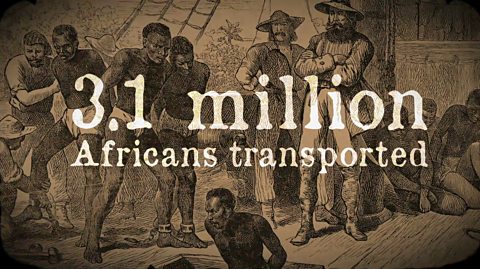
Video - Abolitionist campaigns
The campaign to abolish the trade in enslaved Africans took years and the dedicated work of many people. Find out more in a short video.
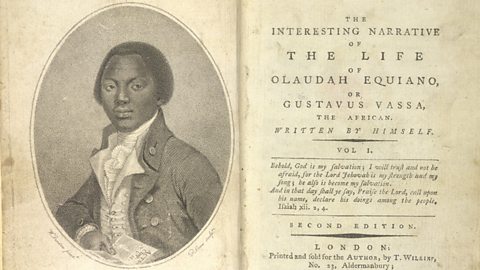
Olaudah Equiano was a writer in 18th Century London.
“… the air soon became unfit for respiration… and brought on a sickness among the slaves, of which many died… The shrieks of the women, and the groans of the dying, rendered the whole a scene of horror almost inconceivable.”
When he wrote those words about the ordeal of captured Africans being transported across the Atlantic he didn’t need to use his imagination. He was writing from experience.
He had been captured at the age of 11, in West Africa, and sold into slavery in the Caribbean.
Later in his life, he bought his freedom, and when he published his autobiography in 1789, it was a great success – helping to raise public awareness of the terrible reality of the slave trade.
Some British religious groups were opposed to slavery. They believed that God had created all men as equals.
The Quakers became active campaigners.
The Society For Effecting The Abolition Of The Slave Trade was formed in 1787, and most of its founders were Quakers.
They held public meetings, published pamphlets, and petitioned Parliament.
One of its members, Thomas Clarkson, began to collect detailed evidence on the way the trade was run – the conditions on the ships, how many men women and children died during the crossings, and the cruel methods used to subdue people.
His evidence was used by Member of Parliament William Wilberforce.
Starting in 1789, Wilberforce regularly introduced bills in Parliament proposing the banning of the slave trade. His bills were voted down; many MPs themselves had investments in the Caribbean.
While many workers feared abolition would impact their own jobs and industries, as the campaign continued, public opinion began to shift.
More and more people began to see slavery as morally wrong – and many boycotted buying sugar.
In 1807, Wilberforce presented his sixteenth Abolition Bill. It passed.
It didn’t make slavery illegal, but it ordered all slave ships to be destroyed, and banned the buying and selling of slaves anywhere in the British Empire.
However, slavery didn’t end immediately, continuing in British owned plantations until it was finally prohibited in 1838.
Learn in more depth
How did the abolitionist movement begin?
At the end of the 18th century, public opinion began to turn against the trade in enslaved people.
The first group to publicly announce its opposition to slavery was the Society of Friends (a Christian group also known as the Quakers).
In 1761 they decided none of their members could be involved in the buying and selling of human beings.
Many of their members became leading figures in the abolitionist movement.
Christian view of slavery
Based upon different interpretations of the Bible and their own moral views, Christians of the 18th century were divided on their opinions of slavery.
There is a passage in the Bible which describes Abraham keeping slaves. Many Christians saw this as meaning that slavery was morally acceptable.
Others saw slavery as unjust and evil and campaigned to have it abolished.
- The Catholic Church became critical of slavery. In 1741 Pope Benedict XIV condemned slavery in general.
- Methodist founder John Wesley denounced slavery and detailed its abuses in a pamphlet published in 1774.
The Committee for the Abolition of the Slave Trade
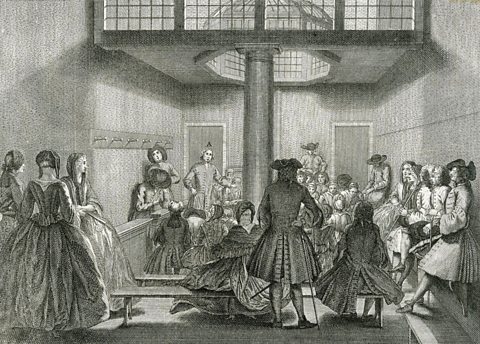 Image source, ALAMY
In 1787, the Committee for the Abolition of the Slave Trade was set up.
The Kingston upon Hull MP, William Wilberforce, represented the Committee in Parliament. Nine of the original twelve members were Quakers.
They faced great opposition from traders, plantation owners, and people with a financial interest in maintaining slavery.
- A huge part of Britain's wealth relied on the products produced by enslaved people in the West Indies.
- Owners of enslaved workforces had paid a lot of money for enslaved people and would be financially worse off.
- If owners of enslaved people demanded compensation, abolition would be too expensive for the government to consider.
The Society decided that the best approach was to try to end the trade in enslaved people, rather than slavery itself.
This would at least end the misery of the Middle Passage.
Image source, ALAMYMain abolitionist arguments
The abolitionists put forward various arguments to support their cause of banning the trade in enslaved people. These can be grouped into the following areas:
- religious arguments
- humanitarian arguments
- economic arguments
Religious arguments against slavery
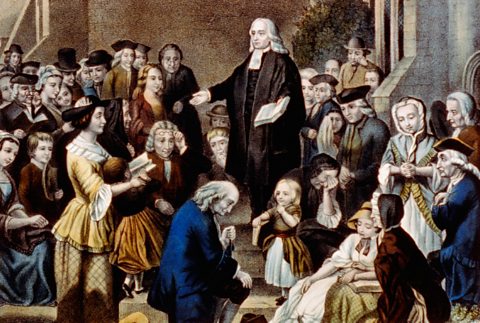 Image source, ALAMY
At home, British people heard about the treatment of enslaved people from missionaries in the colonies. The Christian doctrine that all people were equal in the eyes of the Lord went against the argument for slavery.
The main thrust of Christian abolitionism emerged from the evangelical revival of the 18th century. It was based on its beliefs on morality and sin. John Wesley, the founder of Methodism, questioned the morality of slavery.
From the mid-18th century a new set of church leaders challenged the complacency of previous generations.
- Beilby Porteus, Anglican Bishop of London, seriously questioned the Church’s stance on slavery.
- The Scottish intellectuals William Robertson and James Beattie both influenced the MP William Wilberforce.
- Scottish churches were amongst the key drivers in the abolitionist movement, although the Church of Scotland did not petition Parliament to end the slave trade.
Image source, ALAMYHumanitarian arguments against slavery
For many people sympathetic to the abolitionist cause, the simple fact that innocent African people were enslaved and denied their freedom and their human rights was enough.
The work of abolitionist campaigners in spreading word of the cruelty of the trade was effective. It became clear that the trade in enslaved people brutalised all who took part in it.
There was even a cost to Britons as many British sailors died on the arduous transatlantic crossing involved in the Triangular Trade.
Economic arguments against slavery
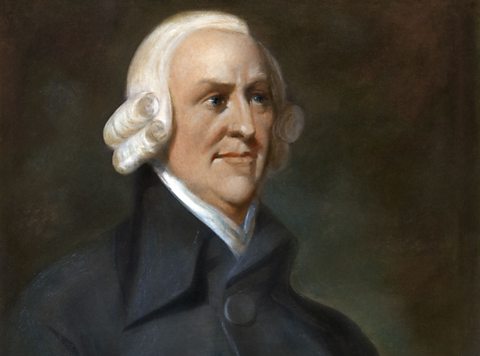 Image source, ALAMY
The Scottish economist and philosopher Adam Smith wrote The Wealth of Nations in 1776. He wrote that enslaved people were the most inefficient and costly form of labour that could be used.
There was a world over-supply of sugar and British merchants had difficulties re-exporting it. Sugar could be sourced at a lower cost and without the use of slavery from Britain’s other colonies, such as India.
Some argued that British industry no longer depended so heavily on the slave trade.
The Industrial Revolution was in full swing and new British factories had a demand for a domestic workforce. British trade with its colonies in India and the Far East, was growing rapidly and these factories wanted to produce domestic goods to sell in these overseas markets. This trade was more lucrative than trading in enslaved people.
Image source, ALAMYWilliam Wilberforce, MP
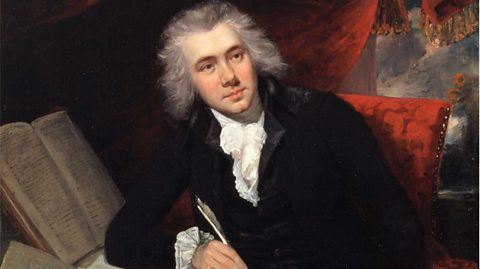 Image source, ALAMY
Led by MP William Wilberforce, the abolitionists spent two decades trying to get Parliament to pass a law ending the slave trade.
In 1789, Wilberforce gave a three hour speech against slavery in Parliament. In 1791, Wilberforce presented to the House of Commons another Bill to abolish the trade.
He had the support of Prime Minister William Pitt the Younger, but the Bill was not passed. It was rejected by 163 votes to 88.
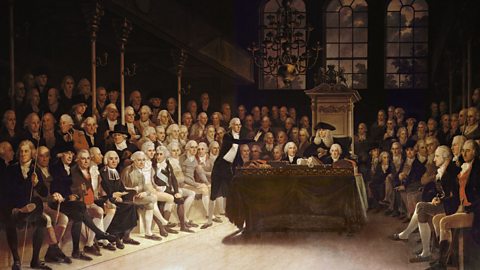
In every year between 1789 and 1806, Wilberforce presented a Bill for the abolition of the trade in enslaved people. In 1804, the House of Commons voted in favour of abolition, but Wilberforce’s Bill was rejected by the House of Lords.
In 1806, Wilberforce’s friend James Stephen proposed a Bill banning British ships from carrying enslaved people to French colonies. Pro-slavery MPs didn't see the significance of the Bill and let it pass. This stopped two-thirds of the trade and made it unprofitable.
In 1807, after a huge campaign, Parliament abolished the trade in enslaved people.
Image source, ALAMYWhat support did abolition have in parliament?
Prominent MPs such as Prime Minister William Pitt the Younger and veteran politician Charles James Fox, largely supported Wilberforce and the abolitionist cause.
The MP Sir William Dolben supported parliamentary reform and the abolition of slavery. With the support of other abolitionists, Dolben had put forward a Bill in 1788 to regulate conditions on board slave ships, which was passed into law by a large majority.
What support did abolition have outside parliament?
The Knight vs Wedderburn 1788 legal case in Edinburgh ruled that slavery was not compatible with Scots Law.
An estimated minimum of 300,000 people in Britain boycotted sugar grown using the labour of enslaved people in the early 1790s. This boycott campaign was largely organised by female campaigners such as Hannah More. The sale of sugar from India increased more than tenfold in this time.
Pro-abolition campaigners also wrote letters and presented petitions to Parliament.
The spring of 1792 saw an outpouring of public feeling against the slave trade throughout the country. In the space of a few weeks, 519 petitions for abolishing the slave trade arrived at Parliament, signed by more than 390,000 people.
Test what you have learned
Quiz
Recap what you have learned
Many of the campaigners against the transatlantic trade in enslaved people belonged to the Quaker faith. Their religion led them to oppose the trade on moral and ethical grounds.
- The Committee for the Abolition of the Slave Trade was established in 1787.
- The Kingston upon Hull MP, William Wilberforce, represented them in the Houses of Parliament.
Over several years, Wilberforce introduced bills to parliament to try and end the trade in enslaved people. The bills were unsuccessful.
Opposition to slavery took different forms:
- religious. Quakers and Methodists believed that slavery was incompatible with Christianity
- humanitarian. Many people sympathised with enslaved Africans and wanted them to have their freedom.
- economic. Some, like the economist Adam Smith, thought that slavery was inefficient.
There were also campaigns, boycotts, and protests by abolitionist campaigners outside of parliament.
More on Trade in enslaved African people
Find out more by working through a topic
- count19 of 21
- count21 of 21