What work did enslaved African people do in the Caribbean?
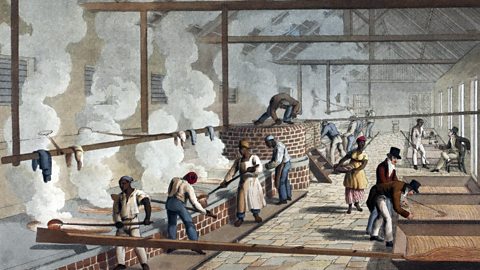 Image source, Science History Images/ALAMY
Quick version
The majority of enslaved people in the Caribbean were forced to work in the fields on sugar plantations:
- work gangs dug, planted, fertilised and cut sugar cane
- they were supervised by enslaved slave drivers
- white overseers were in charge - they exerted brutal discipline and punishments
People worked long hours, often from dawn to dust, for six days a week. Work shifts were even longer at harvest time.
Enslaved workers in sugar factories worked machines that crushed sugar cane, and boiled the juices to make sugar, rum and molasses
- work continued all day and night
- work was in twelve hour shifts
- dangerous, hot conditions could cause injury or death
Some enslaved people worked in domestic service, looking after livestock, or skilled work as carpenters or blacksmiths.
Video - Life and resistance on plantations
Watch this video to find out about the work and conditions experienced by enslaved African on plantations, and how they resisted their captivity.
Find out more about the experience of enslaved African people on plantations, and how they resisted captivity.
Captured Africans who were transported to the Caribbean islands faced an ordeal just as terrible as the ocean crossing they had survived – life on the plantations.
They were quickly sold at auction, their African names and identities taken from them, and were given new ‘Christian’ names.
Any family members were split up and would probably never see each other again.
The rest of their lives would be spent labouring to produce the cash crops that kept their masters rich - coffee, tobacco, rice, cotton, and, most profitable of all – sugar.
Producing sugar was back-breaking work – ground had to be dug, planted and hoed, in scorching heat…
… and at harvest time, the sugar cane had to be crushed and boiled in sugar mills which worked night and day.
Children, old people and pregnant women were assigned to work gangs that were given slightly lighter duties…but skill had to work 12 to 18 hour days in 38 degree heat
The average time of survival for anyone arriving on a plantation was just 8 years.
The owners were aware that the harsh conditions drove their enslaved workers to an early death – but they calculated that it was cheaper to replace them when they died, than allow them to remain healthy.
Discipline was maintained by ‘slave drivers’ – enslaved workers who had earned a position of trust.
Above them were the feared ‘overseers’ – white workers, armed with knives and guns, and renowned for their brutal methods.
Captives found many ways to resist the system – sometimes with minor actions like speaking in their mother tongues, which was forbidden, or working as slowly as possible – sometimes with major actions such as sabotaging machinery or setting fire to buildings.
Plantation's enslaved workers had no rights at all.
They were subject to extreme and violent punishment for breaking the rules in minor ways – or just being suspected of doing so.
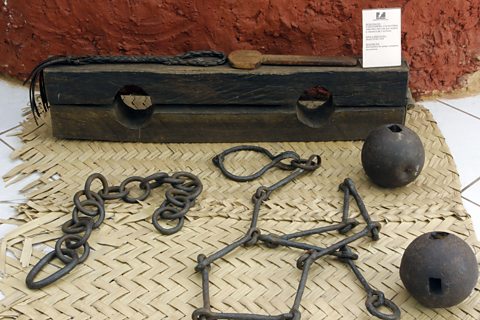
Beating, flogging, burning and rape were common forms of punishment.
Someone accused of talking too much could be forced to wear a metal mouth constraint.
For more serious misdemeanours, people were chained to a treadmill and whipped to keep it turning – or made to work the fields wearing an iron collar.
Many took their chances to escape.
That was a dangerous risk – but in Jamaica, some enslaved Africans did manage to make it to the remote mountain areas, where they formed free communities.
In the face of such inhuman treatment, captives frequently rose up.
Large scale rebellions were particularly frequent in Jamaica.
The white owner class, knowing they were outnumbered, lived in fear of mutiny.
But the odds were always against the captives - they had little hope of fighting the military forces who would be sent by ship as soon as word of a rebellion spread.
Learn in more depth
Working on a Caribbean plantation
On the plantation, enslaved people continued their harsh existence, as growing sugar was gruelling work.
Gangs of enslaved people, consisting of men, women, children and the elderly worked from dawn until dusk under the orders of a white overseer.
What was it like to work on a sugar plantation?
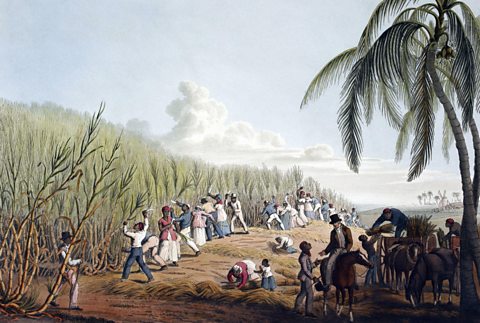 Image source, ALAMY
Growing sugar was hard, labour-intensive work.
Work gangs consisting of men, women and children worked under white overseers. Enslaved people worked from dawn until dusk. They were whipped for not working hard enough.
At harvest time it was common for enslaved people to work 18-hour days, while some people were forced to work for as long as 48 hours without a break.
Sharp instruments, the canes themselves and their leaves all caused frequent cuts which brought the risk of infection. This was made worse by the use of manure for fertiliser.
Life on the plantations was extremely hard. A third of enslaved Africans died within three years of arriving in the Caribbean. This created a constant demand for new enslaved people to replace them.
Image source, ALAMYCaribbean plantation work gangs
Often, if the enslaved Africans were tasked with working in the fields, they were separated into work gangs, each with a specialised task.
In 1755, William Belgrove advised on the best organisation of work gangs in 'A treatise upon husbandry or planting':
men in two gangs
- "the ablest and best by themselves for holeing (digging holes to plant canes in) and the stronger work
- "the more ordinary" for "dunging (fertilising with manure) etc"
women "also into two gangs as before"
children into "two gangs, the least (youngest) to be followed by some careful old woman, who must use them with gentleness"
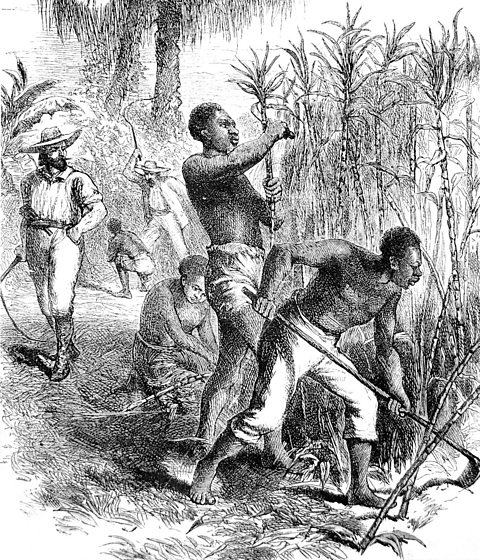 Image source, ALAMY
In general, work was organised as follows:
- the first gang of the fittest and strongest did the heavy work in the fields including digging, planting, cutting and burning
- the second gang were tasked with carrying manure, fertilising the canes and clearing up after the first gang. These tasks were carried out mainly by teenagers and older slaves or new mothers as they weren’t as physically demanding as the tasks carried out by the first gang.
- the third gang was made up of the very young or very old. Their jobs were less physically demanding and included weeding, and bringing food to the other gangs.
After a short time for lunch and a little rest, they worked until sunset.
They worked six days with Sundays off to go to church with the owner's family. However during harvest, they worked seven days in order to bring in the crop as quickly as possible.
Image source, ALAMYEnslaved women on Caribbean plantations
Girls worked on estates from the early age of four. Occupations for girls between the ages of 12 and 19 varied from field work and stock work, to domestic duties. Mature women often worked as midwives, nurses or housekeepers.
In Jamaica, the majority of women between the ages of 19 and 54 were working in the fields.
What was it like to work in a sugar factory?
At harvest time, sugar cane had to be processed quickly to prevent it spoiling, so sugar factories worked round the clock.
Work was arranged into two 12-hour shifts, one during the day and one at night. Enslaved workers would have often been exhausted from long hours of work in intense heat.
Inside the mill, the enslaved workers fed the cane through wooden or metal rollers to crush it to extract the juice.
Operating the machinery in the sugar mill was very dangerous, especially for exhausted workers. People working there could be maimed or even killed. As the rollers did not stop, some enslaved people had hands or arms cut off to prevent them being dragged further into the machines.
Once the cane was crushed, the juice flowed to the boiling house. Here it was repeatedly heated and cooled to remove moisture.
The processed sugar juice was then either turned into rum, molasses syrup or refined into sugar.
Processing sugar was skilled work, and some enslaved workers would have been been valued for their expertise. However the hot conditions would have been very unpleasant to work in and accidents with boiling sugar could cause horrific injuries or death.
What other work did enslaved African people do in the Caribbean?
Domestic service
Not all the enslaved Africans worked in producing sugar. Some carried out jobs within the houses of plantation owners and managers, for example:
- cooking
- cleaning
- laundry
- driving carriages
- serving the family as butlers or maids
- nurses to look after children
These jobs were less physically demanding than work in the sugar fields and could come with some benefits such as better housing and clothing. However, those who had these jobs lived under the constant watch of their owners and could easily be sent back to the fields.
Livestock
Some estimates suggest that around 10% of enslaved people in 18th Century Jamaica worked with livestock.
Horses, oxen and mules were used for transport and to power sugar mills, while cows, pigs, goats and sheep were raised to produce food.
Enslaved workers tended to animals, as well as transporting them to where they were needed, building fences and collecting manure which was used to fertilise plantations. This work was easier and more varied than working in sugar fields.
Towns and cities
The white population of the Caribbean grew around the trade in sugar and enslaved African people. Merchants and services supporting shipping and trade based themselves in growing ports and cities such as Kingston, Jamaica.
White businesses and households would often have one or more enslaved people working for them, carrying out tasks such as cooking and cleaning.
Some enslaved people worked as boatmen, transporting people and goods between ships and shore. Others worked n trades, for example as carpenters or blacksmiths, and developed skills in these areas.
As on the plantations, the population of enslaved people outnumbered that of the free white population:
| Year | Population of Kingston, Jamaica | Enslaved population |
|---|---|---|
| 1774 | 14, 200 | 9,000 |
| 1788 | 26, 478 | 16, 659 |
(Source: Slaves and Slavery in Kingston, 1770–1815, Burnard, T (2020))
Test what you have learned
Quiz
Recap what you have learned
The majority of enslaved people in the Caribbean were forced to work in the fields on sugar plantations:
- enslaved people were organised in work gangs:
- fit and strong men and women did the hardest work of digging, planting and cutting sugar cane
- less able adults fertilised cane with manure, and gathered the cut cane
- children and the elderly weeded and brought food to the other workers
They often worked long hours, sometimes from dawn to dusk for six days a week.
Work gangs were supervised by enslaved slave drivers
White overseers were in charge - they exerted brutal discipline and punishments
Plantations had sugar factories where sugar cane was crushed and the juice boiled to make sugar, rum and molasses:
- at harvest time, enslaved people worked round the clock on twelve hour shifts in extreme heat
- workers could be crushed or killed by machinery
- boiling sugar could cause horrific burns or even kill
Others worked in domestic service in the homes of plantation owners or merchants, or looking after livestock.
In ports and towns, more enslaved people worked in white people's homes. or some were skilled workers like carpenters or blacksmiths.
More on Trade in enslaved African people
Find out more by working through a topic
- count14 of 21
- count16 of 21
- count17 of 21