How did enslaved Africans rebel against their captivity?
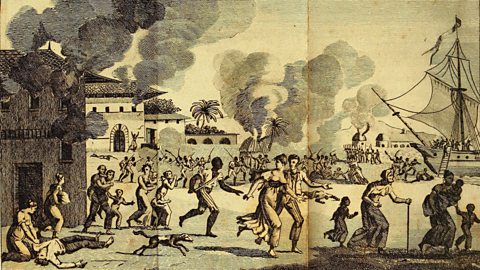 Image source, ALAMY
Quick version
Enslaved Africans did not accept their fate passively. History shows that they rebelled against their captivity.
- Enslaved Africans attempted to take control of slave ships.
- Enslaved Africans resisted captivity on plantations.
On plantations, there were two types of resistance:
- Passive resistance – such as working slowly or damaging machinery.
- Active resistance – such as running away, organising rebellions.
On Caribbean islands the population of black enslaved people was usually much larger than the white European population. The plantation owners and white population lived in fear of rebellions.
Rebellions usually failed for the same reasons:
- European militia forces had access to firearms.
- European soldiers based on Caribbean islands were better trained and more expertly led.
- It was hard for successful rebellions to keep hold of Caribbean islands for a long time.
Learn in more depth
Resistance on board slave ships
African people were far from passive and they offered fierce resistance to being captured and sold into a life of slavery.
There are several notable cases where enslaved Africans tried to take control of the ships they were being transported on.
The Jolly Batchelor, 1742
In 1742, while docked in the Sierra Leone River, the vessel the Jolly Batchelor was attacked and captured by the enslaved African people who were being loaded on board.
The crew were killed in the fighting. The African people stripped the vessel of its rigging and sails and freed the other people who were captive in the hold. They then abandoned the ship.
The Marlborough, 1752
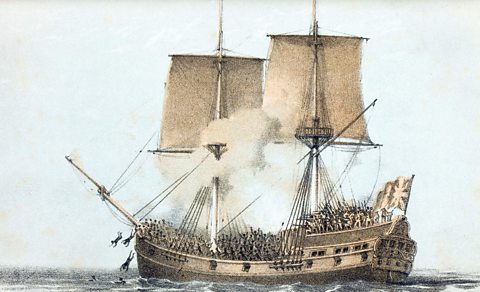 Image source, ALAMY
In 1752, the Bristol-based slave ship, the Marlborough, had picked up a cargo of over 300 enslaved Africans from the slave fortresses of Western Africa.
While sailing to the Americas, a group of enslaved Africans escaped and managed to take control of the ship, killing most of the crew. The surviving crew were forced to sail the ship back to Africa.
The ship made the journey, stopping off in Bonny (modern day Nigeria) to return home the Africans who had come from there.
The ship then sailed on further down the Gold Coast and was never heard of again.
Image source, ALAMYThe Amistad, 1839
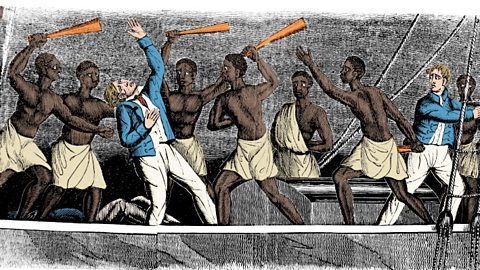 Image source, ALAMY
The most famous on board rebellion of enslaved Africans happened in 1839 on a ship called La Amistad.
The ship was carrying enslaved Africans to a Spanish-owned plantation on Cuba. Led by a man called Sengbe Pieh (also referred to as Joseph Cinqué), a group of Africans escaped from their chains and took control of the ship, killing several of the crew.
The Africans were eventually re-captured and a court hearing was called to decide their fate. In a landmark ruling, the US Supreme Court granted the enslaved Africans their freedom.
Image source, ALAMYResistance on plantations
Some resistance to enslavement took the form of attempting to maintain a sense of self and culture.
Although often banned, enslaved Africans continued to use their home languages, practice West African religion and beliefs, and play or sing traditional African music. Over time these all played a part in developing Caribbean culture.
While plantation owners often separated families, enslaved people did form relationships, friendships and their own communities.
When Sundays were introduced as a day off work, enslaved people could meet at markets, some selling produce from their provision grounds and gardens.
All these actions helped build a sense of community and humanity.
How did enslaved Africans rebel against their captivity?
Enslaved Africans adopted various different methods to rebel against the conditions they lived and worked in.
Whilst the majority of rebellious acts were acts of individual rebellion, there were some instances of co-ordinated action, either within the plantation or spread across several plantations.
There were two common types of resistance:
- passive
- active
Passive resistance
Passive forms of resistance were intended to hinder the rate of work but would not cause any direct harm to an individual.
The most common form of passive resistance was to simply work slower than usual – this would ultimately result in the plantation owner making less profit as they would have fewer crops to sell.
Sometimes enslaved people would break tools, so that they were unusable. This was another method of slowing work.
Active resistance
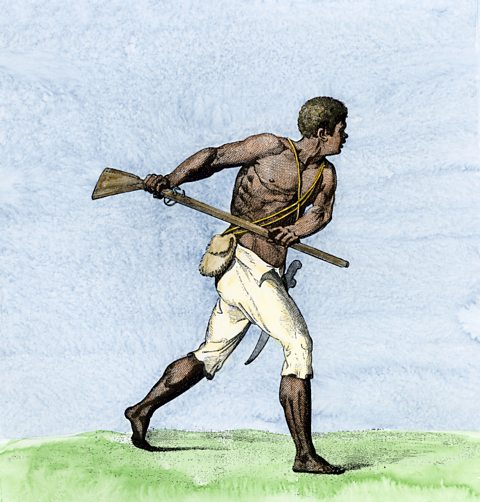 Image source, ALAMY
The most common form of active resistance would have been for an enslaved African to run away from the plantation.
For those that succeeded, it meant a new life away from slavery.
In Caribbean islands such as Jamaica, this could mean joining communities of other Africans who had also escaped slavery. These communities were called the Maroons.
Escape was risky, though.
- The interior of many Caribbean islands were rocky and hard to cross.
- Enslaved people would not know the land and where to go.
- Plantation owners employed slave catchers to hunt escaped workers.
Punishments for enslaved people who had been recaptured could be severe.
- Whippings were common and the number of lashes depended on the seriousness of the offence.
- Some escaped workers who had tried to convince others to join them could be hanged until dead.
Image source, ALAMYWhy did plantation owners fear rebellions?
 Image source, ALAMY
On most Caribbean islands the black population of enslaved people greatly outnumbered the populations of the white European masters. As a result, there was a great fear of violent rebellion of the enslaved population.
To counter this threat all instances of resistance or rebellion among the enslaved population were severely punished. This included enslaved people who resisted the plantation owners by running away.
On Antigua - any enslaved person running away for a period of three months or more is to suffer death, loss of limb or whipping at the discretion of two judges.
On Montserrat - any white person who captures a runaway enslaved person alive is to be paid 500lbs (500 pounds) of sugar by the owner. Any runaway absent for three months or more is to be executed as a criminal.
On Saint Christopher - any white or free person finding an enslaved person off their owner’s plantation without a pass, may whip them.
On Jamaica - any enslaved person found with 5lb to 20lb of fresh meat shall be whipped by the order of two judges, not exceeding 39 lashes.
On Barbados - any enslaved person offering violence to a Christian is to be whipped severely on first offence. For a second offence, the enslaved person is to be severely whipped, with their nose slit and their face branded with a hot iron.
Image source, ALAMYRevolutions and risings
More than once enslaved people organised and armed themselves to fight for their freedom from their masters.
These rebellions were very risky and the punishments, if they failed, were high.
While there were some notable victories for enslaved people, the majority of rebellions failed. Often, this was due to a lack of weapons to fight back against their better equipped opponents.
The First Maroon War, 1728 -1740
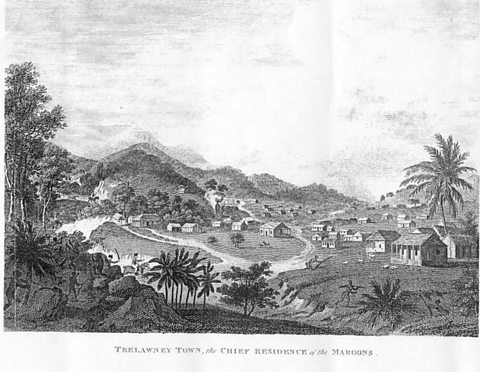 Image source, ALAMY
On Jamaica, enslaved Africans who had managed to escape formed their own communities in the remote mountainous areas of the island. These people became known as the Maroons.
Over time, the size and strength of the Maroons grew to a point where they controlled large parts of the mountain areas of the island. This often brought them into conflict with the British forces that claimed ownership of Jamaica.
Over a period of years, attempts by British military forces to establish control over the island led to several fierce battles with the Maroons.
British forces eventually realised that they were unable to defeat the Maroons, and so proposed a peace settlement.
In 1740, the Maroon leaders, Cudjoe, Quao, and Queen Nanny, signed the treaty that guaranteed the freedom of the Maroons.
In return, the Maroons had to accept that slavery would continue on the island.
Image source, ALAMYTacky’s Rebellion, 1760
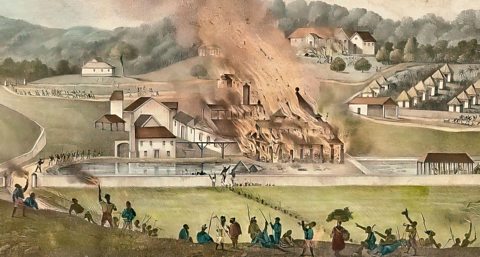 Image source, ALAMY
Led by an enslaved African man called Takyi (later referred to as Tacky), the rebels captured gunpowder and rifles and set off across the island of Jamaica to burn the plantations and liberate other enslaved people.
What shocked the British authorities, was the scale of the rebellion and how well-planned it was.
Under Tacky’s leadership, an army of hundreds of liberated slaves came close to controlling a significant part the island.
Ultimately, the British Army was used to put an end to the rebellion. Hundreds of the enslaved rebels were recaptured, many were executed, and Takyi was killed in combat.
Image source, ALAMYThe Haitian Revolution, 1791 - 1804
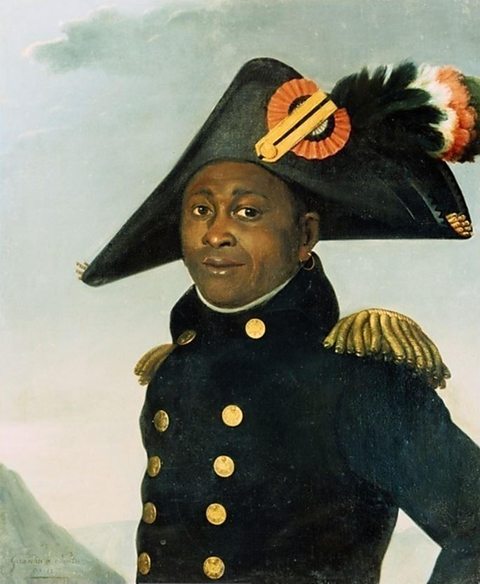 Image source, ALAMY
The most famous rebellion in the Caribbean began in 1791 in the French-controlled island territory of Saint-Domingue.
What started as an uprising of enslaved Africans in the north of the island, soon spread to a major revolution as other enslaved people rose up against their French masters and joined in. Soon, these forces numbered over 100,000 people.
The conflict expanded when Britain and Spain sent forces to the island to put pressure on their European rival, France.
The British and Spanish initially supported the enslaved people, but soon they began to follow their own interests in trying to control the island for themselves,
The most important leader to emerge in the conflict was a black general called Toussaint Louverture.
Louverture had been born enslaved on Saint-Domingue and then had later secured his own freedom.
Under Louverture’s skilled leadership, the domestic enslaved forces saw off the British and Spanish and took control of most of the island’s strategic locations.
Even after Louverture was captured by the French, the revolution continued until the island of Saint-Domingue was able to declare its independence from France in 1804. It renamed itself Haiti.
The formation of Haiti is the only rebellion that resulted in the founding of a state ruled by formerly enslaved people.
Image source, ALAMYTest what you have learned
Quiz
Recap what you have learned
There are a number of ways enslaved Africans rebelled.
- On board slave ships
- On Caribbean plantations.
On the plantations there were two types of resistance:
- Passive – such as working slowly.
- Active – such as running away or trying to fight back.
There were numerous rebellions of enslaved Africans on Caribbean islands:
- The First Maroon War, 1728-1740
- Tacky's Rebellion, 1760
- The Haitian Revolution, 1791 - 1804
Most failed due to lack of access to weapons and lack of skilled military leadership.
More on Trade in enslaved African people
Find out more by working through a topic
- count16 of 21
- count17 of 21
- count19 of 21