Britain's involvement in the Caribbean
Quick version
By the mid 1600s, Britain had established colonies in North America and the Caribbean:
- Virginia, 1607
- Barbados, 1625
- Jamaica, 1655
Plantations were established to grow crops:
- Coffee
- Tobacco
- Cotton
By the early 1700s, the main crop grown on Caribbean plantations was sugar cane.
Enslaved Africans were imported to provide labour on the plantations:
- 12 million enslaved Africans were transported to the New World.
- 3 million enslaved Africans were carried on British ships.
The transatlantic trade between Britain, Africa, and the Caribbean grew to dominate the British economy:
- By 1800, 60 per cent of British trade went to Africa and the Americas.
Video - Britain and the Caribbean
British ports and cities were directly involved in the trade in enslaved Africans in the Caribbean. Find out how the trade affected both Britain and the Caribbean.
When European powers first reached the Caribbean islands, they quickly realised they had discovered an asset that could be exploited.
The Caribbean climate was perfect for growing the luxury goods of the time – coffee, tobacco, cotton and sugar.
On the islands that the British had captured such as Trinidad and Tobago, the Bahamas, Barbados and Jamaica, settlers quickly cleared land to create plantations.
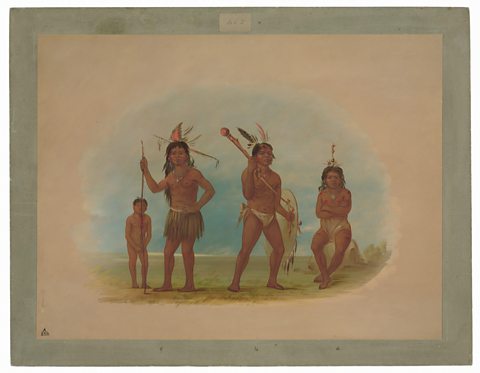
The indigenous peoples of the islands – the Arawak and the Taino – were forced to become unpaid labourers, producing goods which, when shipped to European markets, made the plantation owners massive profits
They were treated with extreme violence by their invaders – and had no resistance to European diseases like smallpox and flu.
As their numbers declined, the plantation owners needed a new source of labour.
The solution they found was to ship captured West Africans to the islands, creating a new workforce of enslaved people.
The cost to the enslaved African workforce was immeasurable.
The people transported to the Caribbean in chains were subject to brutal violence.
Working conditions were so hard that the plantations became mass graveyards for hundreds of thousands of African men, women and children.
As the plantations expanded to occupy all fertile land, the island’s natural ecosystems were destroyed.
But Britain reaped huge benefits…
It wasn’t just the plantation owners who became wealthy.
Cities such as Liverpool and Bristol experienced an economic boom from their part in the slave trade.
Dundee’s linen industry reaped huge profits from exporting garments to clothe enslaved workers and Glasgow was a hub for the European tobacco trade.
75% of sugar production went through London, before being sent on to global markets, making merchants rich.
The British government took its share of the profits in custom duties.
This income fundamentally changed the nation’s finances, and allowed the Treasury to spend vast sums enlarging the Royal Navy – securing Britain’s place as a dominant colonial power all over the world.
Britain’s banks became the richest in the world, with Lloyds of London profiting from insuring the ships that serviced the slave trade routes. Many of those profits were reinvested into new industries – laying the foundations for the Industrial Revolution.
Slavery and sugar changed the world. The trade had a devastating impact on parts of Africa while giving Britain a strong economic future. And it left the Caribbean islands stuck with unstable economies - dependent on the global market price of sugar.
Learn in more depth
Key moments in Britain's involvement in the Caribbean
Britain's Caribbean colonies
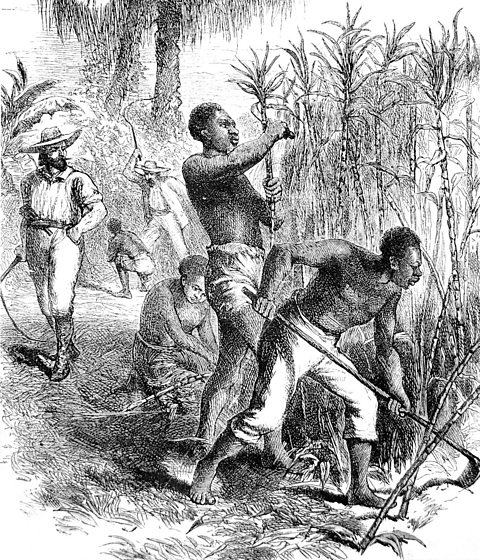 Image source, ALAMY
The first colonies of the British Empire were founded in North America (Virginia, 1607) and the West Indies (Barbados, 1625). In 1655 Jamaica was secured.
British slave traders started supplying enslaved African people to the British colonies to work on plantations.
Britain's involvement in the trade in enslaved people developed further in 1713, when the Treaty of Utrecht granted British traders the contract, known as the Asiento, to trade 144,000 enslaved people a year to Spanish South America.
After 1700, the numbers of enslaved people being transported increased greatly.
- 12 million Africans were captured to be taken to the Americas in slavery.
- Around three million of those people were carried on British ships.
Image source, ALAMYWhat was grown on Caribbean plantations?
Initially, most local plantations were growing cotton and tobacco. However, strong competition from the North American colonies meant that prices in these crops were falling.
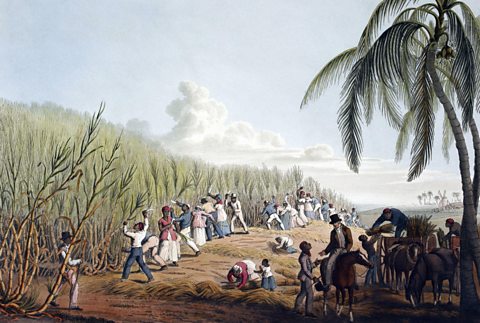
In response, the owners of the large Caribbean plantations decided to switch to growing sugar cane. The plantation owners purchased enslaved people to provide the labour for this work.
Profits from sugar cane
Almost every Caribbean island was covered with sugar plantations and mills for refining the cane for its sweet properties. Until the abolition of slavery, the main source of labour was enslaved African people.
Between 1700 and 1709 the trade in sugar increased dramatically due to the increasing popularity of sugar to sweeten luxury drinks such as tea and coffee.
- In 1700, Britain's sugar consumption was 2kg per person.
- By 1800, Britain's sugar consumption was 8kg per person.
- The Caribbean produced 80–90 per cent of the sugar consumed in Western Europe
Why did plantations demand enslaved labour?
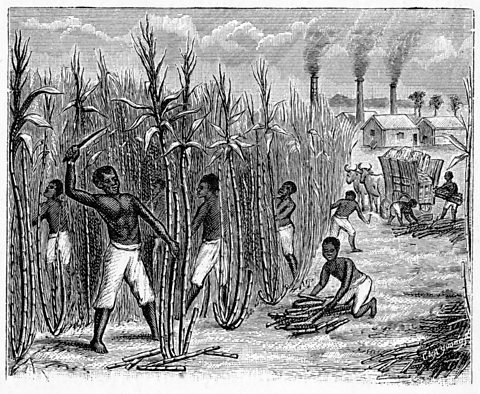 Image source, ALAMY
Sugar production was labour intensive. To meet the increased demand, white Europeans began to forcibly transport and enslave African people.
In 1746, economist Malachi Postlethwaite wrote that without enslaved African people:
… we can have no sugar, tobacco, rum etc. Consequently the public revenue, arising from the importation of plantation produce, will be wiped out. And hundreds of thousands of Britons making goods for the triangular trade will lose their jobs and go a begging
Image source, ALAMYGrowth in Caribbean trade
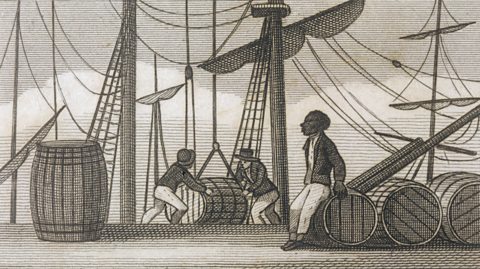
The growth of trade in enslaved people, in plantation crops, and in exports to American and Caribbean colonies led to a growth in shipping.
Overseas trade was carried out within the rules of the Navigation Acts. These stated
- All trade should take place in British ships.
- The ships should be manned by British seamen.
- Trading should be between British ports and other ports in the British Empire.
Additional laws were introduced that gave British shipping companies an advantage over foreign competitors:
- The Molasses Act of 1733 banned the import of foreign sugar to North America.
- The Direct Export Act of 1739, allowed British planters to ship goods directly to Europe.
The growth of the Royal Navy
The Royal Navy grew during the period of conflict for control of the colonies. Once Britain had grown to dominate the Caribbean, the Navy was still needed to protect these colonies and British shipping.
The trade in enslaved people contributed to the growth of the both the Royal Navy and the civilian merchant navy. The trade in enslaved people was an important training ground for British seamen, providing experienced crews for these other navies.
Importance to the British economy
The British economy was transformed by the Atlantic trade in enslaved Africans.
- In 1700, 80 per cent of British trade went to Europe from ports on the east and south coasts of Britain.
- By 1800, 60 per cent of British trade went to Africa and America, sailing from the three main west coast ports – Glasgow, Liverpool, and Bristol.
Test what you have learned
Quiz
Recap what you have learned
Britain formed colonies in North America and the Caribbean in the first half of the 1600s.
- These territories were planted with valuable crops such as cotton, tobacco, and coffee.
- Enslaved African labour was used to harvest the crops.
By the 1700s, sugar was the main crop planted in the Caribbean. Enslaved Africans worked the sugar plantations.
- 12 million enslaved Africans were transported to the New World.
- 3 million enslaved Africans were carried on British slave ships.
The trade in enslaved Africans became crucial to the British economy.
- By 1800, 60 per cent of British trade went to Africa and the Americas.
The trade in enslaved Africans led to the growth of the Royal Navy and Britain's civilian merchant navy.
More on Trade in enslaved African people
Find out more by working through a topic