Making prototypes - addition, deforming, reforming and wastage
Most materials need specialist tools and equipment to shape and form them - polymers are no exception because of the unique The mechanical, physical or optical properties of materials that define how they behave in use. they generally possess.
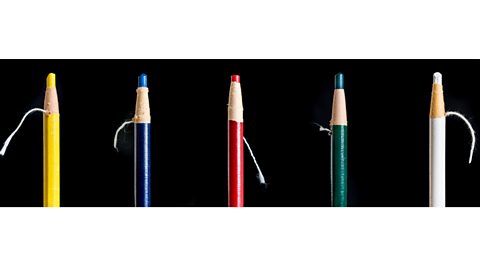
When marking out on the surface of a polymer, especially on a sheet of acrylic, a A wax or grease-based pencil that can write on most non-porous surfaces. is used as this will mark on the high-Shiny. surface. If no such pencil is available, an alcohol-based permanent marker would also work to mark a line to cut to.
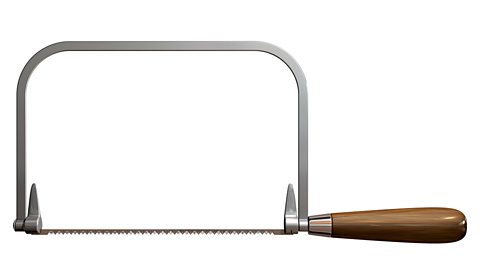
Polymers that are cut by hand are usually done by a coping saw, or sometimes a hacksaw. Once the polymer is cut close to a marked line, a A common tool used for finishing and shaping. can be used to remove up to the desired line. Files can be bought in different shapes, sizes and cutting grades - a rough-cut file can remove polymers faster than a smooth file and should always be used first.
Polymers can also be drilled by using a variety of different drill bits, which work by twisting into a piece of polymer. Twist drills are used to simply drill a hole of a fixed diameter into a piece of polymer.
It is very often the case that the polymer, for example acrylic, needs to be bent to a shape. Once the acrylic is cut, either by hand or using a A machine that uses a laser beam to vaporise material and cut out shapes very accurately., it can be bent using a strip heat, often called a A machine with a heated element, used to heat and shape polymers..
Acrylic needs to be heated to around 150 to 170°C to bend without cracking, and A tool used to aid the repetition of a process and/or to hold a work in place. can be made in a variety of ways so that the bend produced remains the same as the acrylic cools.
A machine that heats a polymer so that it is malleable enough to be pulled over a former with a vacuum. can be used for making A hollow container used to give shape to molten materials. and An exterior case or enclosure. for electronic products. A tough, rigid plastic material with high impact strength. is often the material used in a vacuum former, as it heats up quickly depending on thickness. The process is as follows:
- the HIPS is heated
- once hot, the solid A solid shape that is often used to make a mould. is pressed into the HIPS from a bed that can rise
- the vacuum is turned on, removing all the air from around the former
- the HIPS takes the form of the solid former
Sometimes A clay mineral. can be dusted on the former so that it drops out of the mould with ease. A good vacuum-formed mould will only be possible if a good former has first been made. The former must have a A tapered angle on a former., so it doesn’t get stuck in the mould.
Polymers can also be shaped, once hot, by A method of pressing a hot polymer over a former. and A method of draping a hot polymer over a former to produce a curved shape. - methods often used to shape acrylic. Once the acrylic is hot and Capable of being hammered or pressed into a new shape without being likely to break or return to the original shape., it can be pressed over a former to take a new shape.
