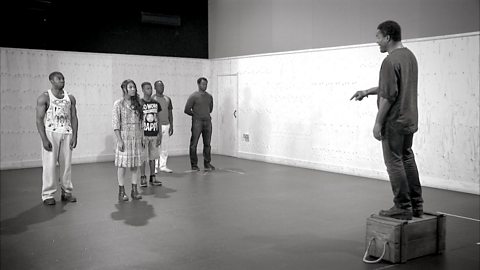
GBOLAHAN OBISESAN:What would be really nice, a really simple exercise, looking at the Colossus speech, "Why, man, he doth bestride the narrow world." And using this Post-it to try and pin point where the key points and ideas of that speech are.
CYRIL NRI:"Why, man, he doth bestride the narrow world like a Colossus, and we petty men walk under his huge legs and peep about to find ourselves dishonourable graves."
CYRIL NRI:In there, for me the most important thing is the "dishonourable graves."
GBOLAHAN OBISESAN:Yeah.
PATERSON JOSEPH:And you know, "petty men" "peep about" words that I've heard and affect me, but not as strongly as that. When somebody's going "you're just a coward"
GBOLAHAN OBISESAN:Yeah.
PATERSON JOSEPH:It's very different to "you're a coward" it passes you by. You might react to it but not the same as somebody pointedly gives that to you, so that’s a good exercise for just lifting up words and what they're doing to you.
PATERSON JOSEPH:When we do that exercise, you realise how many attacking words that there are, emotional words that there are within Cassius's speech to Brutus.
CYRIL NRI:"Men at some time are masters of their fates. The fault, dear Brutus, is not in our stars, but in ourselves, that we are underlings."
GBOLAHAN OBISESAN:It forces you to listen, they kind of have to make sure that they're always listening to what they're saying but then also what's being said to them and how that affects them.
PATERSON JOSEPH:There is a kind of pressure cooker that you put on me, I feel it already when we work on it is that, at the beginning it's all about Caesar and then suddenly you start being really specific about"You're not being a Brutus."
PATERSON JOSEPH:It touches on his pride, the fact that his family were the ones who drove out to people who wanted to be kings. And here he is, a nobody. Probably going to die in a "dishonourable grave" as Cassius has only just put in his head.
PATERSON JOSEPH:Then you get to the nitty-gritty of the word Brutus and Caesar, what's the difference between these two things, if I weigh them?
PATERSON JOSEPH:Weigh these two names, if I "conjure with 'em, starting spirits" all these things that are about rousing and getting up and getting at them why is he choosing that word instead of another word which is, maybe might have been weaker.
GBOLAHAN OBISESAN:In a way, hopefully Cyril's gone away thinking "Right, I can use that speech a bit more. I can defiantly pin-point certain words and ideas that I can use to really stir up an emotion."
CYRIL NRI:"That talked of Rome, that her wide walls encompass'd but one man?"
PATERSON JOSEPH:I don’t know how he does it but it's sort of, secret way in which Shakespeare gets under us, gets under our skin with a sort of-- we're bombarded with words but at the same time there's only one or two of them that are really going to fire us up.
PATERSON JOSEPH:But Shakespeare keeps on at us in that way and keeps on at Brutus in that way to get him, to goad him to action.
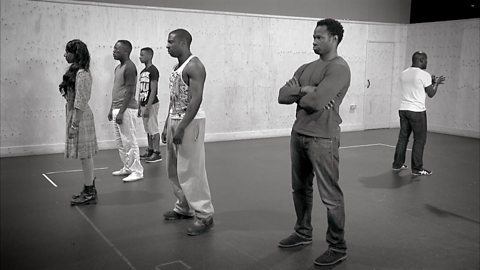
Using a rehearsal game, the actors explore key points in Cassius’s speech about Caesar and the future of Rome.
They relate these to Cassius’s strategy for winning Brutus over to the conspirators.
This short film is from the BBC series, Shakespeare Unlocked.
Teacher Notes
Look closely at the section where Cassius compares Brutus with Caesar, and compare it to the balcony scene from 'Romeo and Juliet' (Act 2, Scene 2) where Juliet debates the nature of a name.
How are these two passages similar, and how are they different?
How much of this difference is focused on the fact that Juliet thinks she is alone, while Cassius is deliberately trying to persuade Brutus?
Ask your students, in pairs, to play the post-it game for themselves, starting to explain the game and pausing it at the point where the actors start.
Once they have finished, get them to watch and see how far their predictions agree with the choices of Cyril Nri.
Curriculum Notes
This short film is suitable for teaching GCSE English literature and drama in England, Wales and Northern Ireland and National 4/ 5 in Scotland.
More from Shakespeare Unlocked: Julius Caesar
Act I, Scene 2 - Cassius enlists Brutus. video
Cassius confronts Brutus about his friend’s uncharacteristic coldness.
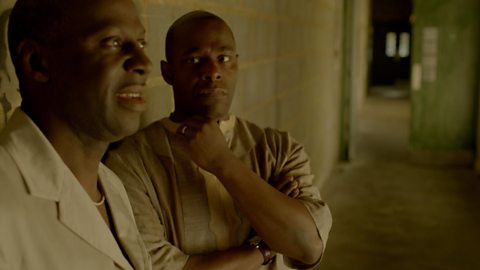
Act I, Scene 2 - Cassius and Brutus (workshop) video
The actors explore what their characters are trying to achieve in this early confrontation.
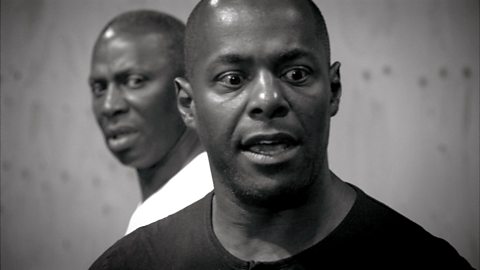
Act I, Scene 2 - Persuading Brutus (workshop) video
Exploring the tactics Cassius uses to persuade Brutus to join the plot to assassinate Caesar.
Act 3, Scene 1 - The Murder. video
Conspirators isolate Caesar on the way to the Senate and Cimber presents his petition.
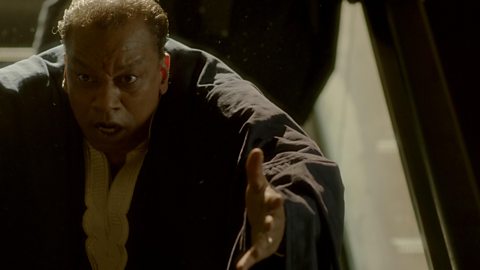
Act 3, Scene 1 - Leader or dictator (workshop) video
The actors explore the character of Julius Caesar.
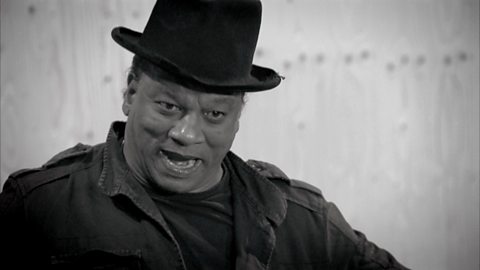
Act 3, Scene 1 - Killing Caesar (workshop) video
The actors use the clues in the text to build an unique interpretation of Caesar’s murder.
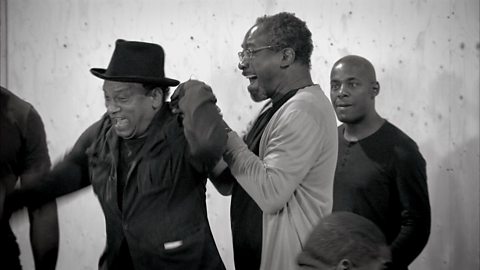
Act 3, Scene 2 - The Orations. video
Brutus explains why conspirators killed Caesar and insists they stay to hear Mark Antony.

Act 3, Scene 2 - Rhetoric and politics (workshop) video
The two funeral speeches are compared, each set against the structures of rhetoric.
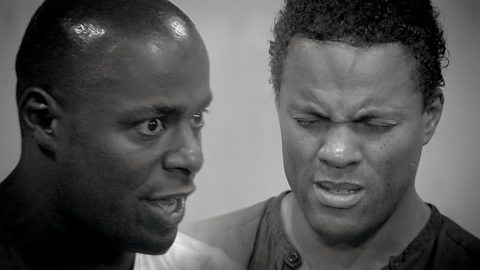
Act 3, Scene 2 - Brutus reasons with the crowd (workshop) video
A practical exercise as the citizens respond to Brutus’s funeral speech.
Act 3, Scene 2 - Mark Antony moves the crowd (workshop) video
The citizens explore their responses to Mark Antony’s speech.