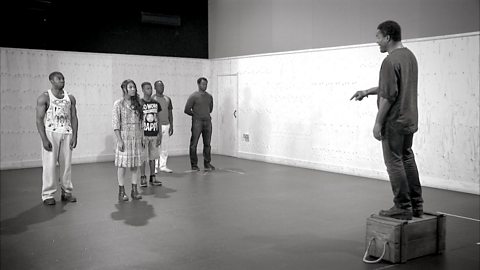
CYRIL NRI:Cassius has shared the dream of the republic with Caesar and has witnessed him taking power for himself, and he feels very strongly that something needs to be done about that. And he starts setting up a plan of action to rid Rome of this tyrant.
GBOLAHAN OBISESAN:So the main emphasis of this particular exercise is to find those moments where it feels as if Cassius' words are striking a chord with Brutus.
PATERSON JOSEPH:So what, we're sitting on the chairs and then moving around–
GBOLAHAN OBISESAN:Yeah.So you start sat opposite each other.
CYRIL NRI:Furthest away.
GBOLAHAN OBISESAN:Furthest away, and then slowly see how this scene brings you closer or–
800:00:45:08 00:00:48:21PATERSON JOSEPH:Okay. Am I allowed to leave the room when he repels me?
CYRIL NRI:Will you go see the order of the course?
PATERSON JOSEPH:Not I.
CYRIL NRI:I pray you do.
PATERSON JOSEPH:I am not gamesome. I do lack some part of that quick spirit that is in Antony. Let me not hinder, Cassius, your desires; I'll leave you.
CYRIL NRI:Brutus.
GBOLAHAN OBISESAN:One character is clearly trying to do something to the other character. So Cassius was trying to get close enough to Brutus, trying to align him towards this issue, how Julius Caesar should be dealt with.
PATERSON JOSEPH:Cassius says, "I have not from your eyes that gentleness and show of love as I was wont to have," as I used to have, to which Brutus says, Cassius, no don't be, don't be deceived.
PATERSON JOSEPH:That's not what's happening. What's happening is that I'm not as friendly as I was because I've got stuff going on.
PATERSON JOSEPH:Vexed I am of late with passions of some difference, conceptions only proper to myself, which give some soil perhaps to my behaviour. But let not therefore my good friends be grieved. Among which number, Cassius, be you one.
CYRIL NRI:In our production, we've used the charm and the mimicry and the togetherness of a shared bond of school.
PATERSON JOSEPH:For the eye sees not itself, but by reflection.
CYRIL NRI:But by reflection
BOTH:by some other things. By some other things.
CYRIL NRI:'Tis just.
PATERSON JOSEPH:In rehearsals I started, sort of, sing-song-ing it. And then Sil joined in and I thought that's brilliant because then it shows that we were probably at that school together.
CYRIL NRI:Yeah.
PATERSON JOSEPH:And that teacher that we remember who used to give us those–
CYRIL NRI:Yeah–
PATERSON JOSEPH:philosophical quotes by rote. So that's how that came about.
PATERSON JOSEPH:We don't really know why Cassius is talking in these couched terms about there are many of the best respect in Rome who think that you're a pretty cool guy and you should think more of yourself than you do.
PATERSON JOSEPH:So we're all kind of going, he's not saying anything, he's, he's not being overt. And then you get to the nitty gritty of the word Brutus and Caesar, what's the difference between these two names?
CYRIL NRI:Write them together. It is as fair a name. Sound them, it doth become the mouth as well Weigh them, it is as heavy. Conjure with them.
CYRIL NRI:Brutus will start a spirit as soon as Caesar.
CYRIL NRI:And then Brutus gives away that he fears that honours are going to be heaped on Caesar. This is what the crowd is shouting about.
PATERSON JOSEPH:What means this shouting? I do fear the people choose Caesar for their king.
CYRIL NRI:Aye. Do you fear it? Then must I think you would not have it so.
PATERSON JOSEPH:I would not, Cassius.
CYRIL NRI:Right. Then I know I'm safe to go ahead.
CYRIL NRI:Why, man, he doth bestride the narrow world like a Colossus and we petty men walk under his huge legs and peep about to find ourselves dishonourable graves.
PATERSON JOSEPH:And then at the end of the scene Cassius begins to touch on Rome. What Rome was. What Rome has become. Who Romans are. And he says something to Brutus that completely changes Brutus' focus.
CYRIL NRI:Now is it Rome indeed and room enough, when there is in it but one only man?
PATERSON JOSEPH:There cannot be only one man in Rome.
PATERSON JOSEPH:That's all we need to hear. Brutus is on side and he's on side because he is a Roman and he's going to show himself to be a Roman.
A classic rehearsal exercise is used to investigate and break down the tactics Cassius uses to persuade Brutus to join the plot to assassinate Caesar.
This short film is from the BBC series, Shakespeare Unlocked.
Teacher Notes
After watching this short film, ask your students to decide on the physical representation of the emotional distance between characters in the scenes immediately preceding and following this.
Now that they have knowledge of the discussion between Caesar's exit and entrance, how do they think that Cassius and Brutus would situate themselves around Caesar?
Does Caesar draw close to them, and they further away from him? Would Brutus and Cassius stand closer together following their conversation?
Then ask students to imitate this exercise with another scene - how does the physical distance between characters imitate their emotional distance?
You can do this exercise with pictures or toy figures representing characters if you wish, and then ask students to annotate a large sheet of paper with the pictures or figures laid out on it, explaining their choice of positions.
Curriculum Notes
This short film is suitable for teaching GCSE English literature and drama in England, Wales and Northern Ireland and National 4/ 5 in Scotland.
More from Shakespeare Unlocked: Julius Caesar
Act I, Scene 2 - Cassius enlists Brutus. video
Cassius confronts Brutus about his friend’s uncharacteristic coldness.
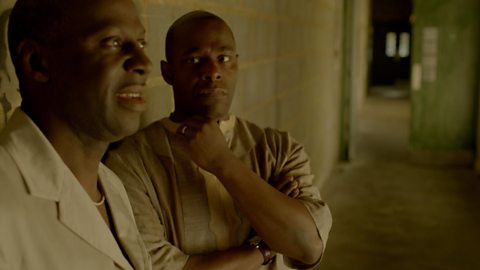
Act I, Scene 2 - Cassius and Brutus (workshop) video
The actors explore what their characters are trying to achieve in this early confrontation.
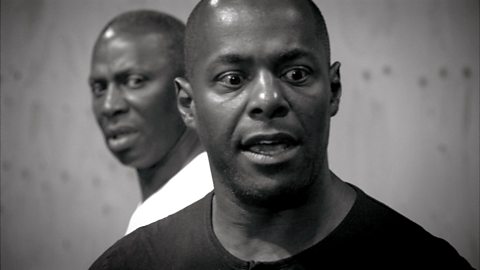
Act I, Scene 2 - Marking the words (workshop) video
The actors explore key points in Cassius’s speech about Caesar and the future of Rome.
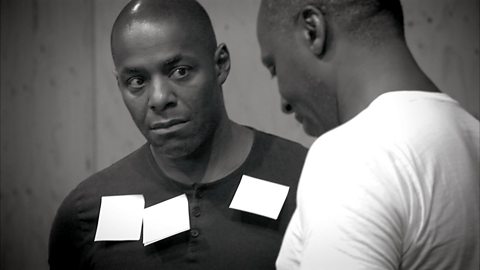
Act 3, Scene 1 - The Murder. video
Conspirators isolate Caesar on the way to the Senate and Cimber presents his petition.
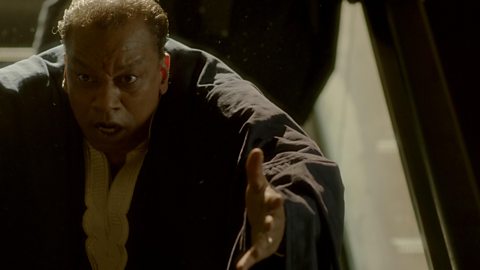
Act 3, Scene 1 - Leader or dictator (workshop) video
The actors explore the character of Julius Caesar.
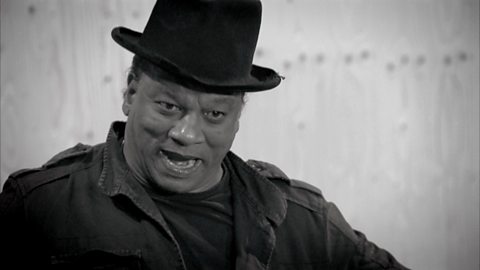
Act 3, Scene 1 - Killing Caesar (workshop) video
The actors use the clues in the text to build an unique interpretation of Caesar’s murder.
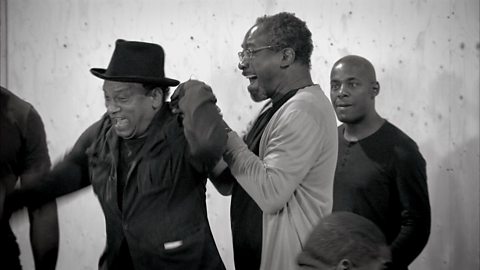
Act 3, Scene 2 - The Orations. video
Brutus explains why conspirators killed Caesar and insists they stay to hear Mark Antony.
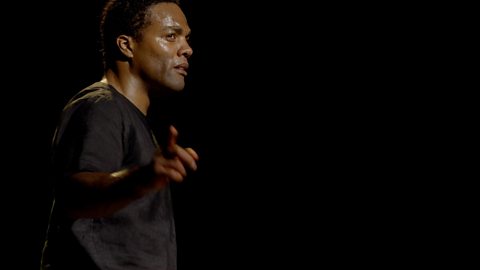
Act 3, Scene 2 - Rhetoric and politics (workshop) video
The two funeral speeches are compared, each set against the structures of rhetoric.
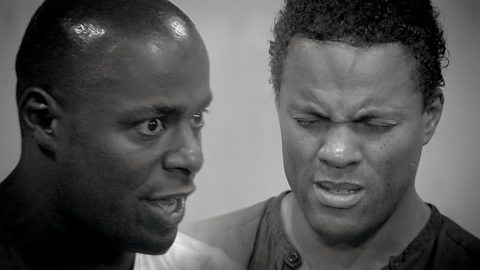
Act 3, Scene 2 - Brutus reasons with the crowd (workshop) video
A practical exercise as the citizens respond to Brutus’s funeral speech.
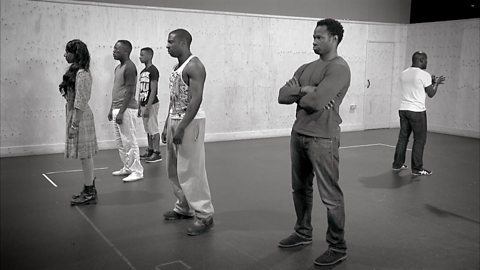
Act 3, Scene 2 - Mark Antony moves the crowd (workshop) video
The citizens explore their responses to Mark Antony’s speech.