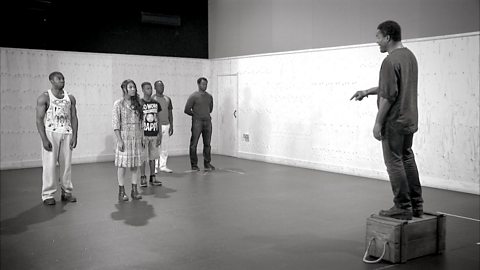
MARK THEODORE:'"Metellus Cimber throws before thy seat a humble heart–"'
JEFFERY KISSOON:"I must prevent thee, Cimber."
JEFFERY KISSOON:'Historically, Caesar was killed, so Shakespeare had to show Caesar' in an unsavoury light. Didn’t he? He had to show him as a kind of tyrant, as a sort of dictator in order for the audience to feel, "Yeah, they are justified in killing him if he's going to talk to people like that."
JEFFERY KISSOON:'Shakespeare set that up wonderfully.'
JEFFERY KISSOON:"Thy brother by decree is banished. If thou dost bend and pray and fawn for him. I spurn thee like a cur out of my way." "Know, Caesar doth not wrong, nor without cause will he be satisfied."
JEFFERY KISSOON:'They're all pleading,' and there's Brutus even… who's the most respected man and well loved by Caesar.
PATERSON JOSEPH:"I kiss thy hand, but not in flattery, Caesar, desiring thee that Publius may have an immediate freedom of repeal."
JEFFERY KISSOON:"What, Brutus?"
MARK THEODORE:I think the reason that they are doing this, for me, is simply to facilitate his death, simply to hold him here, the fact is that he then says "without cause I won't be satisfied" and is about to leave, that’s when people have to come in and stop him.
MARK THEODORE:"Most mighty, and most puissant Caesar."
PATERSON JOSEPH:"I kiss thy hand, but not in flattery."
CYRIL NRI:"As low as to thy foot doth Cassius fall to beg enfranchisement for Publius Cimber."
GBOLAHAN OBISESAN:What seems to be happening is everything that’s played out is played out quite publicly. What if we made the appeal by Cimber a private encounter? Shall we have a go at that?
CYRIL NRI:Okay.
GBOLAHAN OBISESAN:Great.
MARK THEODORE:"Mighty, and most puissant Caesar. Metellus Cimber throws before thy seat an humble heart–
JEFFERY KISSOON:I must prevent thee, Cimber. These couchings and these lowly courtesies might fire the blood of ordinary men and turn preordinance and first decree into the law of children.
JEFFERY KISSOON:Be not fond. To think that Caesar bears such rebel blood that will be thawed from the true quality with that which melteth fools - I mean, sweet words, low-crooked curtsies."
JEFFERY KISSOON:I felt that you could really see the reasonable nature of Caesar. What I felt was if Metellus had another something else to add, cause' Shakespeare doesn’t give him, perhaps Caesar could have changed his mind. But then there's no conspiracy, there's no reason for killing him.
PATERSON JOSEPH:It's not working at first because Caesar is being reasonable, he's saying to him "I'm not just going to change the law because you're begging me" so that what we need is to fire him up a bit, which we do by Cassius coming and going even lower than Cimber.
CYRIL NRI:"As low as to thy foot doth Cassius fall to beg enfranchisement for Publius Cimber."
GBOLAHAN OBISESAN:Which makes Caesar go, "This is ridiculous," and that’s really disrespectful and he's so outraged by this behaviour, that he disses him and tells him to clear off.
JEFFERY KISSOON:"I could be well moved if I were as you if I could pray to move, prayers would move me. But I am constant as the northern star. Of whose true-fixed and resting quality there is no fellow in the firmament."
GBOLAHAN OBISESAN:And it makes us and the rest of the conspirators think that, this egotistical, unapproachable man definitely needs to be seen too, as it were.
GBOLAHAN OBISESAN:Before, you know, he gets absolute power when he becomes king.
JEFFERY KISSOON:Shakespeare's setting him up to be assassinated.
CYRIL NRI:Yeah.
JEFFERY KISSOON:By the next speech to Cassius–
CYRIL NRI:By the next speech to Cassius but,
JEFFERY KISSOON:hang on, he's setting him up in order for the audience to feel justified in this killing and therefore the Senate feels justified in doing his killing.
JEFFERY KISSOON:"I do know but one that unassailable holds on his rank, unshaked of motion. And that I am he let me a little show it even in this: that I was constant Cimber should be banished, and constant do remain to keep him so."
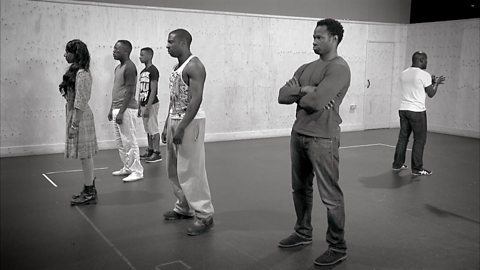
The actors investigate how to play the character of Julius Caesar and explore the dramatic purpose of the action just before the murder.
This short film is from the BBC series, Shakespeare Unlocked.
Teacher Notes
In pairs or small groups, ask your students to dissect Caesar's speech into words and phrases where he speaks about himself and words and phrases where he speaks about others (they could do this in two columns).
Students should then compare the columns together.
How does Caesar speak about himself, and what in the language suggests his arrogance?
Now ask students to look at the language used by the others in the scene about themselves and about Caesar.
How far do their own words add to the division in language?
Curriculum Notes
This short film is suitable for teaching GCSE English literature and drama in England, Wales and Northern Ireland and National 4/ 5 in Scotland.
More from Shakespeare Unlocked: Julius Caesar
Act I, Scene 2 - Cassius enlists Brutus. video
Cassius confronts Brutus about his friend’s uncharacteristic coldness.
Act I, Scene 2 - Cassius and Brutus (workshop) video
The actors explore what their characters are trying to achieve in this early confrontation.
Act I, Scene 2 - Persuading Brutus (workshop) video
Exploring the tactics Cassius uses to persuade Brutus to join the plot to assassinate Caesar.
Act I, Scene 2 - Marking the words (workshop) video
The actors explore key points in Cassius’s speech about Caesar and the future of Rome.
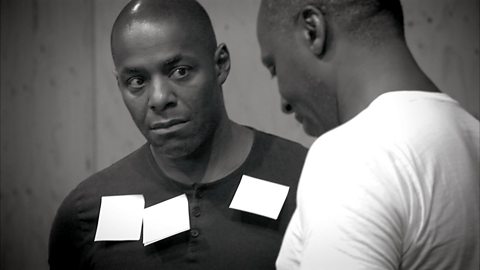
Act 3, Scene 1 - The Murder. video
Conspirators isolate Caesar on the way to the Senate and Cimber presents his petition.
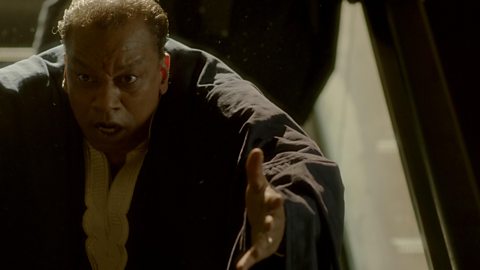
Act 3, Scene 1 - Killing Caesar (workshop) video
The actors use the clues in the text to build an unique interpretation of Caesar’s murder.
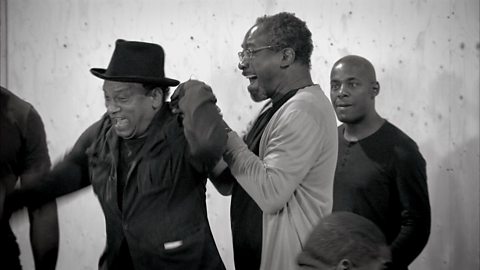
Act 3, Scene 2 - The Orations. video
Brutus explains why conspirators killed Caesar and insists they stay to hear Mark Antony.

Act 3, Scene 2 - Rhetoric and politics (workshop) video
The two funeral speeches are compared, each set against the structures of rhetoric.
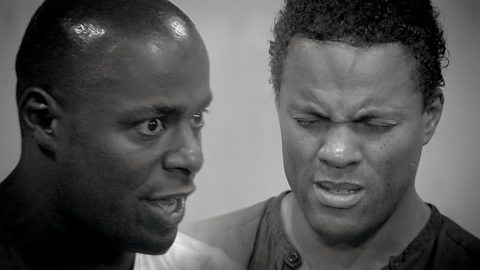
Act 3, Scene 2 - Brutus reasons with the crowd (workshop) video
A practical exercise as the citizens respond to Brutus’s funeral speech.
Act 3, Scene 2 - Mark Antony moves the crowd (workshop) video
The citizens explore their responses to Mark Antony’s speech.