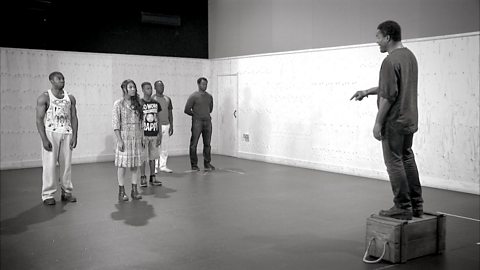
Paterson Joseph:When I first read Brutus's oration
Paterson Joseph:just after the murder of Caesar, I felt that this was a man who was justifying murder, but he wasn't justifying it in order to manipulate the crowd, he was justifying it in order to show them why he had done it.
Paterson Joseph:"Romans, countrymen, and lovers! Hear me for my cause, and be silent that you may hear: believe me for mine honour, and have respect to mine honour, that you may believe."
Paterson Joseph:When somebody talks to us and everything they're saying, inside we're going, "Hmm that's true, hmm actually, yeah that's right." That feels to me what rhetoric is, the person has got your argument, knows what you're feeling or knows what you're thinking and sort of says what you're thinking and then says something else
Paterson Joseph:that you go, "Yeah, yeah, actually you know, that is the inevitable conclusion of my thoughts."
Gbolahan Obisesan:So, where do we think Brutus uses pathos, ethos
Gbolahan Obisesan:and logos? 'The structures of rhetoric.'
Paterson Joseph:Well, the main thing that he uses is ethos. Who am I? And the first thing he says is "I'm a man of honour." It's the first personal thing he says to them, who am I? I'm a man of honour and you all know that I'm a man of honour.
Paterson Joseph:"Believe me for mine honour, and have respect to mine honour that you may believe."
Paterson Joseph:Logos, yes he defiantly uses words that are very clear. At the very beginning he says, "Hear me, believe me, censure me.
Paterson Joseph:"Censure me in your wisdom and awake your senses."
Paterson Joseph:He then appeals to them and appeals to their emotions I suppose, pathos, when he says, if there's any here who loved Caesar… well I'm just like them, I loved Caesar too. But I think the main thrust of his argument is logos, the word is to give them the truth.
Paterson Joseph:And to say to them, this is what happened and this is why this happened.
Paterson Joseph:"As Caesar loved me, I weep for him; as he was fortunate, I rejoice at it; as he was valiant, I honour him; but, as he was ambitious, I slew him."
Paterson Joseph:His lines are well balanced, but they're not overly emotional. 'You could argue that he patronises them by just speaking down to them 'slightly, not getting down and dirty on their level.'
Paterson Joseph:But what I think he does is slightly more honest in that he just delivers the truth and expects that they'll be adult enough to accept that and he is so wrong.
Ray Fearon:"Friends, Romans, countrymen, lend me your ears. I come to bury Caesar, not to praise him. The evil that men do lives after them; the good is oft interred with their bones: so let it be with Caesar."
Ray Fearon:He's just seen Brutus do a fantastic speech, which has actually won over this crowd and by the end of it they've actually said, build a statue for him. You know, let him be Caesar, but I think Mark Antony knows that the audience is quite fickle.
Paterson Joseph:Mark Antony immediately takes the pathos side of things, and starts to be emotional and in his speech you see long lines, but you also see punch, he has a great capacity to use visceral language, he talks about the wounds of Caesar.
Paterson Joseph:He talk about the wounds speaking, "Poor, poor dumb mouths", he talks about the fact that they loved him once. He uses very emotional words and it wins the crowd over, it woos them.
Ray Fearon:I think people will believe you when you're emotional, than actually just believing just dry rhetoric. Which is what Brutus uses, he uses rhetoric without the emotion, and it's a great argument. But it ain't good enough.
Gbolahan Obisesan:So let's try an exercise to pick out words, within that speech and just stress counter arguments against Brutus's argument of why they took out Caesar and just do it with your eyes closed.
Ray Fearon:Okay.
Gbolahan Obisesan:Great.
Ray Fearon:"When that the poor have cried, Caesar hath wept: ambition, should be made of sterner stuff. Yet Brutus says he was ambitious."
Ray Fearon:He's trying to break down ambition, what is ambition?
Gbolahan Obisesan:Yeah, yeah, yeah.
Ray Fearon:Was this act ambitious? Or was that act ambitious?
Gbolahan Obisesan:If it had–
Ray Fearon:Because it doesn’t seem to me that, that seems like a man who's ambitious. By the end, you kind of questioning are these guys honest?
Gbolahan Obisesan:After hearing both speeches, the fact that one's written in prose and the other in verse and–
Paterson Joseph:Why?
Gbolahan Obisesan:Yeah! Why do we think that is?
Paterson Joseph:I often think that, often in Shakespeare, what I've seen is that his honest as in 'they're just going to tell it like it is' characters tend to speak in prose. It might be that Shakespeare's saying that Brutus is speaking straightforwardly.
Gbolahan Obisesan:Yeah.
Paterson Joseph:And that Antony is more structured and more in control.
Ray Fearon:"Bear with me… my heart is in the coffin there with Caesar, and I must pause till it come back to me."
Paterson Joseph:'This guy is just,' ten times more astute than I am about how to work a crowd.
Ray Fearon:When he's got them to real fever pitch, he then raises them to come, the will. And then promises them look, this is what's in Caesar's will, he's promised you money.
Paterson Joseph:Suddenly I've lost them, and I wanted to get up there and go, "Actually I've got some more to say!" But it was too late and that's the brilliance of Mark Antony and the brilliance of Shakespeare, to put those two speeches side by side.
The two funeral speeches are compared, each set against the structures of rhetoric.
Why is Antony’s the more effective when Brutus had previously won them over?
This short film is from the BBC series, Shakespeare Unlocked.
Teacher Notes
Give your students copies of both speeches to look at side by side.
Ask them to highlight the words and phrases that Antony uses which imitate the words used by Brutus.
What are the similarities, and how does Antony use these to help him sway the audience?
Ask students to simplify both speeches by taking out all the repetition in each.
Look carefully at what is left - how much is lost of the persuasiveness by the loss of repetition, and which speech loses most?
Introduce the ideas of Ethos, Pathos and Logos as mentioned in the commentary.
Can students identify for themselves places where these elements of rhetoric seem to be used by Shakespeare in each speech?
Ask students to work in threes, and assign one element to each student.
Each student then has to identify their assigned element in each speech.
Students should then discuss how these are balanced in each speech.
Curriculum Notes
This short film is suitable for teaching GCSE English literature and drama in England, Wales and Northern Ireland and National 4/ 5 in Scotland.
More from Shakespeare Unlocked: Julius Caesar
Act I, Scene 2 - Cassius enlists Brutus. video
Cassius confronts Brutus about his friend’s uncharacteristic coldness.
Act I, Scene 2 - Cassius and Brutus (workshop) video
The actors explore what their characters are trying to achieve in this early confrontation.
Act I, Scene 2 - Persuading Brutus (workshop) video
Exploring the tactics Cassius uses to persuade Brutus to join the plot to assassinate Caesar.
Act I, Scene 2 - Marking the words (workshop) video
The actors explore key points in Cassius’s speech about Caesar and the future of Rome.
Act 3, Scene 1 - The Murder. video
Conspirators isolate Caesar on the way to the Senate and Cimber presents his petition.
Act 3, Scene 1 - Leader or dictator (workshop) video
The actors explore the character of Julius Caesar.
Act 3, Scene 1 - Killing Caesar (workshop) video
The actors use the clues in the text to build an unique interpretation of Caesar’s murder.
Act 3, Scene 2 - The Orations. video
Brutus explains why conspirators killed Caesar and insists they stay to hear Mark Antony.
Act 3, Scene 2 - Brutus reasons with the crowd (workshop) video
A practical exercise as the citizens respond to Brutus’s funeral speech.
Act 3, Scene 2 - Mark Antony moves the crowd (workshop) video
The citizens explore their responses to Mark Antony’s speech.