The new weapons and tactics of the first World War forged an industrialised killing machine.
And it sucked in men from all around the globe.
The world had never seen such a diverse population in such a concentrated area.
And the small Belgian community of Dikkebus was right at the heart of this extraordinary global phenomenon.
Just a few miles away from the town of Dikkebus, lay the Western Front and almost overnight this town was transformed from a provincial back water to being one of the most diverse and multicultural places on the planet.
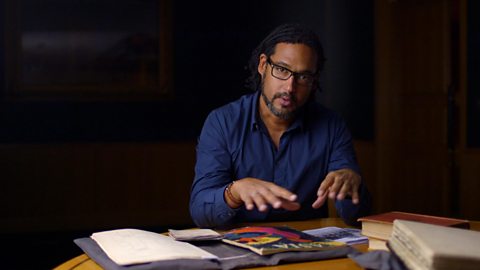
Men from all over the earth came here to fight and to labour. And watching over the whole thing was the young parish priest of this church, Father Alciel Van Wallegham, and he kept a remarkable diary of the war years.
Historian and curator Dominiek Dendooven has studied Father Wallegham’s impressions of those strange times.
What you seem to get from him is a view of the first World War from behind net curtains.
Dominiek:
We actually have through him first hand accounts, but first hand accounts not from one of the parties involved but from a bystander, which it’s, is, it’s very nice because that’s information that first of all you would never think about and secondly you would never ever encounter in official reports.
We’ve got the entry for the 6th of June, a Sunday, several Indian troops have arrived on the parish, black of skin, dressed as English soldiers with the exception of the hat which is draped artfully in a towel.
David:
Artfully?
Dominiek:
Artfully.
David:
So that’s the turban.
Dominiek:
Hmm, they speak English and some a bit of French, in general they are very friendly and polite. Though their curiosity has the upper hand and they especially like to see through the windows of our houses. They bake a kind of pancake and they eat a kind of seed which is, which has a very strong taste.
David:
So this is going to be chapattis.
Dominiek:
Er, yeah they are eating chapattis.
David:
And flavoured with a very strong tasting spice.
Dominiek:
Oh yeah yeah, he says they are eating a kind of seed which is very strong so he must have tasted it because otherwise he wouldn’t have known that it has a strong taste.
David:
So he’s one of the first people in rural Belgium to try Indian food.
Dominiek:
That’s very much so very, because local people normally tend to be chauvinistic regarding food but he is as least someone who is open to taste other things.
David:
Father Wallegham made careful observations of all the different nationalities who passed through his parish.
But one group in particular caught his attention. They travelled from the other side of the world to play their part in the war.
Dominiek:
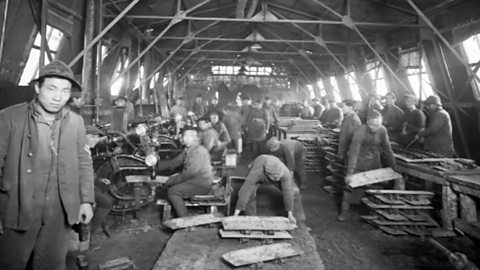
In the area now many Chinese have arrived and they are employed by the English, the British army to work. So it happens that I pass them shortly before noon and constantly they were saying, "Watch watch…" because they wanted to know how late it was. "And I believe they were getting hungry because when I show them it was only 5 minutes to 12 they were nodding contently."
David:
Because they know they are going to get their dinner?
Dominiek:
And then he writes indeed, then he writes "Because it as nearly time to fill their bellies with their beloved rice."
David:
Their beloved rice.
Dominiek:
Their beloved rice… Geliefde rijst.
David:
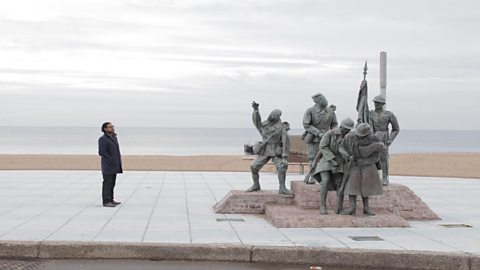
More than fifty different nationalities ended up living and working together in this small pocket of Europe.
When you look at that world behind the lines, it looks more like Europe of the 21st century, diverse, multi-cultural, multi-faith than the Europe of 1914 to 18.
Dominiek:
Yeah and that makes it very interesting for us historians because erm, it points out the relevance, that history can have for today’s societies. Which means if you study how these groups got along during the first World War, it’s kind of a mirror to the problems we face today in our multicultural society.
Video summary
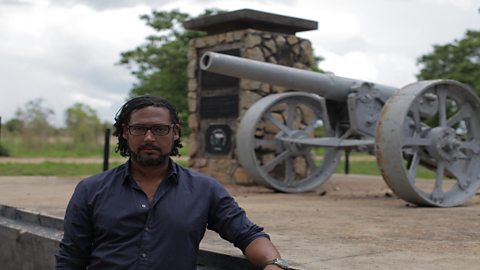
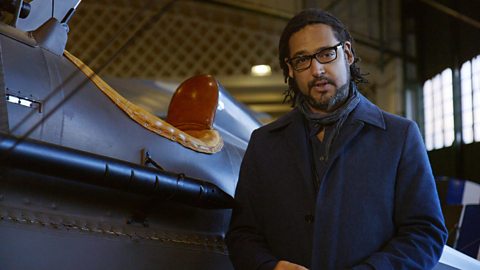
David Olusoga explores the diary of Belgian priest, Father Achiel Van Walleghem, which reveals the diversity of soldiers on the Western Front.
The diary reveals impressions and clues about the lives of soldiers from India and China and this new personal, everyday perspective provides a contrast to official records.
This clip is from the series The World's War.
Teacher Notes
This film could be used to kick-start an analysis of the relative utility of official government records versus personal evidence.
Students could continue by comparing and contrasting examples of both, ideally on the same aspect of the war.
These films are suitable for teaching History at GCSE in England, Wales and Northern Ireland and at National 5 in Scotland.
La Force noire - West African troops in the French army. video
David Olusoga explores the racist theories behind the French-African regiment
Audio evidence from Empire Soldiers in World War One. video
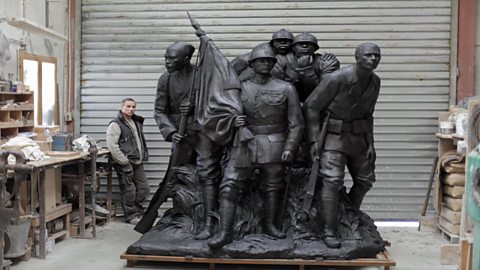
We hear a rare audio recording of Mall Singh, an Indian soldier captured by the Germans.
Different cultural cooperation in World War One. video
David Olusoga explores the experiences of Indian soldiers in World War One.
Indian deserters caught up in a Wartime strategic mission. video
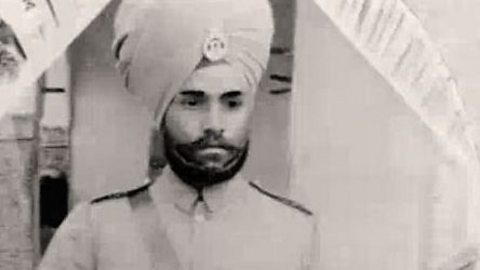
The incredible journey of Jemadar Mir Mast, the British-Indian soldier who risked everything to get home.
Overcoming racial stereotypes in World War One. video
Historian and film-maker, David Olusoga, explores how negative racial attitudes were challenged in France during World War One as new friendships were forged.
The Chinese Labour Corps in World War One. video
David Olusoga investigates the contribution of the least acknowledged group from the Empire - Chinese labourers.
The experience of African American soldiers in Europe in WW1. video
Historian David Olusoga examines the racial prejudice experienced by African Americans in the US Army.
The Indian Royal Flying Corps fighter Ace. video
David Olusoga explores the racial barrier-breaking service of an Indian fighter pilot in the Royal Flying Corps.
The Imperial scope of a European War. video
David Olusoga visits Africa to explore the global scope of the World War One.