Above the blood and mud of the Western Front, the first World War saw the debut of a new form of warfare.
The Royal Flying Corps, which became the Royal Air Force in 1918, played an increasingly critical role in the fighting and a new type of hero was born, the flying ace.
In the summer of 1918, an RAF pilot flying one of these, an SE5A fighter, shot down ten enemy aircraft in the space of just thirteen days, now that’s a kill rate that compares with that with any of the great fighter aces of the first World war.
But this pilot wasn’t British or French or German, he was a 19 year old Indian called Indra Lal Roy.
Indra Lal Roy was born in Calcutta in 1898 to an upper class family.
He moved to London as a boy where he excelled at St Paul’s school, Oxford and a career in the Indian civil service beckoned.
But Indra had other plans, he dreamt of becoming a fighter pilot in the fledgling Royal Flying Corps. But joining up would not be as simple as Indra hoped as Peter Levitt from the Royal Air Force Museum explains.
Peter:
The problem was that if anybody was Asian or Black and interested in joining the flying services before the first World War there was a strong colour bar.
They did not encourage people to join.
There was also a very strict rule against anybody who was not of pure European stock becoming an officer which meant no matter who the Indian was or the African or the Caribbean.
He simply could not be a British officer.
David:
And this was a military regulation?
Peter:
It was enshrined in military and naval law.
David:
But in times of war the rules change.
The casualty rates of the Royal Flying Corps in 1915 and 1916 mean there is a great demand for more planes like this but there’s also a shortage of officers, this is a very critical and fluid moment.
Peter:
This is exactly right.
The casualties in the air are as nothing compared to those on the ground but they are very very severe.
David:
Critically short of men, the Royal Flying Corps was prepared to relax their strict race policy.
Peter:
If there had been no war, Indra Lal Roy would not have been an officer in the Royal Flying Corps, we can say that with certainty if he hadn’t been a public school boy he wouldn’t have been an officer in the Royal Flying Corps.
David:
On this occasion it seemed class was more important to the British than race. But Lal Roy still needed to prove he had what he took to join the exclusive group of fighter pilots.
Peter:
Once he had his commission in July 1917 he was assessed by the Royal Flying Corps and he was sent for training. His hand eye co-ordination was good, he was a good sportsman, he knew how to fly an aircraft.
He was assessed as good enough to be a scout or fighter pilot and they were, they are the elite they can handle their aircraft and they are deemed to have the emotional strength, perhaps the ruthlessness, to kill other men.
David:
In June 1918 Flight Lieutenant Lal Roy was posted to the frontline in France. He and his SE5A were thrown into the frantic fight to drive back the massive German offensive.
So by his skill he put himself very quickly from being a trainee pilot to being in the absolute forefront of one of the most dangerous jobs in the most dangerous moments in the first World War.
Peter:
Absolutely right.
In a sustained period, only 13 days, between the 6th of July 1918 and the 19th July 1918, he shoots down ten German aircraft.
He only flew for 170 hours and 15 minutes to do that, that’s quite exceptional.
And his rate of scoring was such that had he survived then he would be up there with the greats.
David:
So what happened to him?
Peter:
Only three days after his last victory he took off at 8 o’clock in the morning of the 22nd July 1918.
He took off with three other officers, a fight broke out at 16,000 feet with Fokker D7s, two of those German aircraft were shot down and an SE5a was seen to fall in flames.
He didn’t return…
David:
Nineteen year old Indra Lal Roy was buried by the Germans with full military honours in the cemetery of the French village of Estevelles.
Peter:
After the war his mother went to France and it was suggested that he be buried elsewhere but she wouldn’t have it, this is where she said he had fallen in a cause that he believed in.
David:
Indra Lal Roy was posthumously awarded the Distinguished Flying Cross.
Indra Lal Roy’s short life reminds us that this thing we call the first World War is really the story of millions of individual experiences each one of them different.
Here was a young man who went looking for the war, who fought it on his own terms, who emulated his heroes, who broke through the colour bar and who became one of the most deadly air aces on the western front and he did this at a time when it was widely believed that Indians weren’t capable of even running their own country.
Ronald H. Bruce:
"Dear Mrs Roy, I am writing just a short note to try to explain just the sort of real hero your son was. I was in the same squadron and I had the great pleasure and honour to be your son’s friend and admirer for the short time I knew him. He was just wonderful. He wasn’t a fierce fighter by any means, he simply fought with amazing courage and half his thoughts were with the enemy pilots I am sure. He stands alone for pureness, nobleness, courage and most of all modesty."
Video summary
Contains scenes which some viewers may find upsetting. Discussion of racism and discrimination. Teacher review is recommended prior to use in class.
19 year-old Indra Lal Roy broke through the colour bar to become a true war hero.
He was from Calcutta and had attended public school in England and during the war he wanted to join the Royal Flying Corps but it was difficult for him to join up.
Asian and Black people, anyone who was "not from pure European stock", were not able to become British Officers and therefore not encouraged to join the air force.
But during the war, the number of casualties forced a change in rules.
In 1918, he went to the front line in France and in 13 days in July 1918, he shot down 10 German aircraft in his SE5A, before he was killed in a dogfight.
He was buried with full military honours.
This clip is from the series The World's War.
Teacher Notes
This could be used by students to build on their literacy and evidence selection skills.
They could be encouraged to write an obituary for Indra Lal Roy, reflecting his military achievements and his personal achievements as a man who overcame institutional prejudice.
These films are suitable for teaching History at GCSE in England, Wales and Northern Ireland and at National 5 in Scotland.
La Force noire - West African troops in the French army. video
David Olusoga explores the racist theories behind the French-African regiment
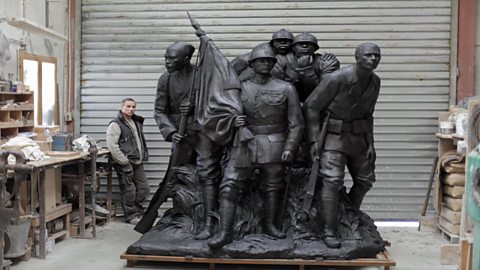
Audio evidence from Empire Soldiers in World War One. video
We hear a rare audio recording of Mall Singh, an Indian soldier captured by the Germans.
Different cultural cooperation in World War One. video
David Olusoga explores the experiences of Indian soldiers in World War One.
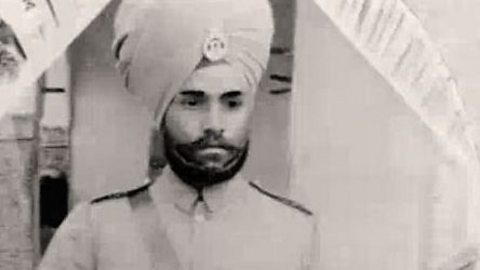
Indian deserters caught up in a Wartime strategic mission. video
The incredible journey of Jemadar Mir Mast, the British-Indian soldier who risked everything to get home.
Multi-cultural Troops. video
David Olusoga explores diary evidence on the diversity of soldiers on the Western Front.
Overcoming racial stereotypes in World War One. video
Historian and film-maker, David Olusoga, explores how negative racial attitudes were challenged in France during World War One as new friendships were forged.
The Chinese Labour Corps in World War One. video
David Olusoga investigates the contribution of the least acknowledged group from the Empire - Chinese labourers.
The experience of African American soldiers in Europe in WW1. video
Historian David Olusoga examines the racial prejudice experienced by African Americans in the US Army.
The Imperial scope of a European War. video
David Olusoga visits Africa to explore the global scope of the World War One.