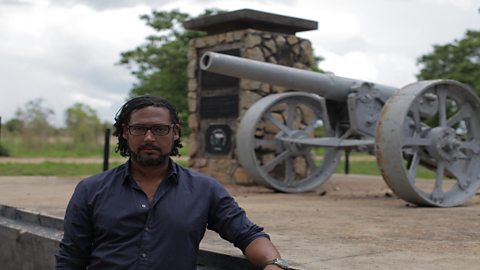
In late summer 1914 the Empires of Europe went to war.
Within weeks thousands of soldiers from British India started arriving here in Marseille in Southern France.
The Indian army was made up of men from all over India, was led by white British officers.
Established to guard the British Raj the India Corps, still in their tropical uniforms, was ill equipped to fight a war in Northern Europe.
But as the German Armies marched across the continent the British needed every soldier they could get their hands on.
The Indians first stop was Marseille’s race course, just outside the city.
Among the thousands of soldiers who were camped out here on the race course at Marseilles was a young Sikh soldier called Manta Singh.
This was the first place that he and the other Indian troops had a chance to get used to their new surroundings, to try to make sense of this strange world into which they had been thrown by the British Empire.
They had a lot to get used to, including learning how to operate the new rifle they had been given with which they were going off to fight a war thousands of miles away from home.
Santanu:
We are usually used to thinking of it as a military clash of empires but what happens when the different empires go to war? Of course they fight and people get killed, but that also means that hundreds of thousands of people are travelling all across the globe in different directions. They’re meeting, interacting, forming bridges, at the same time splintering apart.
And often in such moments, such granular moments that give us insights into the global war.
David:
By the end of October, Manta Singh and the rest of the India Corps had been rushed to Northern France in a frantic attempt to halt the German advance.
The Indian troops now made up a third of the British army.
Manta Singh was thrown into battle near the French village of Neuve Chapelle and ordered to hold the line at all costs.
One of the white officers fighting alongside Manta Singh, was Captain George Henderson, an old India hand.
The two men had become firm friends.
Geoff:
There was fighting going on in the region north of Neuve Chappelle. Captain Henderson went out on patrol. Part of the patrol was going off course.
He signalled…
To that patrol to come back. They didn’t hear him…
He went after that patrol and was shot through both thighs and seriously wounded…
Manta Singh saw this incident and rescued his friend, the story goes with a wheel barrow and took him to safety.
David:
As his friend recovered in hospital Manta Singh returned to the front line, where a new terrible form of combat was setting in.Trench warfare.
The India Corps were among the first to experience the mud and misery of the trenches a life ruled by machine guns, high explosives and gas.
"This is not war." One of them wrote… "This is the end of the world."
In March 1915 the British launched their first major offensive of the war.
The India Corps were in the thick of it, making up half of the attacking force.
Among them was Manta Singh…
The British advance faltered and then collapsed.
More than 4000 Indian soldiers were killed in three days of fighting.
Geoff:
Manta Singh himself was shot through the thigh, we don’t know precisely the circumstances but we do know it was a very very serious injury indeed. Probably more so than his friend, Captain Henderson who unfortunately was shot through both thighs. Manta Singh was brought back to England. The injury was sufficiently serious that they had to amputate his leg. And unfortunately gangrene set in and a few days later Manta Singh died.
David:
Manta Singh’s body was taken here to the South Downs and cremated in accordance with his religious beliefs.
The Chattri Monument marks the spot where more than fifty other Indian soldiers were cremated before their ashes were scattered in the English channel.
On hearing of the death of his friend, Captain Henderson made sure that Manta Singh’s son was cared for and supported.
Remarkably, their sons also served together during the second World War.
And a hundred years after Manta Singh saved Captain Henderson’s life their grandsons carry on this family friendship forged in the world’s war.
Video summary
Contains scenes which some viewers may find upsetting. Teacher review is recommended prior to use in class.
How did the Indian Corps contribute to the Allied Powers on the Western Front?
Historians, David Olosuga, Santanu Das and Geoff Bridger explore the experience of Sikh soldier, Manta Singh, and other Indian soldiers brought over to bolster the British army during World War One.
The Indian Corps made up a third of the British army and they were some of the first troops thrown into trench warfare, where they experienced the full horrors of the front.
Manta Singh went into battle at Neuve Chappelle in 1915, when more than four thousand Indian soldiers were killed in 3 days of fighting.
He became friends with the British army officer, Captain George Henderson, and we hear how Manta Singh rescued Henderson after being shot.
Manta Singh was cremated at the Chattri Monument on the South Downs and the legacy of his friendship with Captain Henderson has continued down the generations in their families.
Teacher Notes
Students could develop their questioning and investigating skills by composing questions for Manta Singh.
These could revolve around his experiences of military training and his curiosity about a foreign, European culture.
Working in pairs, students could then try to answer each other's questions by putting themselves in his shoes.
These films are suitable for teaching History at GCSE in England, Wales and Norther Ireland and at National 5 in Scotland.
La Force noire - West African troops in the French army. video
David Olusoga explores the racist theories behind the French-African regiment
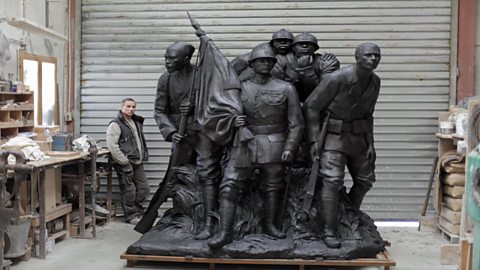
Audio evidence from Empire Soldiers in World War One. video
We hear a rare audio recording of Mall Singh, an Indian soldier captured by the Germans.
Indian deserters caught up in a Wartime strategic mission. video
The incredible journey of Jemadar Mir Mast, the British-Indian soldier who risked everything to get home.
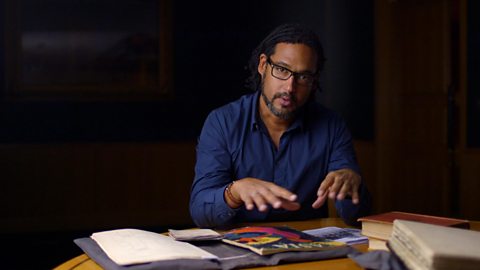
Multi-cultural Troops. video
David Olusoga explores diary evidence on the diversity of soldiers on the Western Front.
Overcoming racial stereotypes in World War One. video
Historian and film-maker, David Olusoga, explores how negative racial attitudes were challenged in France during World War One as new friendships were forged.
The Chinese Labour Corps in World War One. video
David Olusoga investigates the contribution of the least acknowledged group from the Empire - Chinese labourers.
The experience of African American soldiers in Europe in WW1. video
Historian David Olusoga examines the racial prejudice experienced by African Americans in the US Army.
The Indian Royal Flying Corps fighter Ace. video
David Olusoga explores the racial barrier-breaking service of an Indian fighter pilot in the Royal Flying Corps.
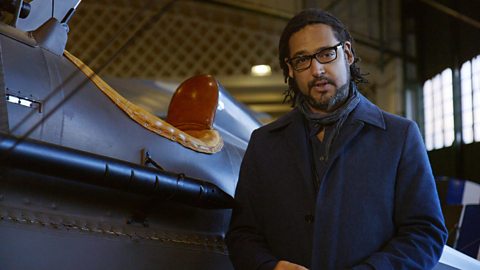
The Imperial scope of a European War. video
David Olusoga visits Africa to explore the global scope of the World War One.