A few miles away from the village of Noyelles-Sur-Mer, not far from the French coast, is a well tended World War One cemetery.
What’s surprising is the men buried here were Chinese civilians.
One of them was Tou Ching Shan or as he was known to the British, 105669. He’s buried alongside more than 800 of his fellow countrymen.
So what are they doing here in a military graveyard in northern France?
Well their story, the story of the Chinese Labour Corp is one of the most forgotten in all of the first World War, but it was their muscle and their ingenuity that kept the wheels of industrial warfare turning.
As the war went on, the armies on the Western Front developed a more and more sophisticated killing machine, capable of industrial scale slaughter.
All it needed was an infinite number of men to feed it.
In October 1916, the British started recruiting Chinese labourers in their thousands to replace the men killed in two years of slaughter.
Initially, these men from China were given the most menial of tasks: digging trenches, humping ammo and burying bodies.
But as the fighting intensified, many found themselves propelled into roles as skilled mechanics on a new military technology making it’s debut in the war.
This is Deborah, a British D51 tank.
In the winter of 1917, she was one of more than 300 of these strange new beasts that lumbered towards the German lines.
Deborah was dug up and recovered eighty years later by her present proud owner Philippe Gorczynski.
For him the story of the tank and the story of the Chinese Labour Corps are inseparable.
So in the first World War this is the most high tech, most complicated piece of machinery on the battlefield.
Philippe:
Yes it was like formula one, it was a new design, modern equipment with an engine, it was the new technology of the of the beginning of the century.
The tanks were submitted to very hard condition of driving but also of fighting so when the tanks went into the action you have to imagine that those inside asked the maximum of their engine, of their tank so as soon as the action was finished the tank has to be completely repaired, re-put into fighting condition.
David:
So for most of its time a tank wasn’t in the hands of soldiers and tank crews, it was with engineers behind the line being repaired and rebuilt?
Philippe:
Yes because I think that every tanks went into the Chinese hands, in fact they were crucial in the involvement of the tank into the first World War.
David:
This was hard work and this was dangerous work but it was also skilled mechanical work.
Philippe:
Yes because it need very careful attention just for the engine, just for the gear box of the tanks, just for all this kind of adjustment, so it needed people who are very careful and very meticulous.
And that was also surprisingly, they have to work on both sides, very heavy and difficult task and also very meticulous work.
They have to work seven day week and sometimes more than ten hours and many of them were suffered from wounds and some were killed.
So it was really hard treatment and always in the middle of the mud, always in the middle of the grease, it was, it was also a kind of hell.
David:
The story of the Chinese Labour Corps did not end with the end of the war. Many, like Labourer Tou Ching Shan stayed on to clear up the mess.
They filled in trenches, recovered bodies, dug cemeteries and carved headstones.
Tou Ching Shan’s grave records his death on the 27th of April 1919, more than five months after the shooting stopped.
He was probably a victim of the Spanish flu epidemic that raged after the war.
There is I think something specially tragic about this place, a Chinese cemetery in the middle of a French farm and most of these men were themselves just farmers from tiny villages and all they wanted to do was to earn some money and see a little bit of the world.
It was their blood, sweat and tears which fed the machine of war.
But all of that, everything they had done, everything they had been through quickly slipped from memory. Of all the many peoples who came to the western front in the first World War, the Chinese labourers are probably the most forgotten of the forgotten.
Video summary
Historian, David Olusoga visits a cemetery in France where more than eight hundred Chinese auxiliaries are buried.
The Chinese Labour Corps is one of the forgotten stories of World War One.
In 1916, the British army recruited thousands of Chinese men to work as labourers.
Some became skilled mechanics working on ‘Deborah’ the British D51 tank.
Many Chinese stayed on to dig cemeteries and carve headstones and some died after the shooting stopped in the Spanish flu epidemic in 1919.
This clip is from the series The World's War.
Teacher Notes
Get students to discuss alternative perspectives of World War One, especially that of non-British troops.
A profile of Do Shing Chan could be constructed from the footage as part of a group task, with other members of the class focusing on others featured in the series.
These films are suitable for teaching History at GCSE and Key Stage 4 in England, Wales and Norther Ireland and at National 5 in Scotland.
La Force noire - West African troops in the French army. video
David Olusoga explores the racist theories behind the French-African regiment
Audio evidence from Empire Soldiers in World War One. video
We hear a rare audio recording of Mall Singh, an Indian soldier captured by the Germans.
Different cultural cooperation in World War One. video
David Olusoga explores the experiences of Indian soldiers in World War One.
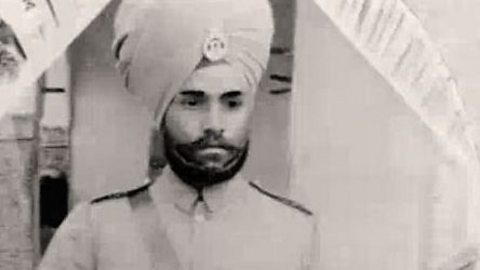
Indian deserters caught up in a Wartime strategic mission. video
The incredible journey of Jemadar Mir Mast, the British-Indian soldier who risked everything to get home.
Multi-cultural Troops. video
David Olusoga explores diary evidence on the diversity of soldiers on the Western Front.
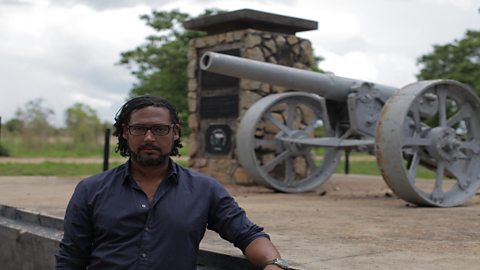
The Imperial scope of a European War. video
David Olusoga visits Africa to explore the global scope of the World War One.
The experience of African American soldiers in Europe in WW1. video
Historian David Olusoga examines the racial prejudice experienced by African Americans in the US Army.
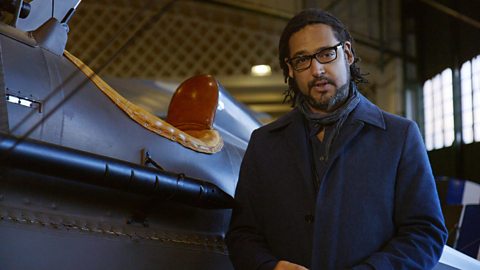
The Indian Royal Flying Corps fighter Ace. video
David Olusoga explores the racial barrier-breaking service of an Indian fighter pilot in the Royal Flying Corps.
The Imperial scope of a European War. video
David Olusoga visits Africa to explore the global scope of the World War One.
