|

| |
Problems without Passports: Interviews
 Listen to programme 4 Listen to programme 4
Read the transcript of programme 4
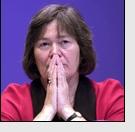 Clare Short was the outspoken and at time controversial Secretary of State for International Development from 1997 - 2003, when she resigned from the Cabinet following the Iraq war. A former Civil Servant at the Home Office, she entered the House of Commons in 1983 as the Member of Parliament for the Midlands constituency of Birmingham Ladywood. Clare Short's main political interests are overseas development, employment equality. Clare Short was the outspoken and at time controversial Secretary of State for International Development from 1997 - 2003, when she resigned from the Cabinet following the Iraq war. A former Civil Servant at the Home Office, she entered the House of Commons in 1983 as the Member of Parliament for the Midlands constituency of Birmingham Ladywood. Clare Short's main political interests are overseas development, employment equality.
Read the transcript
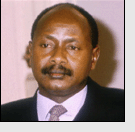 President Museveni fled to Tanzania in 1971 when Idi Amin toppled President Milton Obote, returning in 1980. However, when his party was defeated in elections which he said had been rigged, he formed the National Resistance Army which brought him to power in 1986. Museveni was returned to office in 1996 in Uganda's first direct presidential election, and was re-elected in 2001. He is regarded as a man with a vision and iron determination. He has led the most successful campaign to reverse the spread of HIV / AIDS in all of Africa. President Museveni fled to Tanzania in 1971 when Idi Amin toppled President Milton Obote, returning in 1980. However, when his party was defeated in elections which he said had been rigged, he formed the National Resistance Army which brought him to power in 1986. Museveni was returned to office in 1996 in Uganda's first direct presidential election, and was re-elected in 2001. He is regarded as a man with a vision and iron determination. He has led the most successful campaign to reverse the spread of HIV / AIDS in all of Africa.
 Bono is lead singer of rock band U2 and is a household name around the globe. Bono's involvement with Africa began in 1984 when U2 took part in Band Aid and Live Aid, Bob Geldof's Ethiopian famine-relief efforts. After the Live Aid concert Bono and his wife decided to find out just how bad the African famine was and travelled to Ethiopia to spend six weeks working at an orphanage. In 1999 he joined the Jubilee 2000 movement whose aim was to get the U.S. and other wealthy nations, as well as the World Bank and the International Monetary Fund, to erase the public debt of 52 of the world's poorest countries, most of them in Africa. In 2002 he founded DATA to expand his African agenda to include short-term economic aid, lowered trade embargoes and money to fight aids, in return for democracy, accountability and transparency in governments across that continent. Bono is lead singer of rock band U2 and is a household name around the globe. Bono's involvement with Africa began in 1984 when U2 took part in Band Aid and Live Aid, Bob Geldof's Ethiopian famine-relief efforts. After the Live Aid concert Bono and his wife decided to find out just how bad the African famine was and travelled to Ethiopia to spend six weeks working at an orphanage. In 1999 he joined the Jubilee 2000 movement whose aim was to get the U.S. and other wealthy nations, as well as the World Bank and the International Monetary Fund, to erase the public debt of 52 of the world's poorest countries, most of them in Africa. In 2002 he founded DATA to expand his African agenda to include short-term economic aid, lowered trade embargoes and money to fight aids, in return for democracy, accountability and transparency in governments across that continent.
Read the transcript
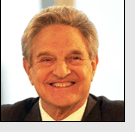 George Soros was born in Budapest, Hungary in 1930 but moved to the United States in 1956, where he began to accumulate a large fortune through an international investment fund he founded and managed. He has been active as a philanthropist since 1979, when he began providing funds to help black students attend Capetown University in apartheid South Africa. Today he is Chairman of the Open Society Institute and the founder of a network of philanthropic organizations that are active in more than 50 countries. These foundations are dedicated to building and maintaining the infrastructure and institutions of an open society. In 2000 the Soros foundations spent $494 million to support projects in education, public health, civil society development, and many other areas. George Soros was born in Budapest, Hungary in 1930 but moved to the United States in 1956, where he began to accumulate a large fortune through an international investment fund he founded and managed. He has been active as a philanthropist since 1979, when he began providing funds to help black students attend Capetown University in apartheid South Africa. Today he is Chairman of the Open Society Institute and the founder of a network of philanthropic organizations that are active in more than 50 countries. These foundations are dedicated to building and maintaining the infrastructure and institutions of an open society. In 2000 the Soros foundations spent $494 million to support projects in education, public health, civil society development, and many other areas.
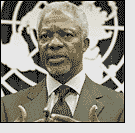 Kofi Annan is the seventh Secretary-General of the United Nations. He took over the job from Boutros Boutros-Ghali in 1997, having served as chief of the UN's peace keeping operations. He is the first is the first black African to hold the post and, together with the United Nations, was awarded the Nobel Peace Prize in 2001. Kofi Annan is the seventh Secretary-General of the United Nations. He took over the job from Boutros Boutros-Ghali in 1997, having served as chief of the UN's peace keeping operations. He is the first is the first black African to hold the post and, together with the United Nations, was awarded the Nobel Peace Prize in 2001.
Listen to the interviewRead the transcript
| | | |
| |
| | |