Soros calls for 'regime change' in US
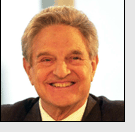 Billionaire philanthropist George Soros has called for an end to the Bush administration ahead of next year's Presidential elections.
Mr Soros - whose Foundation Network has given $1bn around the world to various causes to help tackle poverty and disease - told BBC Radio 4's The UN Or Not? programme that the US would only stop pursuing "extremist" policies if there was a change at the White House.
"It is only possible if you have a regime change in the United States - in other words if President Bush is voted out of power,"
"I am very hopeful that people will wake up and realise that they have been led down the garden path, that actually the September 11 has been hijacked by a bunch of extremists to put into effect policies that they were advocating before such as the invasion of Iraq."
Imposing power
Mr Soros added that there was a "false ideology" behind the policies of the Bush administration.
The US is now discovering that it is extremely painful and certainly costly to go it aloneGeorge Soros
"There is a group of - I would call them extremists - who have the following belief: that international relations are relations of power, not of law, that international law will always follow what power has achieved," he said.
"And therefore [they believe] the United States being the most powerful nation on earth should impose its power, impose its will and its interests on the world and it should do it looking after itself.
"I think is a very dangerous ideology. It is very dangerous because America is in fact very powerful."
He added that he felt US actions in the build-up to the war on Iraq was evidence of the extremist element in the Bush administration.
"Probably President Chirac would not disagree with this philosophy but he is not so powerful - so I am not so worried about what France is doing," Soros said, referring to France's opposition to the war.
"But America being really the dominant power to be in the grips of such an extremist ideology is very dangerous for the world and that is my major concern."
However, Mr Soros added that he felt the rift between America and the United Nations over the war - which Bush referred to as a "difficult and defining moment" for the UN - had in fact strengthened the UN, rather than weakened it.
"I think that the United States has over-reached," he said.
"What happens to extremists is that they go to extremes and the falsehood in their ideology becomes apparent.
"In a democracy the electorate - which is not extremist - will punish them and they know it, so they have to retreat.
"I think there is a good chance that the US will yet turn to a greater extent to the United Nations because they are now discovering that it is extremely painful and certainly costly to go it alone so in the end the outcome may be to strengthen the United Nations."
State interests
Mr Soros was, however, equally critical of the UN as unable to function well as a collective of states.
"The United Nations is not an organisation that is terribly effective in promoting open society because it is an association of states... states always put their national interests ahead of the common interest," Mr Soros said.
"So it is not a very effective organisation for changing condition inside states."
Mr Soros has a history of donating great sums of money to areas in need around the world - but only once has he done this through the UN.
"In Bosnia we gave it to UNHCR - but that was really quite the exception.
"We do interfere in the internal affairs of states, but based on supporting people inside the country who take a certain stance.
"We have actually been quite effective in bringing about democratisation, democratic regime change in Slovakia, Croatia and Yugoslavia, but that's by helping civil society in those countries to mobilise."
Positive response
Mr Soros is highly critical of much government bureaucracy, preferring to make his donations directly to those in need as much as possible.
In June this year he announced he would be drastically cutting back the money he gave to Russia.
And he told The UN Or Not? that cash his fund were pledging to the fight against HIV/Aids would be "more effective" because it was going "only through a governmental organisation."
He conceded too that Bush's policies on the HIV/Aids pandemic were positive.
"There is some response in America, in the Bush administration, to pressure from some of their constituencies - so there is the Millennium Challenge account, the contribution on fighting HIV/Aids," Soros said.
"Those are positive aspects of the Bush administration. I am very supportive of the Millennium Challenge account - this is the new development aid that they are putting in - and I am very supportive and delighted that President Bush is willing to contribute to the global fund on Aids.
"So I am critical on some aspects of the Bush administration but not every aspect - and here I am actually very supportive."







 Listen