Annan presses for UN reform
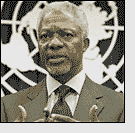 United Nations Secretary General Kofi Annan has told the BBC of his plans to reform the organisation in light of the "difficult and defining moment" it faced over the war on Iraq.
Mr Annan said he acknowledged that the crisis had split the Security Council to the extent it had been impossible to make a decision as one body.
But he said he was "optimistic" about where the UN could go and hinted that the developing world would have a greater say on the Security Council in future.
"There is a need for reform and I think most governments have accepted and recognised it, and we've talked about it ad infinitum in this building," Annan told BBC Radio 4's The UN Or Not? programme.
"We've talked about the need to reform the Security Council, various attempts have been made but they have all failed.
"I think that everybody agrees that the membership and the structure of the council is a bit anachronistic - it reflects the geo-political realities of 1945, and here we are in 2003 stuck with this structure."
Representation
Mr Annan said that the five permanent members of the Security Council - the UK, the US, France, Russia and China - were vastly unrepresentative of the global population as a whole.
As Blix put it, it took us three and half years to gear up and we were shut down in three monthsKofi Annan
"Of the five permanent members, four of them are from industrialised countries," he said.
"Only one, China, you can say comes from the south. What sort of global representation is that?"
And he added that the flaws in the Security Council's decision-making process had been highlighted during the protracted row over whether to go to war in Iraq.
He felt some countries had been able to put pressure on others - particularly those in Africa.
"Luckily Latin America had two important countries on the council - Mexico and Chile - it could have been some other countries," Mr Annan said.
"Africa had Guinea, Cameroon and Angola. They did very well, but sometimes they come under intense pressure.
"The sort of pressure you can bring to bear on some of these countries, you can't bring to bear on South Africa, Nigeria or Egypt."
And he added that the division in Europe - between what became termed "Old Europe" and the UK and Spain - had exposed ever deeper problems with the Council's structure.
"In the end Europe itself was divided, with two of the permanent members from Europe on one side, and UK on the other side - and yet we are all supposed to act in the collective interest," Mr Annan stated.
"So there are lots of questions that people are asking about the way the council is structured and the way it functions."
Optimism
Mr Annan admitted that the entire Iraq crisis was a "depressing period".
"As [chief weapons inspector Hans] Blix put it, it took us three and half years to gear up and we were shut down in three months.
"And of course when that happened and the council wouldn't come to a conclusion, there was a sense of what happens to this organisation - but here there was a debate of the UN being irrelevant, the UN going the route of the League of Nations.
"I personally didn't believe it but it was unfortunate that the council had to be divided because a council is at its most effective when they are united and they have a common position."
However, Mr Annan added that now the flaws had been exposed, they could be corrected - and that he was now much more optimistic about the future of the UN.
"Now we are beginning to pick up the pieces and I think the rift is beginning to heal.
"I am an optimist by nature and also I am optimistic because of the facts, because of what has happened.
"In a way, Iraq has more or less driven home to leaders around the world that the UN is a precious instrument, the UN is important."
He pointed out that only two years previously, the UN had won the Nobel Peace Prize and had begun pushing forward its Millennium Goals project - an initiative to tackle issues such as disease, lack of education and the water crisis worldwide.
"Quite frankly there are lots of issues that no one country, no matter how powerful, can deal with alone," Mr Annan stressed.
"The issues that we are confronted with, from terrorism, to weapons of mass destruction, to so called new threats - where they are the hard threats or the soft threats of depravation and poverty - we need to work across borders to be able to cope with them."
Needing the UN
Mr Annan commented further that in the future he felt the UN would only become more important.
He pointed out that even the countries described by US President Bush as being on the "axis of evil" were being threatened primarily with UN action.
"There is a tendency for people to think that it is only the small countries and the medium sized countries who need the UN," he said.
"The big countries need the UN too. The same time that the UN was being knocked, the US kept telling Korea, we will take your case to the UN.
"Not only that, on the question of Iran, they say let the [UN] Atomic Agency and the others come in and do it."
And he said that because the UN was no longer involved in the hunt for weapons of mass destruction in Iraq, the search would continue to lack credibility.
"I know that we have the British and American scientists looking for weapons in Iraq. They may find them, they may not find them," he said.
"But even if they find them would they be credible? Some argue maybe not - if they do, they are not UN inspectors."









 Listen