 |

| |
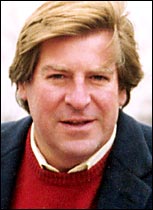 Edward Stourton was born in Lagos, Nigeria in November 1957. Educated first at Ampleforth College and then at Trinity College, Cambridge, he took a degree in English Literature before joining ITN as a graduate trainee in 1979. Edward Stourton was born in Lagos, Nigeria in November 1957. Educated first at Ampleforth College and then at Trinity College, Cambridge, he took a degree in English Literature before joining ITN as a graduate trainee in 1979.
He was a founder member of Channel Four News in 1982, working as a scriptwriter but adding producer, duty home news editor and chief sub-editor to his duties. Edward reported from Beirut for the first time in 1983 and spent most of the next decade covering foreign news.
In 1986, he was appointed Channel 4's Washington Correspondent covering the final years of the Reagan presidency and the 1988 presidential campaign. He also presented special programmes on the Iran-Contra scandal.
1n 1988 Stourton joined the BBC as Paris Correspondent. In 1990 he returned to ITN as Diplomatic Editor, and during his three years in the job he reported from Baghdad during the Gulf War, from Bosnia during the siege of Sarajevo, from Moscow in the final days of the Soviet Union and from Europe throughout the negotiations leading up to the Maastricht summit.
In 1993 he returned to the BBC to the One O'clock News, which he presented for six years. He has also presented editions of Assignment and Panorama, and the phone-in programme Call Ed Stourton on Radio 4. His current affairs work for Radio 4 includes the series The Violence Files, Asia Gold and Global Shakeout. Asia Gold won the Sony Gold for current affairs in 1997.
In 1997 he presented Absolute Truth, a landmark, four-part series for BBC2 on the modern Catholic Church and wrote a book to accompany the series.
In January 1999 he joined the presentation team on the Today programme and in August 1999 he additionally became the BBC2 World Affairs Strand Correspondent, which he presents from the field.
In addition, he has written and presented several high profile radio and television programmes on world events since September 11th, including the highly acclaimed series The Diplomatic Jigsaw and a follow-up on BBC 2, transmitted shortly after the start of the war in Iraq.
| | | |
| |
| | |







 Listen