|

| |
The Lessons of History
 Listen to programme 2 Listen to programme 2
Read the transcript of programme 2
The history of the United Nations provides a telling backdrop to the events of the past year.
The history of the relationship between the United Nations and the United States has never been straightforward. As with the League of Nations, America played a vital role in the foundation of the UN - the name 'United Nations' was even coined by President Roosevelt in 1941 to describe those countries fighting against the Axis.
But there were bound to be conflicting interests between a world body representing so many different views and interests and a self confident superpower with a vision of its own.
Edward Stourton looks back over key points in the UN's history from the founding of the UN in 1945, through the stagnation of the Cold War and the optimism of the nineties to the crises of Somalia and Kosovo.
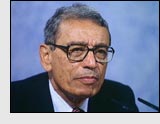 There are contributions from Sir Brian Urquhart (who joined the UN at the beginning in 1945 and was personal assistant to the first Secretary General), Dr Jeane Kirkpatrick (Ronald Reagan's ambassador to the UN during the Cold War), James Baker (former Secretary of State at the time of the first Gulf War), Boutros Boutros Ghali (UN Secretary General between 1992-1996) and Madeleine Albright (Secretary of State in the Clinton administration, during the crisis in Kosovo). There are contributions from Sir Brian Urquhart (who joined the UN at the beginning in 1945 and was personal assistant to the first Secretary General), Dr Jeane Kirkpatrick (Ronald Reagan's ambassador to the UN during the Cold War), James Baker (former Secretary of State at the time of the first Gulf War), Boutros Boutros Ghali (UN Secretary General between 1992-1996) and Madeleine Albright (Secretary of State in the Clinton administration, during the crisis in Kosovo).
Eyewitness accounts of events are provided by Archie Mackenzie (British spokesman at the signing of the UN Charter in 1945), Vladimir Petrovsky (Kruschev's head of protocol when the Soviet President banged his shoe on the table at the UN in 1960) and Bernard Kouchner, (founder of Medicins Sans Frontiers and the UN Secretary General's former special representative in Kosovo).
| | | |
| |
| | |