|

| |
Problems without Passports
 Listen to programme 4 Listen to programme 4
Read the transcript of programme 4
In 2001, Nelson Mandela asked "Will the legacy of our generation be more than a series of broken promises?"
In the final programme in the series about the future role and relevance of the United Nations, Edward Stourton looks at the work of the UN in fulfilling the promises the developed world has made to Africa, fighting against 'problems without passports' - the global concerns of famine, disease, poverty and threats to the environment.
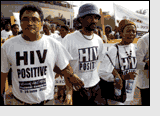 At a time when the United States of America seems to be favouring unilateral aid programmes - earlier this year President Bush announced a $15 billion US initiative to fight HIV / AIDS in Africa and the Caribbean - this programme questions the future for multilateral action in the field of humanitarian work. At a time when the United States of America seems to be favouring unilateral aid programmes - earlier this year President Bush announced a $15 billion US initiative to fight HIV / AIDS in Africa and the Caribbean - this programme questions the future for multilateral action in the field of humanitarian work.
But does the money and aid from individual governments or wealthy businessmen get to the people who most need it more quickly if channelled outside the bureaucracy of the UN?
Or, in a continent where nearly half the population are living below the international poverty line of $1 a day, is a co-ordinated, multi-national effort the only way of delivering results, rather than more broken promises?
The programme examines whether the United Nations is making progress on the ground in attaining its Millennium Development goals for Africa, the challenge Secretary General Kofi Annan threw down to the world at the turn of the century.
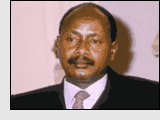 It reports from Uganda about the amazing success the country has enjoyed in dramatically reducing HIV / AIDS infection rates and questions the President, Yoweri Museveni, about the UN's role in achieving this success. It reports from Uganda about the amazing success the country has enjoyed in dramatically reducing HIV / AIDS infection rates and questions the President, Yoweri Museveni, about the UN's role in achieving this success.
The Ugandan government and the UN have also joined forces in an innovative programme to develop the private sector economy as part of the long-term goal of eradicating poverty.
In Kenya the programme visits a primary school in the largest slum area in sub-Saharan Africa where class sizes have risen to over one hundred and twenty since the introduction of free primary education - another of the UN's Millennium goals. And the programme hears about a new role for the UN, working at the heart of government, to help them rid the public service of the scourge of corruption.
Rock musician and campaigner Bono tells the programme that "given the malaise of poverty and illness that affects so much of the world's population, a global mechanism like the UN would have to be invented if it didn't already exist".
Other contributions include President Museveni (Ugandan President), international financier George Soros, and Kofi Annan, the UN Secretary General.
| | | |
| |
| | |