Women dey get angrier?
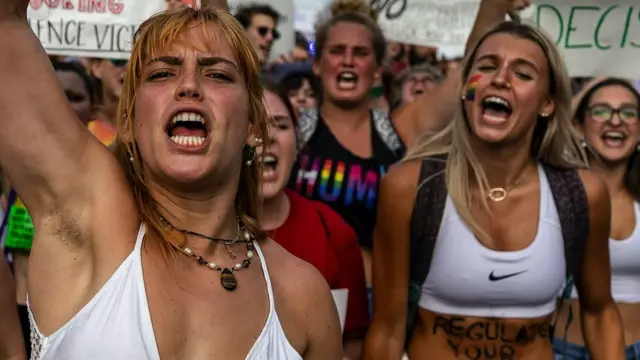
Wia dis foto come from, Getty Images
- Author, Stephanie Hegarty
- Role, Population correspondent
One annual poll by Gallup suggest say women, on average for world, don dey get angrier since di past 10 years. Why e be like dis?
Two years ago Tahsha Renee bin dey stand for her kitchen wen one deep, dark, deep scream comot from her lungs. E surprise her.
"Anger always be emotion wey easy for me to tap into," she tok. But dis no be like anytin wey she bin feel before.
Na during di pandemic and she say di tin don do her. She bin spend di first 20 minutes dey waka around her house as she bin dey list out loud, everytin wey make her angry.
But afta di the scream she fell one intense physical release.
Since den, togeda wit her partner Jacquelynne Faith, Tahsha don dey gada women from all over di world on zoom for sacred rage healing, to talk about everytin wey dem make dem angry and den scream am out.
For many of di women wey don participate, e dey transformative.
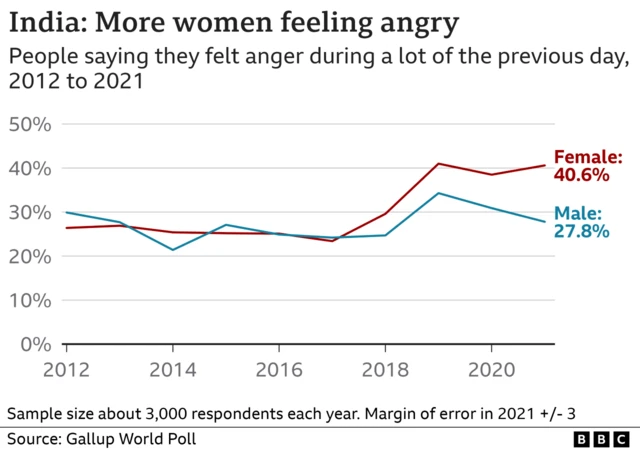
According to one BBC analysis of 10 years of data from di Gallup World Poll, women dey get angrier.


End of Di one wey oda users dey read well well
Every year di poll dey survey more dan 120,000 pipo for more dan 150 kontri asking, among oda tins, which emotions dem dey feel a lot of di previous day.
Wen e come to negative feelings in particular - anger, sadness, stress and worry - women consistently report feeling dis these more frequently dan men.
Di BBC analysis find say since 2012 more women dan men dey report feeling sadness and worry, though both genders don dey steadily trend upwards.
Wen e come to anger and stress however, di gap wit men dey get wider. For 2012 both genders report anger and stress at similar levels. Nine years later women dey angrier - by a margin of six percentage points - and more stressed too. And e get one particular divergence around di time of di pandemic.
Your device may not support this visualisation
Dis no surprise Sarah Harmon, one therapist for di US. For early 2021 she get a group of female clients togeda to stand for one field and scream.
"I be mom of two young kids wey bin dey work from home and I bin get dis intense, low-grade frustration wey bin dey build to complete rage," she say.
A year later she go di field again. "Dat na di scream wey go viral," she tok. One journalist pick am up for one of her online mum groups and suddenly reporters dey call from all over di world.
Sarah believe say she tap into sometin wey women dey feel, intense frustration say di burden of di pandemic dey fall excessively on dem.
One 2020 survey of almost 5,000 parents for heterosexual relationships for England, by di Institute for Fiscal Studies, find out say mothers dey do more of domestic responsibilities during lockdown dan fathers.
As a result, dem bin reduce dia working hours. Dis bin be di case even wen na dem dey earn more money for di family.
For some kontris di difference in di number of women and men wey say dem feel anger di previous day dey much higher dan di average for world.
For Cambodia, di gap bin be 17 percentage points for 2021 while for India and Pakistan na 12.
Psychiatrist Dr Lakshmi Vijayakumar believe say dis na result of tension wey dey occur as more women for dis kontris don become educated, employed and economically independent.
"At di same time, dem dey tied down archaic, patriarchal systems and culture," she tok. "di disconnection patriarchal system for house and di modern woman outside di house dey cause a lot of anger."
Every Friday evening for rush hour for Chennai for India, she witness dis dynamic in action.
"You go see di men dey relax, going to tea shop, smoking. And you go see women dey hurry go bus or train station. Dem ey tink about wetin to cook. Many women dey begin cut vegetables inside train as dem dey go home on di train."
Before, she say, e bin no dey proper for women to say dem dey angry, but dat don dey change. "Now dem get a little bit more ability to express dia emotions, so di anger dey more."

Progress for Women?
Each year di BBC 100 Women dey list names of 100 inspiring and influential women around di world.
Dis year e dey honour di progress we dem don make since di first list, 10 years ago - so di BBC commission Savanta ComRes to ask women for 15 countries to compare di present wit 2012.
- At least half of women wey dem survey for each kontri say dem feel more able to make dia own financial decisions dan 10 years ago
- At least half for each kontri except di US and Pakistan also feel say e easier for women to discuss consent wit dia romantic partner
- For most kontris, at least two-thirds of women wey dem survey say social media make positive impact on dia life - though for US and UK di figure bin dey under 50%
- For 12 out of 15 kontris 40% or more of women wey dem survey say freedom to express dia views na area for dia life wey don progress most in di last 10 years
- 46% of di women wey dem survey for US feel say e dey harder for women to access medically safe abortion dan e bin dey 10 years ago
Di pandemic effect on women work fit also dey get impact. Before 2020 women participation for work bin get slow progress, according to Ginette Azcona, one data scientist for UN Women. But for 2020 e hang. Dis year di number of women wey dey work dey below 2019 levels for 169 countries.
"We get sex-segregated labour market," US-based feminist author Soraya Chemaly, wey write about anger for her 2019 book, Rage Becomes Her, tok.
She see much of pandemic related tiredness dey happun to female-dominated industries like care.
"Na pseudo-maternal work and di pay poor. Dis pipo register very high levels of repressed, suppressed and diverted anger. And e gt a lot to do wit wi di expectation say dem suppose work tirelessly. And wit no kind of legitimate boundaries.
"Similar tin dey occur most times for heterosexual marriage," she tok.
·For US, dem don write many tins about di burden of di pandemic on women but results from di Gallup World Poll no indicate say women dey angrier dan men.
"Women for US feel very deep shame about anger," Soraya Chemaly tok, and dem dey more likely to report dia anger as stress or sadness.
Perhaps significantly, American women dey report higher levels of stress and sadness dan men.

Wia dis foto come from, Getty Images
Dis na true for oda places too. Many more women dan men say dem dey stressed for Brazil, Uruguay, Peru, Cyprus and Greece. For Brazil almost six in 10 women say dem fey feel stressed most of di previous day, compared wit just under four in 10 men.
But Tahsha Renee tink say many women for US and oda places don now reach di place wey dem dey able to say, "No more!"
"In a way dat dey actually help change occur. And dem dey use dia anger to do dat," she say.
"You need rage and anger," Ginette Azcona for UN Women agree. "Sometimes you need dis, to shake tins up - and get pipo to pay attention and listen."
Data journalism by Liana Bravo, Christine Jeavans and Helena Rosiecka
Additional reporting by Georgina Pearce, Rebecca Thorn, Valeria Perasso and Lara Owen