BBC Pop Up’s US road trip: Local stories, global audience, licence to experiment

Matt Danzico
is head of the BBC’s Video Innovation Lab. Twitter: @mattdanzico
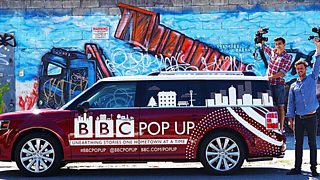
BBC Pop Up’s six-month journey around the US came to an end a little over a week ago. Staffed solely by video journalists, the team created our first ‘mobile BBC bureau’ to experiment with style, audience engagement and the creation of local stories for a global audience.
The Pop Up team relocated to a new city each month, producing a monthly half-hour programme for BBC World television and the BBC News Channel as well as dozens of five-to-seven-minute independent features for the BBC News online.
Our story ideas were crowdsourced, taken directly from suggestions by local residents that the team spoke to in each region. The journalists’ aim was to act as the conduits through which towns across the US could tell their stories to BBC News’s global audience. From stories about rape on college campuses to the closure of a coffee house in Baton Rouge, a range of stories were covered - big and small.
The project was a joint venture between BBC US online and BBC World television. And from day one we wanted to be as transparent as possible about this project. That is why we have been documenting the trip in full on Tumblr and our blog.
One of our first posts openly discussed the stack of names we were considering for the programme, while another early post saw us sketching out ideas for our car.
Why this level of transparency? BBC Pop Up was conceived as an experiment. Benjamin Zand and I had been working in the Video Innovation Lab in London - a unit that experiments with new types of programming - and we wanted to create a series that explored audience engagement on a hyper-local level, while attempting to grow our viewers in North America.
The team
The BBC has a growing collection of video journalists who film, report, edit and produce stories entirely by themselves. These one-man bands are unlike traditional news or documentary crews. Rather, they are trained in every aspect of video journalism, from conceiving a story or documentary to the final product. Through BBC Pop Up, we wanted to see what would happen if we gathered these DIY-ers together as a team under one project.
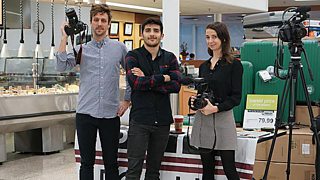
Although Benjamin Zand and I (pictured top image, crowdsourcing in Boulder, Colorado) were the permanent members of the team, we saw five other extremely talented BBC video journalists sweep through for short periods, including Anna Bressanin, Jack Garland, David Botti and Franz Strasser. In addition, one BBC World Service radio producer and one on-camera reporter visited the mobile bureau.
There were three permanent video journalists (VJs) in our original plans. But scheduling issues meant the team was staffed by two permanent VJs and a rotating position, which in the end actually helped enliven the programme with fresh thinking.
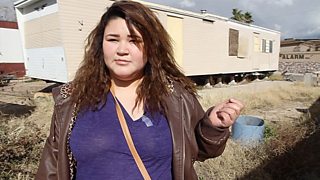
Anna (pictured above with me, left, and Benjamin in a South Dakota supermarket to canvas shoppers about local issues) visited the bureau multiple times and created a significant amount of content. Her report on trailer parks in Tucson, Arizon (below) remains one of my favourites from the entire trip.
In the end Benjamin and I were responsible for around 80% of the videos produced over the six-month period. Not having another full-time VJ did increase our workload significantly, but the slack was also picked up in other ways by the Washington bureau, which helped by securing interviews and doing research.
As a two-member crew, Benjamin and I spent 10 hours a day, sometimes seven days a week, working together. Our relationship could have been the downfall of the project had we not already been friends. A solid relationship with colleagues is essential when working for long stretches together on the road.
We also worked closely with our editor in Washington who oversaw each piece of content from the field, editing videos we sent him privately on Vimeo before making them live on the website.
The output
In 197 days, our rambling band of journalists travelled through 19 of the 50 US states, living for a month at a time in six of them. All in all the crew created more than 50 glossy videos, of which 46 were full-feature reports and seven behind-the-scenes video shorts.
Our primary goal in each location was to create two or three video features as well as an intro and outro video of our visit. At the end of each month a handful of stories were compiled into a monthly documentary programme for BBC World. But we shot much more than that. A host of other material like blog posts, live television interviews, tweets, Instagram photos and other supporting material were created.
Four community meet-ups (similar to town halls) were also organised to gather story ideas and discuss. And free journalism workshops were taught throughout the US at seven universities, one middle school and a newspaper.
This is the breakdown of content produced:
- 51 online videos (the majority also played on television)
- 7 half-hour television documentaries for BBC World and BBC News Channel
- 213 blog posts (both short and long)
- 1,702 tweets
- 270 Instagram photos
- 18 journalism classes taught.
We quickly realised that the project forced us to always be ‘on’. So in our free time we had dinner or coffee with our neighbours to discuss local happenings, and we offered journalism workshops after hours in the community - all of which was aimed at establishing our presence in the towns we visited.
We also created far more behind-the-scenes shorts as the months went on, diving more into the cultural aspects of the communities rather than creating features we knew wouldn’t make the monthly documentary.
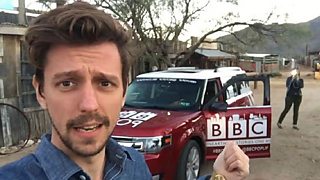
Examples of our shorts included a tour of an Arizona ghost town (below), an explainer on Thanksgiving and a tour through a local haunted house. Some of these videos ran on the website but others were just posted on social media.
Video style
Like any good experiment, there were successes and failures. Pop Up was created to experiment with engagement, but we also wanted to test new storytelling formats. We didn’t, however, experiment with style nearly as much as we had originally intended. This was perhaps one of the failures of the trip.
Early on we created reporter-less videos that looked like traditional documentaries. But as the months ticked on we began inserting ourselves into our stories to help give them a more natural feel.
We felt it wasn’t always obvious that Benjamin and I were the ones actually filming and editing the stories. So we started appearing in our own videos and bringing our voices from behind the cameras into our reports. This format still didn’t push the boundaries of video style as far as we’d wanted.
In part two of this blog BBC Pop Up bureau chief Matt Danzico assesses the strategy behind the project and reveals more lessons learned.
Why mobile video news on Instagram is a fashion we can’t ignore
#BBCTrending’s first question-and-answer session just had to be on Twitter
Engaging social media audiences
How to be a digital innovator: BBC Trending
Digital innovation: Producing video for online and TV
SocialMediaWhatsTrending - journalism’s brave new world?
Line between online news video and TV news is blurring
BBC News Labs: The story’s all about making connections
Small communities can have a big impact on your journalism
Will anyone keep appointments to view in an on-demand world?
