Why mobile video news on Instagram is a fashion we can’t ignore

Matt Danzico
is head of the BBC’s Video Innovation Lab. Twitter: @mattdanzico

Centuries ago Vecinza was a much stronger cultural hub of Italian fashion, as were Genoa and Naples. But most fashion professionals in the country have since migrated to Milan or Rome. It’s beneficial to be located close to the geographic heart of an industry. That proximity offers community, eyeballs and opportunity.
These benefits have been evident not only in fashion but in literature and manufacturing. Take Ernest Hemingway, F Scott Fitzgerald and other writers of the 'Lost Generation' in Paris in the 1920s. Or Henry Ford and General Motors founder Billy Durant in Detroit during the first decade of the 1900s.
These were bubbling epicentres of creativity for these industries. Milan and Rome have become centralised hubs for Italian fashion in the last half a century, much in the same way Detroit became a centralised hub of automotive production during Ford’s time.
So why make these points in a blog about creating video for mobiles?
Similar to these past migrations, the internet has in the past decade seen an ever-increasing shift of early adopters from websites to apps. One example could be seen in the relocation within the photography community from web-based Flickr.com to app-based Instagram.
In fact many new internet users are now choosing to purchase mobiles over personal computers, fuelling the growth of the app market. The process is called 'leapfrogging' and has both rapidly and inexpensively reduced the internet access gap while simultaneously slowing the growth of PC sales.
PC shipments fell a record 10% last year, according to several research firms. And experts warn that the PC is taking the world wide web down with it simply because mobile and tablets rely more upon self-contained apps.
The US market now spends more than a fifth of its media consumption time on mobiles, a great portion of which is spent participating in online communities, according to mobile research group BI Intelligence. That’s as much time spent on mobiles as spent on PCs and laptops.
Mobile photo and video app Instagram alone boasts more than 150 million active monthly users, while video and photo-ready chat service WhatsApp - which has just been snapped up by Facebook for $19bn - has a whopping 400-450 million active monthly users. Snapchat and Vine claim 30 million and 40 million respectively.
And similar to the Milan, Paris and Detroit of the past, these mobile applications are hubs where conversations are helping to evolve industries like fashion, art and technology, albeit digitally.
In the years before social media emerged, much of the web represented a fragmented, decentralised network - one without a core where ideas floated in the ether and were found through search or serendipity on PCs.
But like Myspace and Facebook did before them for the social web, mobile applications like Instagram and Vine, or chat applications like WhatsApp and Line, are helping to centralise mobile use. They are the new Milans and Romes of the internet - hubs for mobile users. And many of these apps, where users are gathering in droves, have strong video components.
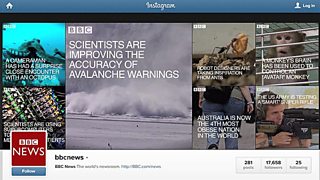
More than 40% of adults online use multiple social networking sites, says Pew Research. And Instagram users on mobiles are nearly as likely as Facebook users to check the service on daily. While Facebook showed a 3% drop in user growth in 2013, Instagram was up 23%, according to a report by the GlobalWebIndex.
In 2010, former Wired editor-in-chief Chris Anderson predicted the demise of the web in his article The Web is Dead. In the four years since many of his predictions about building content “right into the mobile operating systems” have become reality as these communities have developed on mobile.
The BBC has recently started creating bespoke video for mobile and social platforms. That content has taken the form of a Twitter-centric programme called #BBCtrending and an Instagram series with the temporary name Instafax. The latter is an experimental video news service for mobile applications that was developed by the BBC's Video Innovation Lab. We release three-to-four Instafax stories a day on the day's headlines and features.

The videos typically feature text laid on top of a square video frame, with stories often set to music or ambient noise. We don't use a voiceover because a large majority of mobile users watch content on mute. Adding a voiceover would also slow the production process.
For us the key to Instafax is refining the creation process so that it's extremely efficient and requires minimal effort, while maximising what the company already has: some of the world's greatest video from around the globe and tightly written news stories.
But these programmes only represent the beginning. We are only just now arriving in these mobile cities and are setting up our first shops and forming our first friendships with those who are already established. The challenge now becomes how to scale these video offerings quickly in many of the other hubs across the greater expanse of the internet, while suffering cuts across the organisation as large media grows increasingly unstable.
I see the backbones of these news series as ones that can be flexed to fit more mobile spaces where news outlets have yet to move, so that we may help create the ethos of the environments as they grow.
To continue the metaphor, the BBC as a broadcaster is in many ways only now collecting itself and starting to migrate. With any luck we will soon be geographically a bit closer to the video consumers of the 21st century - for that’s where we will find new opportunity.
Matt Dansico took part in a panel discussion on short-form video at the News Rewired conference in London on 20 February #newsrw.
BBC News Labs: The story’s all about making connections
#BBCTrending’s first question-and-answer session just had to be on Twitter
Investigative apps are useful tools for journalists, if rough around the edges
