College of Journalism
Posts
A new social media guide for journalists, built with a busy reporter in mind
Cordelia Hebblethwaite
of BBC Newsnight is author of The Social Media Reporter
Anyone who doubts the power of social media should spend a few minutes standing in the headquarters of the analytics company Banjo, as I did in the spring of 2015.
In a small air-conditioned room in Las Vegas, a few miles from the famous Strip, a bank of monitors show events unfolding in real time on social media around the world.
Giant spikes shoot from a spinning globe, indicating areas of unusually high social media activity. Another screen shows all the fires breaking out around the world, detected using image recognition technology.
Social media analysis can be super advanced like this, or extremely low-fi. And there are lots of free and simple tips and tools that can help (indeed Banjo themselves offer a free version of their service for journalists).
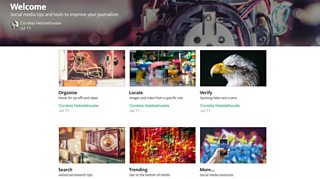
A couple of weeks ago, I finally hit publish on The Social Media Reporter (above). It’s a free online guide for journalists that aims to demystify social media and provide practical, concise tips for navigating through the sea…
Meet the new blog, same as the old blog
Charles Miller
edits this blog. Twitter: @chblm
Sharp-eyed readers may have noticed a new announcement under the turquoise typewriter to the right. Yes, this blog has moved.
We had an offer accepted on a vacant blog: no chain, plenty of room to grow, all bathrooms en suite.
But seriously.
Over the past few months we’ve expanded the remit of this blog, from its original journalism brief to the whole of the BBC Academy’s agenda – including broadcast, production, online and technology.
To reflect that we’re moving from this, our old College of Journalism site, to a new address, consistent with our new interests:
The good news is that you probably won’t know anything’s changed. It looks exactly the same and all our current and past blog posts are there. And we’ll be carrying on publishing blogs without missing a beat.
To find older posts, including from earlier in 2016, click the relevant year under ‘College of Journalism blog posts’ in the right hand column.
This blog homepage will stay as it is, frozen in time. Unless we get a decent offer for it from another blog of course.
How journalists can use apps and bots to increase productivity and engagement
Laura Taflinger
Digital content producer, BBC Academy
These days, the success of a newsroom depends on rapid reporting and the ability to find and utilise online data quickly.
Many media organisations use real-time messaging services and other efficiency tools to help staff communicate with each other and quickly get news online. But in an era of instant news and ever-increasing data, what more can journalists do to work effectively? Can another app or software programme truly support news reporting?
At the recent ReThink conference for Digital Cities Birmingham, Slack account executive Alia Lamaadar claimed that all media companies are now in the business of technology. She argued that by harnessing technology such as bots, journalists can further improve their reporting and reach larger audiences.
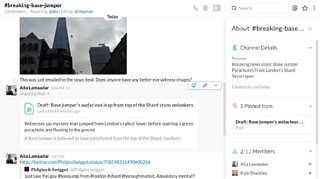
“Media has always had to be attuned to an audience and be receptive to trends as they happen,” she said. “The teams that I’ve worked with in media are definitely the most innovative – they embrace their role as content creators and as technologists.” (An example of how reporters and editors can use a Slack channel for breaking news is shown below.)
What it's really like when your video goes viral
Marc Settle
specialises in smartphone reporting for the BBC Academy
This is the story of how I made a viral video with just two pieces of train track, and the lessons I learned from it about traffic-hungry news websites.

It all started so innocently. My two year old son Leo has an impressive collection of wooden train tracks. Once he’s in bed, I tidy up his playroom.
Usually I just put the train set away any old how, but this time I decided to stack the…
360 video in news: Not just watching, but experiencing
Charles Miller
edits this blog. Twitter: @chblm
We were in an anonymous modern campus in Birmingham for a conference. But by clicking a smartphone into a headset and strapping it on, several of the digitally uninitiated found themselves in the presence of a 12-year old girl in a Syrian refugee camp in Jordan.
Sarah Jones, deputy head of media at Coventry University was at the Digital Cities conference to talk about 360 video in news coverage. It was her headset that the newbies were allowed to try. They emerged blinking into the daylight and talked about it in a different way from ordinary film: “You feel as if you were actually there...…
Why telling the “full story” of Islamic State group was my toughest assignment yet
Jim Muir
BBC correspondent, Middle East

Jim Muir’s 11,000-word explainer Islamic State group: The full story is the longest article the BBC News website has ever published. It’s epic, with engagement levels to match. Here’s how he tackled his “monster”:
It was a Friday in January and my phone rang in Baghdad, where I was on assignment. It was my regional boss, Richard Colebourn. Would I be interested in doing a big online take-out on…
Is this a smiley face which I see before me - or is #ShakespeareMe a whole new way to discover the Bard?
Cathy Loughran
is an editor of the BBC Academy blog
What would Shakespeare have made of social media? In particular, would our greatest writer have been a fan of emojis? Discuss.
Henry V Act 3, Scene 1
Predictably, perhaps, some critics have already had their say about the ShakespeareMe interactive feature, launched today on the experimental BBC Taster site as part of the much wider BBC Shakespeare Festival.
It invites users to choose emojis to reflect their mood and get…
Fictional story, real emotions: How The Archers’ audience was shaken and stirred
Nickie Latham
is social media lead for The Archers
For more than two years, The Archers has been telling the story of Helen and Rob. In that time, Radio 4 listeners have been party to a truth that few who live in the quiet village of Ambridge had uncovered - that Helen has been systematically abused by her husband Rob.
On Sunday 3 April, listeners were shocked when Helen stabbed Rob after her attempt to leave turned to violence.
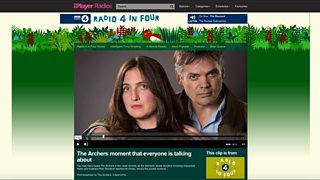
I knew it was…
My journey from boffin to broadcaster and the struggle to ditch the sub-clauses
Sarah Dillon
University of Cambridge lecturer and BBC Radio presenter
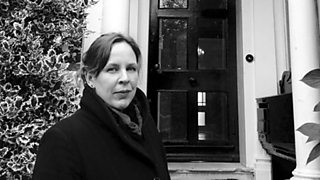
Sarah Dillon in a promotional image for BBC Radio 3's Literary Pursuits series
As well as lecturing in literature and film, Sarah Dillon presents the Close Reading feature on BBC Radio 4’s Open Book programme and BBC Radio 3’s documentary series Literary Pursuits, which returns on Sunday 29 May. Her double life is a balancing act, she says, between two very different worlds:
I always seem to be in entirely inappropriate situations when I receive life-changing professional…
What can the Commonwealth do for journalists?
William Horsley
is international director, Centre for Freedom of the Media
Former BBC News correspondent William Horsley, who works on policy initiatives to safeguard freedom of expression, reports from a meeting of the Commonwealth Human Rights Initiative in London last week.
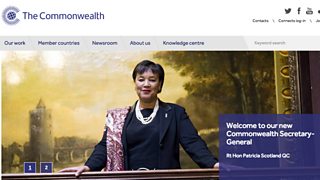
The Commonwealth website
How can the Commonwealth confront the repression – and in some cases forceful oppression - of independent and critical journalists in some of its member states?
This week Patricia Scotland, a…