Digital news in 28 languages, driven by ‘mobile-first’: No-one said it was easy

Dmitry Shishkin
is digital development editor, BBC World Service Group. Twitter: @dmitryshishkin
BBC World Service has been doing news in languages other than English for decades. Its digital presence has existed since 1997 and currently the portfolio consists of 28 foreign languages,reaching about 80 million unique browsers a month.
The task of my team is to manage digital development of the languages we offer and drive their digital strategy, sitting on the intersection of creative and technical initiatives.
Over the past few years we have seen a few major digital publishers - CNN, NYTimes, WSJ, the Guardian, Huffington Post - developing their non-English news offer. In the first of two posts, I will share a few of the key things I’ve learned over the past four years:
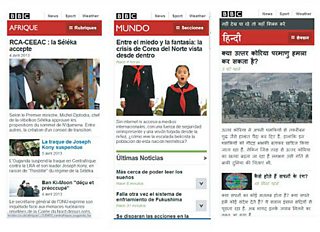
A news service in this many languages is a juggling act
When you run a portfolio of 28 digital entities, you find yourself constantly prioritising. With finite resources, it’s impossible to get everyone what they wish to have, so, together with my counterpart from the product team, we prioritise very hard.
Such prioritisation lists could be very different depending on various factors and taking into consideration specific audiences’ needs. Some services have predominantly mobile audiences (of which, more later); some operate in highly developed social and competitive markets; some syndicate their content to third parties; some enjoy big proportions of direct traffic.
For instance, BBC Brasil and BBC Mundo (Spanish for Latin America) services, being two of the largest ones, regularly reach around 15 million unique browsers a month, while the smallest, Kyrgyz and Uzbek, less than 100,000.
Every prioritisation decision is based on audience data, performance and the strategic importance of the services. Of course, during the big, important editorial events we accommodate all of them (Olympics or football World Cups or big elections are good examples when you ought to try to please everyone with the content on offer). We also keep about 10% spare capacity dedicated to ‘business as usual’ tasks and requests.
Although all sites share the same technical back end, the sheer vastness and complexity of the portfolio means we are running the websites with diverse scripts, complex fonts, different cultural environments, and teams working on different continents. Keeping a consistent user experience in line with a pan-BBC one is hard, as this still very relevant 2011 blog by our creative director suggests.
Lately we have gone further in our product development thinking by outreaching to the local tech scene in Africa, which could help us find better technical solutions, scalable across the emerging world. We partnered a couple of tech hubs in Kenya and South Africa and are currently working on a few pilots that could then go on to be applied in Asia or Latin America.
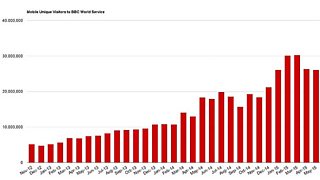
‘Mobile-first’ can sometimes mean mobile first and last
The most important thing to know about the BBC World Service language portfolio is that some of our sites have reached the coveted ‘mobile-first’ status years before the term became widely used by Western digital publishers. Sixty-six per cent of our audiences in May 2015 reached us on either mobile phones or tablets, while the BBC Hausa service, serving Nigerian audiences, was 95% mobile as early as 2012. There the audience skipped desktop web consumption altogether: the web experience equals mobile experience in large parts of the planet.
And given the majority of our target audience is in emerging markets, where the next billion of connected users will come from, it was strategically important for us not only to offer users the most optimised experience by relaunching every website in responsive design but implement a mobile-first editorial change project.
It helped editors to calibrate their output with the realities of mobile news consumption. The change has significantly affected the whole publishing process - from editorial commissioning to turning the screens in the newsroom from horizontal to vertical in order to support the switch from desktop to mobile thinking.
We are obsessed with data at BBC News and World Service in particular - using it for social media or search engine optimisation, or real-time reporting. A data-based rigorous approach is being introduced into the editorial workflow across the board, and my mantra over the past few years has been a famous saying, attributed to US engineer and statistician W Edwards Deming, that “without data you are just another person with an opinion”.
And of course we are experimenting with the mobile-friendly formats including short-form video, smart use of images and such like.
This is a slightly edited version of Dmitry Shishkin’s original Mediashift article, re-versioned here with the publisher’s kind permission. Part two of his post will look at latest digital and social formats for the BBC’s international news.
Our digital journalism section, including:
Video on mobile: How to file great digital content
Writing for mobile: Bite-size basics
The BBC Academy’s 18 language websites
Blog by Dmitry Shishkin on using social media for world news
