Eyewitness media: ‘Valued stop-gap but no match for professional journalism’

Pete Brown
is researcher and co-founder of Eyewitness Media Hub @emhub
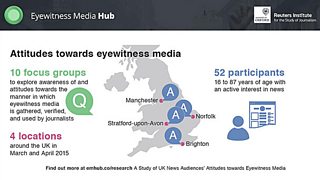
Much has been made of the extent to which eyewitness media has infiltrated news output and the impact they have had on professional journalists’ workflows. But what do news consumers in the UK think about this content?
For the latest Eyewitness Media Hub study we questioned more than 50 people in 10 focus groups around the UK - aged 16 to 87 and with an active interest in the news - to try to gauge some opinions.
We wanted to know:
1. What qualities do audiences believe eyewitness media bring to news output?
2. How important do people think it is to verify and credit eyewitness media?
3. To what extent do audiences feel news organisations should label this material?
4. What are audiences’ attitudes towards the process through which journalists seek permission to use eyewitness media on social media?
5. And what reservations do people have about eyewitness media in the news?
You can read the full report and findings, but here are some of the key conclusions we drew:
They get it…
Audiences can be highly sophisticated in their understanding of quite nuanced aspects of news output - perhaps more so than they are given credit for. Far from being passive, uninterested ‘consumers’, participants in all of our focus groups were extremely thoughtful in their assessments of eyewitness media’s contribution to journalistic output. They are not just aware but have formed distinct, at times very strong, opinions about it, accepting its strengths and weaknesses.
…but not the legalities
Knowledge is rather less sophisticated on the legal issues surrounding use of this content and certain integral aspects of journalists’ professional practices, like verification.
Appetite is clear, with journalists as trusted guides
Eyewitness media is actively embraced by UK audiences of all ages for its capacity to illuminate stories with a degree of immediacy and authenticity that professional content simply cannot match.
Audiences may have a strong appetite for eyewitness media and breaking news, but they expect news providers to bring an element of quality control and order to the ‘noise’ of the social web and to ‘add value’ to stories told through the prism of eyewitness media - even if they do not necessarily know what this process entails. Our findings (re)highlight the value of verification skills to the contemporary journalist.
A general lack of enthusiasm for unverified content was also a reminder that it’s pointless taking risks in this area. There are no prizes for being first to be wrong when it comes to publishing eyewitness media.
They don’t mind if it looks second rate
Inferior aesthetic quality is seen as a price worth paying for the authenticity and, in particular, the immediacy eyewitness media bring. Though important, many people view such material as a stop-gap. Beyond the initial breaking story, they expect news professionals to provide footage and analysis with clarity and quality. As one contributor put it: “Eyewitness media is a welcome and valued addition to journalists’ arsenal, but far from a fully blown substitute for professional content.”
They do mind if they’re ambushed by upsetting images
Even though the majority of the most graphic imagery is likely to be left on the cutting room floor, some audience members recalled seeing eyewitness footage that had upset them. During discussions of this topic, it was not uncommon to hear phrases such as ‘I don’t need to see it’ and ‘I couldn’t avoid it’.
The former should be a reminder that the average viewer’s tolerance of/resistance to distressing content may be considerably lower than that of a journalist. The latter should reaffirm the importance of giving audiences due warning about the existence of potentially upsetting imagery and ensuring viewers are not inadvertently exposed to such content through ‘autoplay’ videos or screengrabs that leave little to the imagination.
Credits, and even labelling, aren’t seen as important
Unsurprisingly, our research suggests that audiences are generally indifferent to whether or not eyewitness media is credited. A little more surprisingly, they felt the same about labelling material as ‘amateur’ content. The near unanimous response across the groups was that people did not need to be alerted to this fact because they could ‘just tell’.
As someone who has lost many hours to the detective work of trying to establish whether or not unlabelled content used in TV bulletins, online newspapers and broadcasters’ websites had been produced by an eyewitness as opposed to a professional, I would question this assumption. Indeed, the possibility that audience members may be overestimating their ability to differentiate between professional content and that produced by an eyewitness leads me to conclude that labelling is more essential than ever.
But “intimidation” by news outlets would be resisted
Regarding the process through which news outlets gather eyewitness media, our focus group participants repeatedly expressed disdain for, and/or resistance to, the “verbose, jargonistic, confusing” and even “intimidating” language through which some organisations seek to secure content. Perhaps the finding that will set alarm bells ringing the loudest is that many said that this approach would make them more likely to demand payment before handing over their content.
If I were to make a contribution to this conversation based on the findings of this research, it would be that any potential solution must give content creators the power to be selective about which news outlets are and aren’t permitted to benefit from the use of their work. This is their prerogative and is an issue about which a great many of our focus group participants were hugely passionate.
And finally
The enthusiasm shown by our participants suggests that news organisations can ill afford to disregard the power of eyewitness media or the value placed on it by their audiences. Those with an eye on tomorrow will prioritise, and invest in, the resources required to ensure they thrive in this area.
But this doesn’t mean anxiously awaiting the day the ‘amateurs’ replace the professionals. Far from it. It means recognising the importance of having journalists who are fluent in the skills and technology required to gather, verify and disseminate the important, interesting and vital information audiences so crave, in a way that is accurate, transparent, accountable and ethical.
Pete Brown @beteprown was lead researcher on ‘It’s Genuine, as Opposed to Manufactured’: A Study of UK News Audiences’ Attitudes towards Eyewitness Media. The research was done in partnership with the Reuters Institute for the Study of Journalism.
How to make the most of user generated content
Verifying social media content
Our special section on social media skills for journalists
Eyewitness media: Newsrooms must handle it better or risk losing out
