Key points about the cosine rule
The cosine rule is a A fact, rule, or principle that is expressed in terms of mathematical symbols. The plural of formula is formulae. used to find a missing side or angle in a triangle when two sides andAn angle between two given sides., or all the lengths of all three sides, are known.
There are two versions of the cosine rule:
- Find an unknown side using 𝑎² = 𝑏² + 𝑐² – 2𝑏𝑐 cos𝐴
- Find an unknown angle using cos𝐴 = \(\frac{𝑏² + 𝑐² – 𝑎²}{2𝑏𝑐}\)
Scientific calculators need to be used for trigonometry and should be in degrees mode. Often there is a small D or DEG at the top of the calculator screen. If not, go into the calculator settings to change the angle units to degrees.
Make sure you are confident with finding unknown sides and angles in right-angled triangles to be successful with non-right-angled A branch of mathematics which explores the relationships between sides and angles in a triangle..
How to find an unknown side using the cosine rule
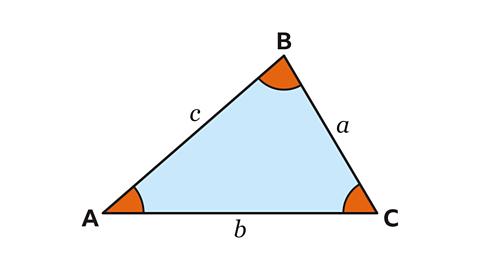
To find an unknown side in a triangle, two sides and An angle between two given sides. must be known.
Label the angles and sides of the triangle and use the formula 𝑎² = 𝑏² + 𝑐² – 2𝑏𝑐 cos𝐴 to find the missing side.
If the The point at which two or more lines cross. The corner of a shape. The plural form is vertices. of the triangle are not called 𝐴, 𝐵 and 𝐶, it is common practice to rename them to assist with theThe process of replacing a letter (or variable) with a number. into the formula. Make sure vertex 𝐴 is opposite the side that needs to be calculated.
Answers should use the given notation in the question.

- An SAS (two sides and the included angle) triangle is a unique triangle which can be constructed with a pencil, ruler and protractor.
Follow the worked example below
GCSE exam-style questions
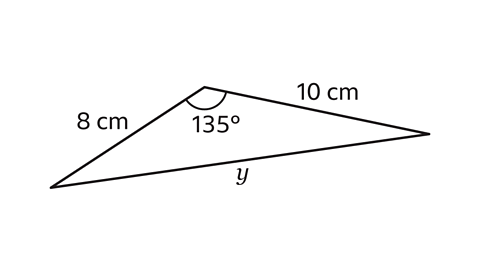
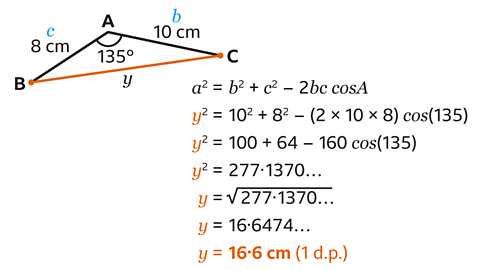
- Calculate the length of side 𝑦.
Give the answer to one decimal place.
𝑦 = 16·6 cm
- Label the sides of the triangle.
Here the vertices are not labelled, so pick the vertex with angle 135° to be 𝐴. The choice of 𝐵 and 𝐶 does not matter.
The 8 cm side, opposite angle 𝐶, is called 𝑐.
The 10 cm side, opposite angle 𝐵, is called 𝑏.
The side labelled 𝑦, opposite angle 𝐴, is called 𝑎.
- Substitute the values of 𝐴, 𝑎, 𝑏 and 𝑐 into the formula to give
𝑦² = 10² + 8² – (2 × 10 × 8)cos(135).
- 10² = 100, 8² = 64 and 2 × 10 × 8 = 160, so this simplifies to
𝑦² = 100 + 64 – 160cos(135)
- Type 100 + 64 - 160cos(135) into a scientific calculator.
Usually, the calculator will automatically open a bracket after pressing the cosine button.
Remember to close the bracket after typing in the angle.
This gives 𝑦² = 277·1370…
It is important not to round the numbers at this stage.
- The inverse of squaring is square rooting, so to find 𝑦, calculate the square root of 277·1370…
Type the square root button followed by the 'ANS' button into a scientific calculator.
This gives the answer of 𝑦 = 16·6474…
Therefore, rounded to one decimal place, 𝑦 = 16·6 cm.
- Calculate the length of 𝑋𝑌.
Give the answer to one decimal place.
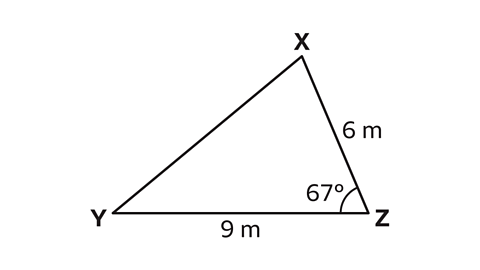
𝑋𝑌 = 8·6 m
- Label the sides of the triangle.
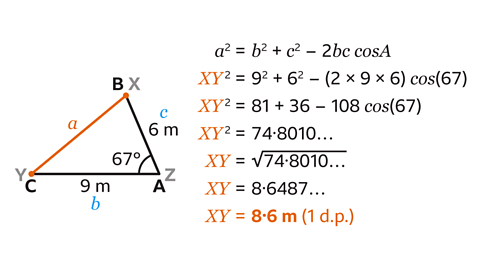
Since the vertices are not called 𝐴, 𝐵 and 𝐶, let vertex 𝑍, with angle 67°, be 𝐴. The choice of 𝐵 and 𝐶 doesn't matter.
Let vertex 𝑋 be 𝐵 and vertex 𝑌 be 𝐶.
The 9 m side, opposite angle 𝐵, is called 𝑏.
The 6 m side, opposite angle 𝐶, is called 𝑐.
The 10 cm side, opposite angle 𝐵, is called 𝑏.
The side labelled 𝑋𝑌, opposite angle 𝐴 is called 𝑎.
- Substitute the values of 𝐴, 𝑎, 𝑏 and 𝑐 into the formula to give
𝑋𝑌² = 9² + 6² – (2 × 9 × 6)cos(67).
- 9² = 81, 6² = 36 and 2 × 9 × 6 = 108, so this simplifies to
𝑋𝑌² = 81 + 36 – 108cos(67)
- Type 81 + 36 - 108cos(67) into a scientific calculator.
Usually, the calculator will automatically open a bracket after pressing the cosine button.
Remember to close the bracket after typing in the angle.
This gives 𝑋𝑌² = 74·8010…
It is important not to round the numbers at this stage.
- Find 𝑋𝑌 by calculating the square root of 74·8010…
Type the square root button followed by the 'ANS' button into a scientific calculator.
This gives the answer of 𝑋𝑌 = 8·6487…
Therefore, rounded to one decimal place, 𝑋𝑌 = 8·6 m.
How to re-arrange the cosine formula
To use the cosine formula to find a missing angle in a triangle, the formula must be re-arranged to become:
cos𝐴 = \(\frac{𝑏² + 𝑐² – 𝑎²}{2𝑏𝑐} \)
Find out more about re-arranging the cosine formula below
How to find an unknown angle using the cosine rule
To find an unknown angle in a triangle, the length of all three sides must be known.
Find the missing angle by labelling the angles and sides of the triangle and using the formula:
cos𝐴 = \(\frac{𝑏² + 𝑐² – 𝑎²}{2𝑏𝑐} \)
This formula has vertex 𝐴 as the angle to be calculated. If the variables used for the vertices are not 𝐴, 𝐵 and 𝐶, rename them to fit.
- When finding angles using trigonometry, the inverse function is used.
Follow the worked example below
GCSE exam-style questions
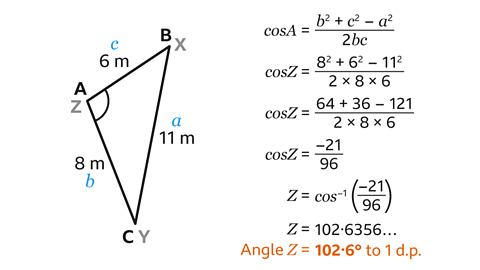
- Calculate the size of angle 𝑍.
Give the answer to one decimal place.
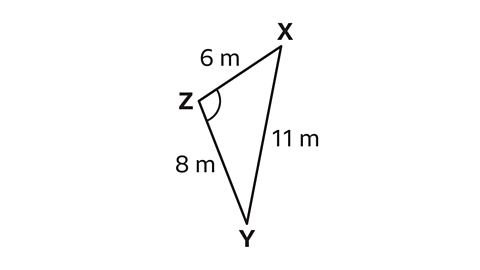
𝑍 = 102·6
- Label the sides of the triangle.
Since the vertices are not called 𝐴, 𝐵 and 𝐶, let vertex, 𝑍, the angle to be calculated, be 𝐴. The choice of 𝐵 and 𝐶 doesn't matter.
Let vertex 𝑋 be 𝐵 and vertex 𝑌 be 𝐶.
The 11 m side, opposite angle 𝐴, is called 𝑎.
The 8 m side, opposite angle 𝐵, is called 𝑏.
The 6 m side, opposite angle 𝐶, is called 𝑐.
Substitute the values of 𝐴, 𝑎, 𝑏 and 𝑐 into the rearranged formula to give cos𝑍 = \(\frac{8² + 6² – 11²}{2 × 8 × 6} \).
Work out the value of each of the squares.
8² = 64
6² = 36
11² = 121
- Simplify the numerator and denominator.
64 + 36 – 121 = – 212 × 8 × 6 = 96
So, cos𝑍 = \(\frac{– 21}{96} \).
- Work out the angle, 𝑍, by using the inverse function of cosine.
𝑍 = cos⁻¹(\(\frac{– 21}{96} \))
Press 'shift' then 'cos' to write cos⁻¹ on a scientific calculator.
- Type – 21 ÷ 96.
Remember to close the brackets.
This gives 𝑍 = 102·6356…
Rounded to 1 decimal place, Angle 𝑍 = 102·6°.
- Calculate the size of angle 𝐶.
Give the answer to one decimal place.
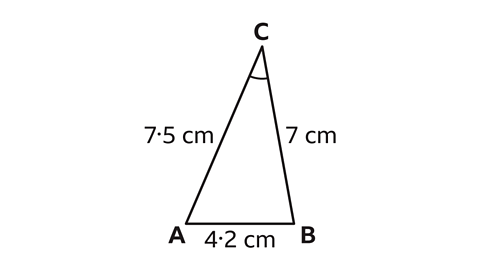
𝐶 = 33·4°
- Label the sides of the triangle.
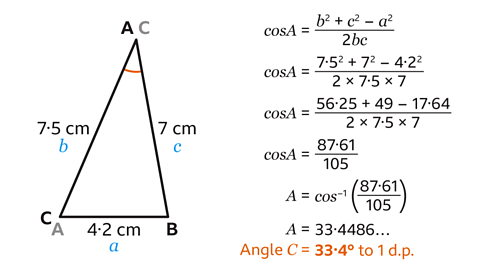
Although the vertices are called 𝐴, 𝐵 and 𝐶, the angle to be calculated is not 𝐴. Swap the vertices so angle 𝐶 is called 𝐴 and vice-versa.
In this case, the 4·2 cm side, opposite angle 𝐴, is called 𝑎.
The 7·5 cm side, opposite angle 𝐵, is called 𝑏.
The 7 cm side, opposite angle 𝐶, is called 𝑐.
- Substitute the values of 𝐴, 𝑎, 𝑏 and 𝑐 into the rearranged formula to give
cos𝐴 = \(\frac{7·5² + 7² – 4·2²}{2 × 7·5 × 7} \).
- Work out the value of each of the squares.
7·5² = 56·25
7² = 49
4·2² = 17·64
- Simplify the numerator and the denominator.
56·25 + 49 – 17·64 = 87·61 and 2 × 7·5 × 7 = 105
So cos𝐴 = \(\frac{87·61}{105} \).
- Work out the angle, 𝐴, using the inverse function of cosine:
𝐴 = cos⁻¹(\(\frac{87·61}{105}\))
Press 'Shift' then 'cos' to write cos⁻¹ on a scientific calculator.
- Type 87·61 ÷ 105.
Remember to close the brackets.
This gives 𝐴 = 33·4486…
Rounded to 1 decimal place, and remembering to swap back to the original variable, Angle 𝐶 = 33·4°.
Check your understanding
Quiz – Cosine rule
Practise what you've learned about the cosine rule with this quiz.
Now you've revised the cosine rule, why not look at combined transformations and invariant points?
More on Geometry and measure
Find out more by working through a topic
- count33 of 35
- count34 of 35

- count35 of 35
- count1 of 35