Key points about geometric problems using vectors

Solving geometric problems with vectors involves adding and subtracting vectors around a shape.
Problems could involve proving:
- two vectors are Two lines that are equidistant and never cross.
- three points are Lying in the same straight line.
Make sure you are confident at naming and calculating vectors on a network or around a shape.
How to prove two vectors are parallel
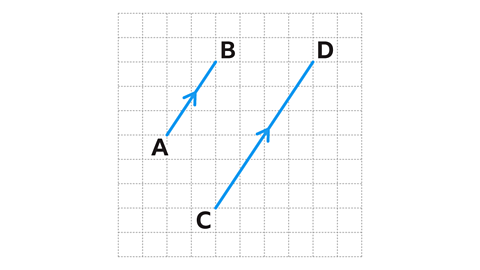
Two A vector quantity has both direction and magnitude (size). are parallel if they have the same (or opposite) directions.
Their magnitude can be different.
In the image to the right, \(\overrightarrow{AB}\) and \(\overrightarrow{CD}\) are parallel.
\(\overrightarrow{AB}\) and \(\overrightarrow{CD}\) have the same direction.
\(\overrightarrow{CD}\) is twice the length of \(\overrightarrow{AB}\).
To prove two vectors are parallel, show one vector is a An integer that is in the multiplication table of a specific number. (A number that may be divided by another, without a remainder). of another.
For example, vector \(\overrightarrow{PQ}\) = 𝑥 + 2𝑦 is parallel to vector \(\overrightarrow{RS}\) = 3𝑥 + 6𝑦, as each Part of a vector that aligns with the horizontal or vertical movement. of vector \(\overrightarrow{PQ}\) has been multiplied by 3.
Follow the worked example below
Check your understanding
GCSE exam-style questions
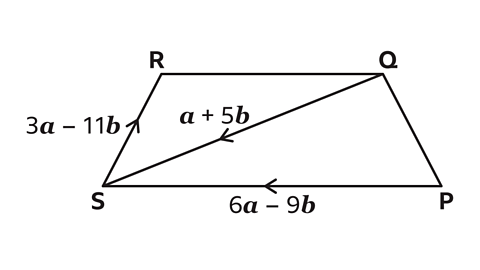
- Quadrilateral \(PQRS\) is shown.
\(\overrightarrow{PS}\) = 6𝑎 – 9𝑏, \(\overrightarrow{QS}\) = 𝑎 + 5𝑏 and \(\overrightarrow{SR}\) = 3𝑎 – 11𝑏.
Prove \(\overrightarrow{QR}\) and \(\overrightarrow{PS}\) are parallel.
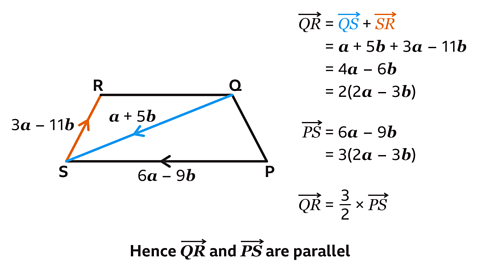
- Start by expressing each vector in terms of a and 𝑏.
Plan a route from 𝑄 to 𝑅 along line segments where the vectors are known.
\(\overrightarrow{QR}\) = \(\overrightarrow{QS}\) + \(\overrightarrow{SR}\)
- \(\overrightarrow{QR}\) = \(\overrightarrow{QS}\) + \(\overrightarrow{SR}\) = 𝑎 + 5𝑏 + 3𝑎 – 11𝑏.
This simplifies to \(\overrightarrow{QR}\) = 4𝑎 – 6𝑏.
Factorising the expression, by taking out a common factor of two, gives
\(\overrightarrow{QR}\) = 2(2𝑎 – 3𝑏).
- \(\overrightarrow{PS}\) = 6𝑎 – 9𝑏.
Factorising the expression, by taking out a common factor of three, gives
\(\overrightarrow{PS}\) = 3(2𝑎 – 3𝑏).
- To prove two vectors are parallel, show one vector is a multiple of another.
\(\overrightarrow{QR}\) = ³⁄₂ × \(\overrightarrow{PS}\).
Therefore, \(\overrightarrow{QR}\) and \(\overrightarrow{PS}\) are parallel.
- \(ABCD\) is a trapezium.
\(P\) is the midpoint of \(\overrightarrow{AC}\).
\(Q\) is the midpoint of \(\overrightarrow{DC}\).
Prove \(\overrightarrow{PQ}\) and \(\overrightarrow{BC}\) are parallel.
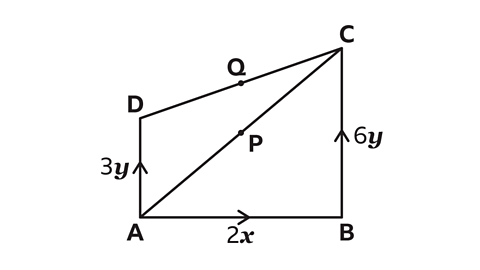
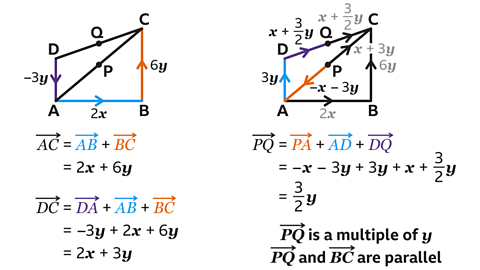
- Start by expressing each of the vectors \(\overrightarrow{AC}\) and \(\overrightarrow{DC}\), in terms of 𝑥 and 𝑦.
Plan a route from \(A\) to \(C\), along line segments where the vectors are known.
\(\overrightarrow{AC}\) = \(\overrightarrow{AB}\) + \(\overrightarrow{BC}\) = 2𝑥 + 6𝑦
- Plan a route from \(D\) to \(C\), along line segments where the vectors are known.
\(\overrightarrow{DC}\) = \(\overrightarrow{DA}\) + \(\overrightarrow{AB}\) + \(\overrightarrow{BC}\) = –3𝑦 + 2𝑥 + 6𝑦.
This simplifies to \(\overrightarrow{DC}\) = 2𝑥 + 3𝑦.
The midpoint \(P\) splits the vector \(\overrightarrow{AC}\) in half.
So, \(\overrightarrow{AP}\) = \(\overrightarrow{PC}\) = 𝑥 + 3𝑦.
The midpoint \(Q\) splits the vector \(\overrightarrow{DC}\) in half.
So, \(\overrightarrow{DQ}\) = \(\overrightarrow{QC}\) = 𝑥 + ³⁄₂𝑦.
- Plan a route from \(P\) to \(Q\), along line segments where the vectors are known.
\(\overrightarrow{PQ}\) = \(\overrightarrow{PA}\) + \(\overrightarrow{AD}\) + \(\overrightarrow{DQ}\).
The direction of \(\overrightarrow{PA}\) is in the opposite direction, so a negative vector is used.
\(\overrightarrow{PQ}\) = \(\overrightarrow{PA}\) + \(\overrightarrow{AD}\) + \(\overrightarrow{DQ}\) = –𝑥 + 3𝑦 + 3𝑦* + 𝑥 + ³⁄₂𝑦
This simplifies to \(\overrightarrow{PQ}\) = ³⁄₂𝑦.
- To prove two vectors are parallel, show one vector is a multiple of another.
Both \(\overrightarrow{PQ}\) and \(\overrightarrow{BC}\) are multiples of 𝑦.
Therefore, \(\overrightarrow{PQ}\) and \(\overrightarrow{BC}\) are parallel.
How to prove three points are co-linear
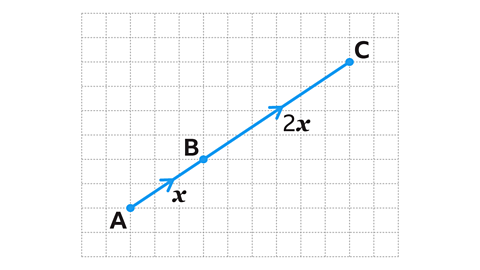
Three points, \({A}\), \({B}\) and \({C}\), are Lying in the same straight line. if vectors \(\overrightarrow{AB}\) and \(\overrightarrow{BC}\) are parallel, ie they are An integer that is in the multiplication table of a specific number. (A number that may be divided by another, without a remainder). of each other.
To prove three points are co-linear, show one vector is a multiple of another and that they share a common point.
In the image to the right, \(\overrightarrow{AB}\) and \(\overrightarrow{BC}\) are parallel.
Points \({A}\), \({B}\) and \({C}\) are co-linear.
Follow the worked example below
GCSE exam-style questions
- Use vectors to show \(ACD\) is a straight line.
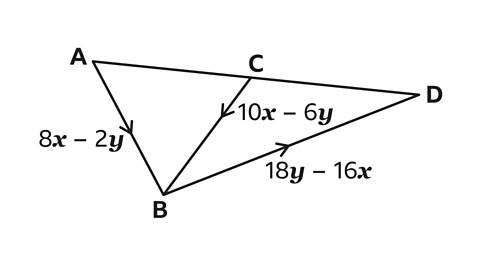
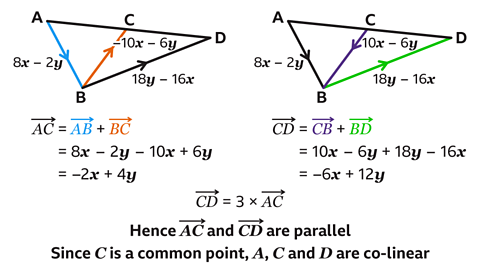
Find \(\overrightarrow{AC}\) and \(\overrightarrow{CD}\) in terms of 𝑥 and 𝑦.
Plan a route from \(A\) to \(C\), along line segments where the vectors are known.
\(\overrightarrow{AC}\) = \(\overrightarrow{AB}\) + \(\overrightarrow{BC}\)
The direction of \(\overrightarrow{BC}\) is in the opposite direction, so a negative vector is used.
\(\overrightarrow{AC}\) = 8𝑥 – 2𝑦 – 10𝑥 + 6𝑦
This simplifies to \(\overrightarrow{AC}\) = –2𝑥 + 4𝑦.
- Plan a route from \(C\) to \(D\), along line segments, where the vectors are known.
\(\overrightarrow{CD}\) = \(\overrightarrow{CB}\) + \(\overrightarrow{BD}\)
\(\overrightarrow{CD}\) = 10𝑥 – 6y + 18y – 16𝑥
This simplifies to \(\overrightarrow{CD}\) = –6𝑥 + 12𝑦.
- The vectors \(\overrightarrow{AC}\) and \(\overrightarrow{CD}\) are multiples of each other.
\(\overrightarrow{CD}\) = 3 × \(\overrightarrow{AC}\)
This means the vectors are parallel.
Since \(\overrightarrow{AC}\) and \(\overrightarrow{CD}\) have the point \(C\) in common, the points \(A\), \(C\) and \(D\) all lie on a straight line and are co-linear.
- The diagram shows a parallelogram.
\(\overrightarrow{OA}\) = 6𝑎
\(\overrightarrow{OB}\) = 6𝑏
\(D\) is the point on \(OC\), such that \(OD:DC\) = 2:1.
\(E\) is the midpoint of \(BC\).
Show that \(A\), \(D\) and \(E\) are on the same straight line.
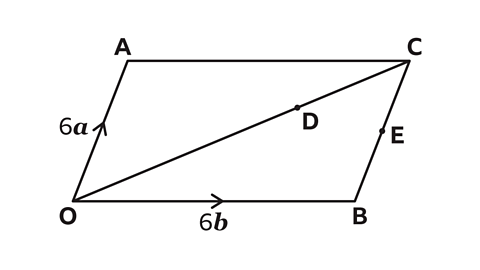
To show \(A\), \(D\) and \(E\) lie on a straight line, start by calculating some additional vectors.
Use the geometry of the parallelogram to work out the missing vectors on each side. In a parallelogram the opposite sides are the same length and parallel.
Since \(\overrightarrow{OA}\) = 6𝑎, then \(\overrightarrow{BC}\) = 6𝑎.
Similarly, since \(\overrightarrow{OB}\) = 6𝑏, then \(\overrightarrow{AC}\) = 6𝑏.
The midpoint \(E\) splits the vector \(\overrightarrow{BC}\) in half. So, \(\overrightarrow{BE}\) = \(\overrightarrow{EC}\) = 3𝑎.
Plan a route from \(O\) to \(C\), along line segments where the vectors are known.
\(\overrightarrow{OC}\) = \(\overrightarrow{OA}\) + \(\overrightarrow{AC}\)
\(\overrightarrow{OC}\) = 6𝑎 + 6𝑏
- \(D\) is the point on \(OC\), such that \(OD:DC\) = 2:1.
This means \(\overrightarrow{OD}\) is two thirds of the length of \(\overrightarrow{OC}\) and \(\overrightarrow{DC}\) is one third of the length of \(\overrightarrow{DC}\).
\(\overrightarrow{OD}\) = ⅔ (6𝑎 + 6𝑏) = 4𝑎 + 4𝑏
\(\overrightarrow{DC}\) = ⅓ (6𝑎 + 6𝑏) = 2𝑎 + 2𝑏
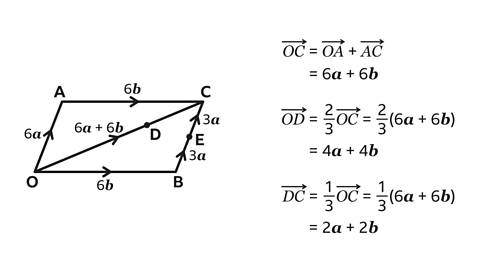
With all the vectors calculated it is now possible to show \(A\), \(D\) and \(E\) are co-linear. Find \(\overrightarrow{AD}\) and \(\overrightarrow{DE}\) in terms of 𝑎 and 𝑏.
Plan a route from \(A\) to \(D\), along line segments where the vectors are known.
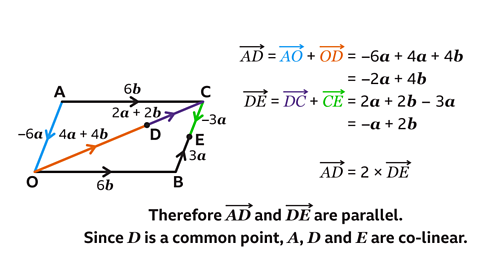
\(\overrightarrow{AD}\) = \(\overrightarrow{AO}\) + \(\overrightarrow{OD}\)
The direction of \(\overrightarrow{AO}\) is in the opposite direction, so a negative vector is used.
\(\overrightarrow{AD}\) = –6𝑎 + 4𝑎 + 4𝑏
This simplifies to \(\overrightarrow{AD}\) = –2𝑎 + 4𝑏.
- Plan a route from \(D\) to \(A\), along line segments where the vectors are known.
\(\overrightarrow{DE}\) = \(\overrightarrow{DC}\) + \(\overrightarrow{CE}\)
The direction of \(\overrightarrow{CE}\) is in the opposite direction, so a negative vector is used.
\(\overrightarrow{DE}\) = 2𝑎 + 2𝑏 – 3𝑎
This simplifies to \(\overrightarrow{DE}\) = –𝑎 + 2𝑏.
- The vectors \(\overrightarrow{AD}\) and \(\overrightarrow{DE}\) are multiples of each other.
\(\overrightarrow{AD}\) = 2 × \(\overrightarrow{DE}\).
This means the vectors are parallel.
Since \(\overrightarrow{AD}\) and \(\overrightarrow{DE}\) have the point \(D\) in common, the points \(A\), \(D\) and \(E\) all lie on a straight line and are co-linear.
Quiz – Geometric problems using vectors
Practise what you've learned about geometric problems using vectors with this quiz.
Now you've revised geometric problems using vectors, why not look at solving 2D and 3D problems using Pythagoras' theorem?
More on Geometry and measure
Find out more by working through a topic
- count1 of 35

- count2 of 35

- count3 of 35

- count4 of 35