Making prototypes - addition, deforming, reforming and wastage
There are a wide range of processes that a A person who works on developing concept ideas produced by designers to achieve a functioning product. The design of the functioning product will be based upon scientific and mathematical understanding. can use to make prototypes, including:
- A method of shaping a form by building on top of material.
- A method of shaping a form by the removal of material.
- Processing a material into a 3D form through folding, perforating, bending or shaping.
- The changing of a material’s shape, often by heat.
Additive manufacturing
Additive manufacturing is the process of making three dimensional models by building up layers. Methods and technologies include:
- A method of creating 3D models by building up layers.
- An additive manufacturing process that uses a laser to sinter or harden layers of material to build up a 3D model.
- An additive manufacturing process that builds up layers from a filament of thermoplastic material.
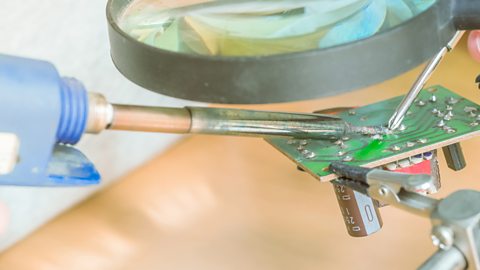
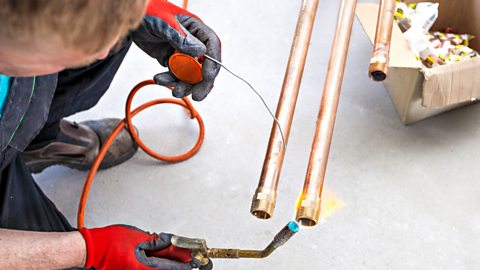
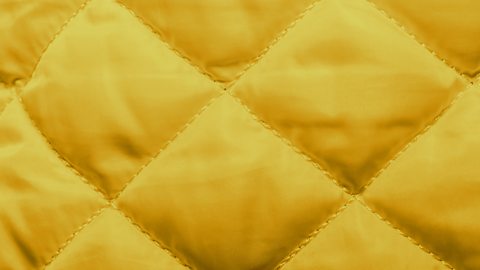
The additive method of production is quickly developing and more methods are becoming available. Simpler forms of additive manufacturing include gluing or laminating papers and boards; soldering, welding and brazing metals; and sewing, bonding and quilting fabrics.
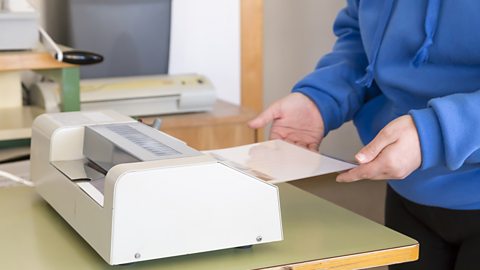
Image caption, Laminating paper
1 of 4
Subtractive manufacturing
Subtractive manufacturing produces waste as three-dimensional forms are created by removing material from solid sheets or blocks by:
- Creating holes in a sheet material.
- A cutting process using a drill to make a hole in a material.
- To wear down with friction.
- The process of using a machine with a rotary cutter to cut and shape material.
- A method of spinning a material so that a cylindrical shape or bowl can be produced.
- To cut or tear long strips from a material.
- Creating designs on metal or glass by corroding the surface with acid.
- A cutting process using a saw to section a material.
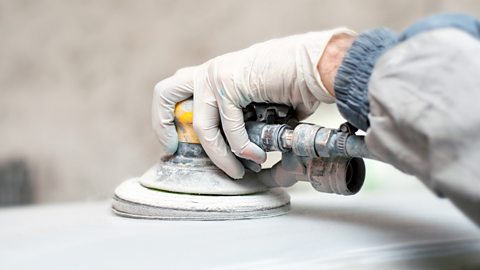
Image caption, Abrading using a buffing machine
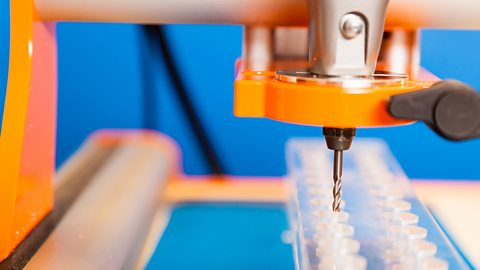
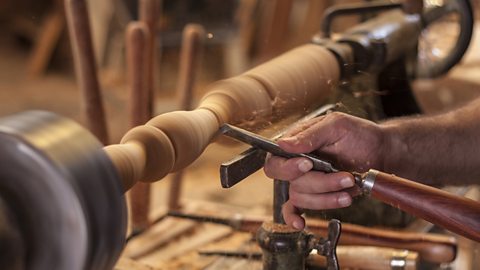
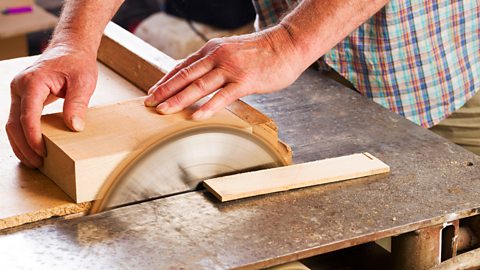
1 of 4
Deformation
Deformation is the collective name for folding, Pressing small holes into a material., bending and shaping materials to create 3D forms. For example, some timbers can be steamed and bent, and a piece of cardboard can be cut and folded for packaging.
Reformation
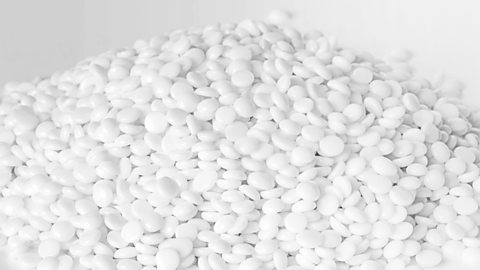
When some materials are heated, design engineers can alter their properties so they can be reformed into new shapes. An example would be polymorph, a polymer that when heated in near boiling water (around 62°C) it becomes Capable of being hammered or pressed into a new shape without being likely to break or return to the original shape. and can then be shaped by hand to form new solid plastic forms.