Stock forms
Most A person or company that makes something from raw materials or from an assembly of component parts. produce their products in standard sizes and shapes. Sometimes these are specific to an industry or a geographical region, but increasingly they are internationally standardised, meaning they all adhere to the same set of instructions. For example:
- plywood comes in a range of thicknesses - common sizes are 6.5 mm, 9 mm, 12 mm, 15 mm and 18 mm
- a standard sheet of timber is 2,400 mm × 600 mm
- metal sheet thickness is measured in gauges, from 30 gauge (thin) to 7 gauge (thick)
- acrylic comes in 2 mm, 3 mm, 6 mm, 8 mm and 10 mm thickness - thicker sizes are available, but these are less common
- fabrics are measured in many ways, eg by The number of threads woven together. - a bolt (or roll) is usually either 40 yards (37 m) or 100 yards (91 m)
- papers and boards are measured in grams per square metre (gsm) - 80 to 100 gsm is the general weight of standard office paper, and anything over 300 gsm is classified as a board
- standard sizes for paper mean you can use them in a printer designed for set dimensions - eg A0 is largest size and A10 is the smallest in the A-series, which is about the size of a postage stamp
Standard paper sizes from A0 to A7
Components that also come in standard sizes and weights include:
- clips, fasteners and binders for papers and boards
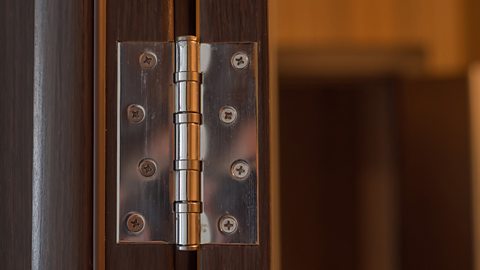
- hinges, brackets and screws for timbers
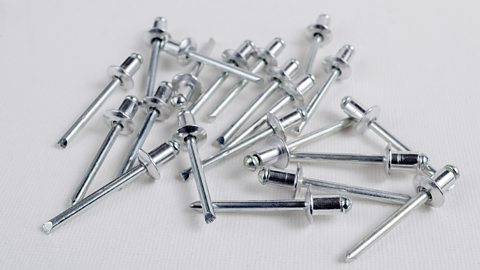
- bolts, A metal plug used to hold sheet material together. They expand when the central plug is pulled upwards through the body of the rivet. and hinges for metals
- caps, fasteners and bolts for polymers
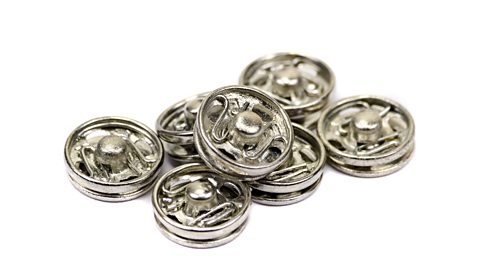
- zips, buttons and poppers for fabrics
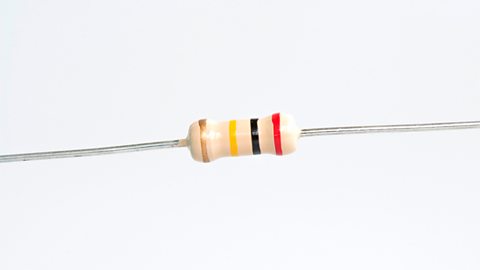
- electronic components, including An electrical component that restricts the flow of electrical charge. Fixed-value resistors do not change their resistance, but with variable resistors it is possible to vary the resistance., Circuit component which stores and discharges electrical current. They are made from two parallel metal plates separated by an insulator (called a dielectric)., An electrical device that allows current to flow in one direction only., Components which do not conduct electricity unless they are turned on by a (different) electrical current. This means they can be used as switches, amplifiers and in other ways., A component used to control another circuit. and A computer chip used instead of a CPU that contains a processor, memory and inputs/outputs.
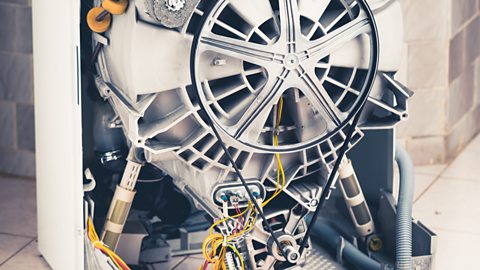
- mechanical components, including A wheel with teeth that can change the speed of a mechanism., A wheel attached to a crankshaft., A wheel with a grooved edge that a cord passes around., A loop used to link two or more pulleys., A bar featuring a pivot that can be pushed or pulled to make the moving of a load easier. and A system of links.
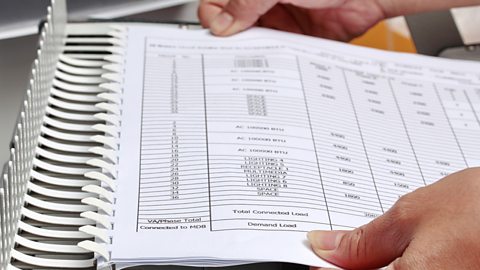
Image caption, Paper binding
1 of 6
End of image gallery
Something you solder into a circuit, eg a resistor or a diode. are mostly internationally standardised, meaning a design engineer in one country can buy components from another and expect them to perform a certain way and be a set size.
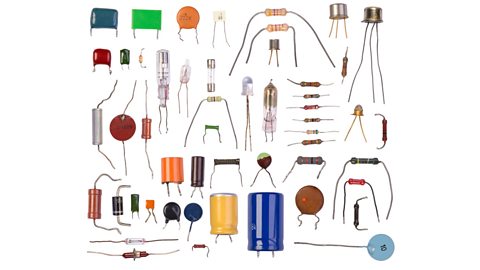
Electronic components
