Ensuring structural integrity
Forces act on materials all the time - even if a material appears stationary it still has a force acting on it. There are five terms used to describe what type of force can act on a material:
- Pulling force exerted by each end of an object such as a string or rope. - a pulling force
- Being squashed. - a pushing force
- A bending force is applied at an angle causing a material to be in compression and tension at the same time. - forces at an angle to the material
- A twisting force. - a twisting force
- A force across a material, eg scissors cut by applying a shear force. - forces acting across the material
A person who works on developing concept ideas produced by designers to achieve a functioning product. The design of the functioning product will be based upon scientific and mathematical understanding. often adapt materials to alter their performance, improving their ability to withstand A weight., Changing shape and/or size as a result of forces being applied. and When a product is tested to breaking point..
For example, a bicycle frame is commonly made up of a number of triangulated tubular pieces, most notable in the classic ‘double diamond’ design.
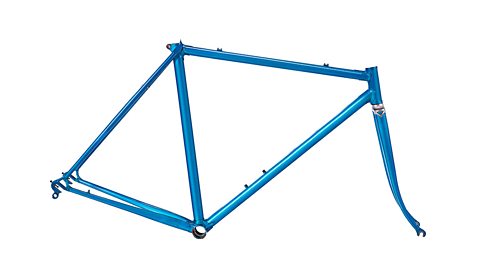
Joints of the frame will often be To strengthen a material that could weaken when a force is applied. with additional materials, steel plates are placed at the front where the main frame meets the fork holding the front wheel. This increases the frame thickness to improve its Tensile strength is the ability of a material to resist pulling forces without snapping, eg a guitar string has high tensile strength. and Ability to withstand loads.. The stiffness of a bicycle frame is a measure of how much the frame twists, flexes (torsion) and bends. The A straight line which joins two points on the circle and passes through the centre is a diameter. of the metal tubes used will affect the stiffness of the frame - the greater the diameter the stiffer the frame. If the frame is not stiff enough, energy will be lost as it will be transferred to the frame (as a twisting force, referred to as torsion) rather than transferred through the wheels.
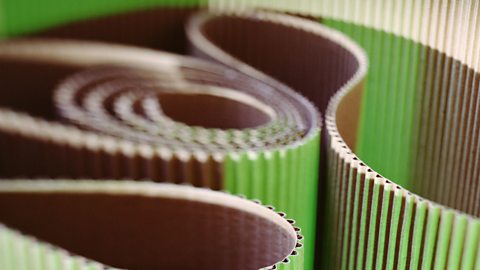
Another example is the Ridges repeatedly folded into paper to make it stronger. of cardboard - it can be corrugated and sandwiched between flat sheets to make it stiffer and more rigid. The more layers added, the stronger the end result.
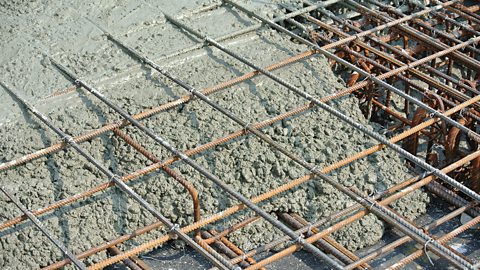
Steel bar (called ‘rebar’) is used to reinforce A particle-based composite made from cement and sand. Often combined with an aggregate such as stones or pebbles or reinforced with steel rods. to improve its tensile strength and to reduce the amount of bending that occurs.