In August 1914 Britain had gone to war against Germany.
Only five months later the enemy brought the war to Britain.
On the North East coast of England the morning of December the 16th 1914 was still and misty.
The first signs of anything unusual were the flashes coming from unidentified ships several miles out to sea.
One family realised what was happening when a German shell fragment struck the house and smashed into the front of the family alarm clock, stopping it forever at three minutes past eight.
It was the start of a ferocious bombardment.
The people of Hartlepool felt the full horror of modern war.
Homes were death traps, but so too were these streets. The German shells burst on impact sending shards of screaming hot metal in all directions at hundreds of miles an hour.
It was the first successful big attack on Britain since 1066; many thought the nightmare of a German invasion had become reality. Terrified children had simply no idea what was happening.
Violet:
All we could hear is bang, this noise bangs, but see it was far out to sea, it didn’t sound like bombs dropping against here.
Jeremy:
What did you think the sound was?
Violet:
We didn’t know, me older sister, me, me brother’s children are upstairs and she said “I think somebody’s beating their carpets”, that’s what she said. So anyway she goes out and she finds out, she says “Oh mum”, she come running back, “Mum the Germans are here, they’re on the beach and everybody’s running off, running, running away." I went upstairs and looked out the bedroom window, I could see big flashes.
Jeremy:
Out at sea?
Violet:
Flashes out at sea, yeah.
Jeremy:
And how were people reacting?
Violet:
Oh, crying and some of them crying, running with the prams and, er anyway there was hardly anybody left in Hartlepool, it’s all up the country.
Jeremy:
People were scurrying along outside, were they?
Violet:
And then somebody come and said “Oh, somebody’s had his head blew off”. Well, that frightened me…
Jeremy:
Mm…
Violet:
somebody had their head blew off.
Jeremy:
Mm. What did you, do you remember what you felt, you were seven years old?
Violet:
I was horrified, I thought they were coming any minute to the to the door to take us to kill us, I was sitting shivering, I just sat on the end of the bed and I was like that shivering, mm, terrified.
Jeremy:
What, thinking a German might walk through the door?
Violet:
I thought they were coming any minute to take us away, you know, to get us, yeah.
Jeremy:
The children of Hartlepool were among the many victims of Kaiser Wilhelm’s Navy that day. Three members of the Dixon family were killed by a shell as they ran for it holding hands, George, his sister Margaret and their brother Albert, aged seven. Their mother’s leg was blown off.
Suddenly the dead of World War One had different faces, the faces of British children.
For most British people what happened here in the North East that day was a war crime, an atrocity, a line had definitely been crossed, from now on civilians in Britain knew they too could be in mortal danger.
Video summary
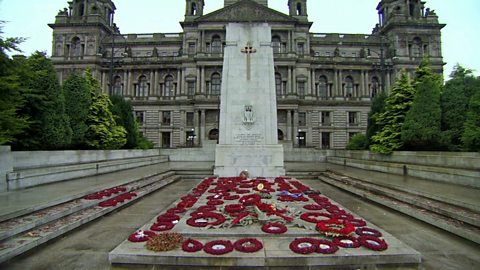
Violet Muers tells Jeremy Paxman her eye witness account of living through the surprise German naval bombardment of Hartlepool in 1914.
She describes the panic, fear and injuries the bombing caused on December 16th 1914, when she was 7 years old.
It was one of several bombardments of coastal towns in the North-East of England that day, and the first attack on British shores since 1066.
At the time they believed the Germans were invading. We see an alarm clock hit by shrapnel in the attack, along with photos of damaged buildings and newspaper reports showing children killed in the attack.
Paxman explains the effects of a falling shell, and how they caused so much damage. It demonstrates how British civilians were rapidly drawn into the First World War.
Teacher viewing recommended prior to use in class.
Teacher Notes
Key Stage 3:A hot seat technique could be used in class, where the group ask relevant questions of one person in the role of a witness to the bombardment. Then others occupy the hot seat to answer different questions about the incident. The target is to develop appropriate investigative and questioning skills for a specific purpose.
Key Stage 4:Use this clip to focus on developing evidence skills. The class consider the usefulness and limitations of the witness recollections, listing ideas for both sides. This may be developed to discuss the issues of reliability of memories from a very long time ago. The need to balance and corroborate can also be developed based on the example._
National 5 / Higher:The German naval bombardment could be used to introduce the German strategy of attacking British civilians. This could lead into study of the impact of zeppelin raids in Scotland - which reached as far as Edinburgh and Leigh. Students could discuss the impact of eyewitness accounts of the war. What do original memories add to our knowledge and assessment of historical events. How can these be corroborated and compared to give a broader picture?
This clip will be relevant for teaching History. This topic appears in at KS3 in England, Wales and Northern Ireland and OCR, Edexcel, AQA and WJEC/Eduqas GCSE/KS4 in England and Wales and CCEA GCSE in Northern Ireland. It also appears in National 5 and Higher in Scotland.
How Britain declared war in WW1. video
Jeremy Paxman explores the declaration of war after Germany invaded Belgium in 1914.

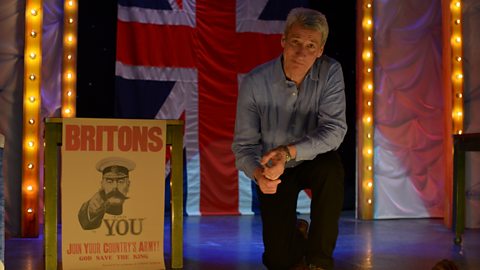
Your country needs you! video
Jeremy Paxman explains Lord Kitchener's iconic recruitment PR campaign of WW1.
Crushing defeat in the first battle of WW1. video
Jeremy Paxman explores how Britain suffered defeat at the Battle of Mons.

The Home Front. video
Jeremy Paxman explains how German u-boats crippled the country and led to rationing and the Home Front.
WW1 poetry and shell shock. video
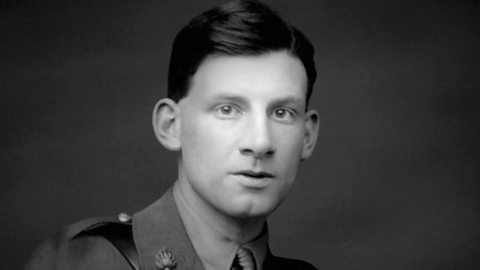
Jeremy Paxman looks at the mental health problems suffered by poet Siegfried Sassoon and soldiers in the First World War.
Treating Indian soldiers at Brighton Pavilion. video
Jeremy Paxman explains how a former royal residence became a hospital for injured soldiers in WW1.
The dangerous jobs of women in WW1. video
How women entered the workforce and took up dangerous roles to support the war effort.

How the Britain turned the tide in 1918. video
How the British workforce, the Home Front and the USA joined together to fight back against the German advance in 1918.
1918: the end of the war and Remembrance Day. video
Jeremy Paxman describes the end of the First World War.