Medicine Through Time…
CHADWICK and SNOW!
At the beginning of the 19th century, bad sanitation, overcrowding and really rubbish medical services meant that public health was pretty terrible.
But a couple of top blokes called Edwin Chadwick and John Snow were determined to change this by exploring the link between living conditions and disease, like cholera and influenza which were causing untold havoc.
Let’s kick off with Edwin Chadwick.
During the cholera epidemic of 1842, the government commissioned a report into public health, and asked Chadwick, a lawyer and social reformer, to lead it.
In the report, good old Chadwick concluded that there was an urgent need to improve the living conditions of the poor,as their lifestyles were directly linked to their health.
But the report wasn’t simply inspired by a charitable spirit – there was, surprise, surprise, also a profit angle.
As Chadwick explained, workers weren’t as productive if they were unwell - shock horror - so bad health was costing us as a nation. Remember, this was at the height of the Industrial Revolution, and wealth, I mean health…y industry relied on healthy workers.
Chadwick argued that improving the health of the poor would directly benefit the nation, and suggested implementing, ‘Boards of Health’, who would have the power to wash the streets and supply fresh and clean running water.
MPs reacted with ‘astonishment, dismay, and horror’ as they did not want to spend a penny of government money on such issuesWhen it came to the population, they believed in a laissez-faire style of government, which basically translates as, ‘let people get on with it’.
However, when cholera struck again in 1848, killing over 14,000 people, parliament was forced to create the historic Public Health Act, and a new ‘Board of Health’ with Chadwick as chairman.
No doubt Chadders had good intentions and helped to make the streets cleaner.
But because he believed in miasma, yes, miasma - the idea that disease was spread by foul-smelling air, he actually made the cholera epidemic worse by insisting that all human waste was put into the River Thames, from where it made its way into the water supply.
Bit of an epic fail to say the least.
One of miasma’s fiercest critics was medical pioneer John Snow, who, in 1849, published a book claiming that dirty water was the cause of cholera. Gasps all round.
The miasma devotees were outraged, but Snow was committed to proving his theory with detailed investigation and evidence-gathering.
In 1854, 700 people died from cholera around Broad Street in Soho, London. Snow mapped the area and found three pieces of evidence that backed up his water theory:
One.
When he removed the handle from the local water pump so it could no longer be used, no-one else died.
Two.
A lady who lived far away from Soho also died in the same outbreak.
Snow discovered that she had been getting her servants to bring water from the diseased pump because she liked the taste. Mmmm all that yummy human waste – gross!
Three.
Snow discovered that no-one had died at the brewery across the street from the pump, because they’d all been drinking beer instead.
Snow proved that cholera was not caused by miasma, but by contaminated water. He even found a leaking toilet next to the pump.
Double gross!
Old Snowy’s methodical approach was a great example of science in action: hypothesis, research and observation. Booom.
It was one of the most important medical discoveries of the time, but thanks to laissez faire politicians , who were ie. doing nothing,and the deep-seated theory of miasma, doctors, politicians and even Chadwick, continued to discredit Snow’s ideas.
In fact, it wasn’t until an incredible 30 years later when Robert Koch identified cholerae as the cause of cholera, that Snow's theory of disease became more widely accepted.
At last!
And if you take a walk in London’s Soho today, you’ll see a memorial to Snow in the form of a black water pump, and… perhaps the highest honour of all – a pub called The John Snow.
So cheers to these lads, Chadwick and Snow – who bravely challenged attitudes to the poor and public health.
The government didn’t like it at the time, but they were eventually forced to lump it.
Cheers to that!
Video summary
An engaging animated summary of the work of medical pioneers, Edwin Chadwick & John Snow.
This animation outlines the pioneering work these two social reformers undertook to improve public health.
It breaks down the series of events that led to better understanding of how poverty and poor living conditions linked to poor health and disease.
We see how from identifying an issue, to hypothesis, research and observation both pioneers used detailed evidence and investigation to challenge old theories.
Using authentic archival illustrations and images alongside the quick pace and irreverent tone of narrator Duncan Wisbey.
This film immerses pupils in 19th century Soho and the stomach-churning conditions of London at the time.
This is from the series: Medicine through time.
Teacher Notes
Pupils could be asked to identify the different stages of Snow’s investigation, and how he came to his conclusion.
They could be shown Snow’s map of the area, and compare this to Soho today.
Pupils could investigate why are these pioneers paired up in this film? What linked them (better sanitation and improving public health), but what separates them (social reform vs. scientific investigation and beliefs in miasma).
This clip will be relevant for teaching KS3 and KS4/GCSE History in England, Wales and Northern Ireland and National 4 History in Scotland.
This topic appears in OCR, AQA, WJEC in England and Wales, CCEA GCSE in Northern Ireland and SQA Scotland.
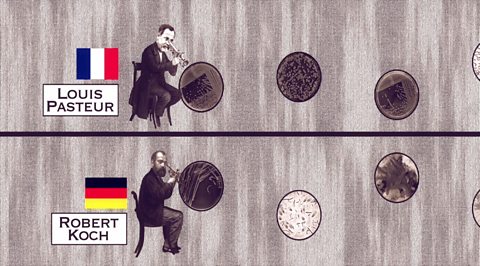
History KS3 / GCSE: Pasteur and Koch. video
An engaging animated look at the work of medical pioneers, Pasteur and Koch.
History KS3 / GCSE: Lister and Simpson. video
An engaging animated look at the work of medical pioneers, Lister and Simpson.

History KS3 / GCSE: 16th and 17th Century Medicine. video
An engaging animated summary of medical progress in the 16th and 17th centuries.
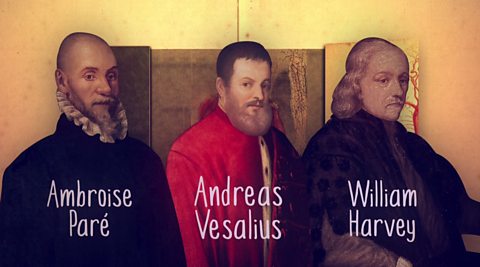
History KS3 / GCSE: Vesalius, Paré and Harvey. video
An engaging animated look at the work of medical pioneers Vesalius, Paré and Harvey
History KS3 / GCSE: 19th Century Medicine. video
An engaging animated summary of medical progress in the 19th century.
History KS3 / GCSE: Medieval Medicine. video
An engaging animated summary of medical progress through the medieval period.
History KS3 / GCSE: Fleming, Florey and Chain. video
An engaging animated look at the work of medical pioneers, Fleming, Florey and Chain.
History KS3 / GCSE: 18th Century Medicine. video
An engaging animated summary of medical progress in the 18th century.
History KS3 / GCSE: Modern Medicine. video
An animated summary of medical progress during the 20th century to the present day.