Medicine Through Time…
The Eighteenth Century.
Shifting attitudes in medicine gained momentum, as the government and charities started to take more interest in public health, and doctors began to challenge the norm.
One doctor in particular single-handedly smashed accepted medical wisdom. Enter: Dr Edward Jenner 'the father of immunology'.
Jenner lived in England when smallpox was at its height.
While studying the disease, Jenner noticed that milkmaids who previously had cowpox, a disease from the same family as smallpox,never seemed to go on to catch the much deadlier smallpox (not that he was staring at the milkmaids, or anything).
From this, Jenner discovered that by injecting someone with a small dose of cowpox, you could make them immune to smallpox.
He tested this hypothesis on 25 people, including a small boy called James Phipps and his own precious son Robert (nice one, Dad.)
Even though the people he injected developed some minor cowpox symptoms (like a kind of flu), they soon recovered.
Not only that, but they were then resistant to smallpox.
When he published his findings, he was laughed at by everyone from the Royal Society through to the Church, who didn’t realise that Jenner had changed the course of medical science forever.
With his cowpox experiment, Dr Edward Jenner had just invented the first ever vaccine, so-called after the word ‘vacca’, which is Latin for ‘cow’.
His dalliances down on the farm with the milkmaids had kicked off an immunological revolution… The effects of which are still felt today, and led to smallpox being completely eradicated through vaccination in 1980.
A truly mooooomentous event…
Now, it so happened that Edward Jenner’s professor - a charming chap called Dr John Hunter - was also a big cheese in 18th century medicine.
Hunter was a real surgery boffin and he made it his mission to revolutionise the messy business of cutting people open and sewing them back up.
Up until now, surgeons were often poorly trained, having gained their knowledge on the battlefield or - gulp! - on the barber shop floor.
But Hunter insisted that surgery should be viewed as more of a science than a craft, and that surgeons should be better trained with a methodical approach. And so his ideas spread quickly among his fellow medical professionals.
“At last. Proper training!”
Before the 18th century, medical institutions had been few and far between. But now there was an explosion in the number of public hospitals. This was largely thanks to charities and wealthy philanthropists, who began funding free healthcare and building medical facilities. These new hospitals adopted modern methods of training and practice, under the guidance of doctors - a profession which was becoming widely respected.
As a result, more and more people were seeking out professional medical opinions, and soon there were doctors everywhere.
From birth, through sickness, to the deathbed.
And while there were still a few dodgy quacks knocking about, it was becoming harder to pass off kooky ideas as medical science.All this sounds like progress, and it sure was, but whilst the numbers of doctors and hospitals rose, at the same time so did the population, especially in urban areas.
Too many people were living in filthy, impoverished conditions, with poor housing and sanitation, meaning the health of the average person was still pretty rubbish.
People started to enjoy a little spare income, and when the war in France cut the supply of brandy, Britons, using their well earned spare cash, started quaffing gin as an alternative like there was no tomorrow.
The country’s philanthropists noticed that this (ahem) cocktail of bad conditions - poverty, overcrowding and alcohol - was having a disastrous effect on people’s wellbeing.
And for the first time, the government started taking an active interest in public health.
So, by the end of the 18th century there were more hospitals and doctors, better surgical training, less religious superstitionand thanks to people like Jenner and Hunter - a more successful approach to treating and preventing disease.
And although medicine still had a long way to go, attitudes had certainly started to shift in a more progressive direction.
Video summary
An engaging animated summary of medical progress in the 18th century; a time that saw doctors challenging the norm, the first ever vaccine and encouraged scientific training for surgeons.
Narrated by actor and impressionist Duncan Wisbey, the pace is quick and tone irreverent.
Using authentic archival illustrations and drawings the key figures focused on are Edward Jenner and John Hunter who both made major breakthroughs in observation, experimentation and immunology.
Key themes that directly affected progress during this period are explored such as the population rise in urban areas, more hospitals and institutions built by philanthropists, the gin craze and effect this had on people’s well-being and as a result the government's growing interest in public health.
As a result, it immerses students in an effective and imaginative way.
This is from the series: Medicine through time.
Teacher Notes
This could be used to ask pupils to give various examples of modern day vaccines, highlighting how important Jenner’s discovery was in 1796.
Pupils could investigate how the gin epidemic forced the government to take a more active role in public health.
This clip will be relevant for teaching KS3 and KS4/GCSE History in England, Wales and Northern Ireland and National 4 History in Scotland.
This topic appears in OCR, AQA, WJEC in England and Wales, CCEA GCSE in Northern Ireland and SQA Scotland.
History KS3 / GCSE: Modern Medicine. video
An animated summary of medical progress during the 20th century to the present day.
History KS3 / GCSE: Vesalius, Paré and Harvey. video
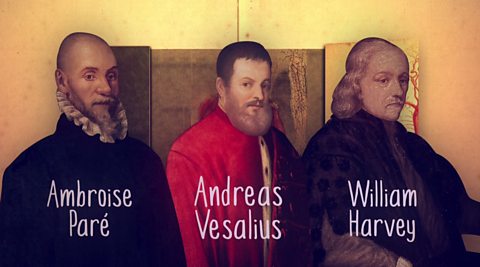
An engaging animated look at the work of medical pioneers Vesalius, Paré and Harvey
History KS3 / GCSE: Pasteur and Koch. video
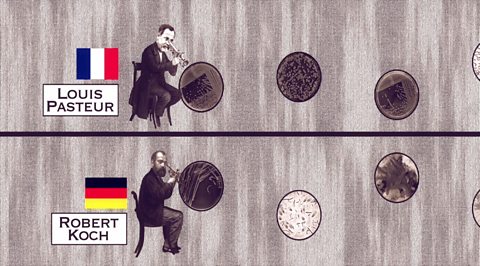
An engaging animated look at the work of medical pioneers, Pasteur and Koch.
History KS3 / GCSE: Lister and Simpson. video
An engaging animated look at the work of medical pioneers, Lister and Simpson.

History KS3 / GCSE: 19th Century Medicine. video
An engaging animated summary of medical progress in the 19th century.
History KS3 / GCSE: Fleming, Florey and Chain. video
An engaging animated look at the work of medical pioneers, Fleming, Florey and Chain.
History KS3 / GCSE: Chadwick and Snow. video
An engaging animated look at the work of medical pioneers, Chadwick and Snow.
History KS3 / GCSE: 16th and 17th Century Medicine. video
An engaging animated summary of medical progress in the 16th and 17th centuries.
History KS3 / GCSE: Medieval Medicine. video
An engaging animated summary of medical progress through the medieval period.