Medicine Through Time…
The 19th Century!
The government’s attitude to health care was finally changing, and old superstitious treatments were swept away by developments in medical technology.
At the beginning of the century everyone was adamant that disease caused germs…
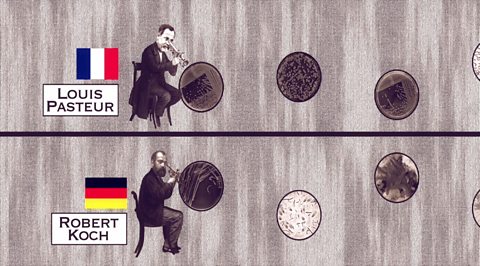
But a forward-thinking Frenchman by the name of Dr Louis Pasteur believed it was, in fact, the other way round - that germs caused disease.
Pasteur was desperate to prove his groundbreaking theory, but he wasn’t alone…
In his attempt to gather scientific evidence, he found himself in a race against a pioneering micro-biologist from Germany called Robert Koch.
The two men avidly examined germs under their microscopes, the result of this bacterial battle was one of the most significant advancements in medical history…
Germ Theory!
British boffin Joseph Lister also played a part in the advancement of Germ Theory.
He applied the evolving knowledge to his own patients, and proposed combating germs by using carbolic acid on surgical instruments and hands, earning him the title: ‘The Father of Antiseptics.’
Take a bow, Joe.
But despite the birth of Germ Theory and antiseptics, the majority of people still believed in outdated ideas, such as the theory that disease was caused by foul-smelling air, or ‘Miasma’ as it was known.
One such believer was the ‘Lady with the Lamp’ Florence Nightingale.
A nurse, social reformer, statistician and crusading night owl, she went to the frontline of the Crimean War, where she treated wounded soldiers by the light of her lamp. Although her belief in miasma was not scientifically correct, her efforts to banish ‘bad air’ actually led to cleaner hospitals, better trained nurses, and all round better care.
And she wasn’t the only Victorian woman breaking new ground…
There was Elizabeth Garrett, who became Britain’s first female doctor in 1865.
And social reformer Octavia Hill, who campaigned for better housing, sanitation, and more open spaces for the poor, many of which we still enjoy today!
Rampant industrialisation was causing overcrowding and incredibly dirty cities.
Britain’s population had risen an incredible 50% from 18 million in 1811 to over twenty seven million by 1851 and while most rich folk sat back and sipped cocktails, a few good fellows like William Farr and Edwin Chadwick were out campaigning on behalf of the poor.
They fought to reform the woefully inadequate poor laws, arguing the need for better sanitation, which all resulted in improved mortality rates.
Along with Octavia Hill, Farr and Chadwick were passionate about proving the link between disease and poverty. But government action came slooowly.
They repealed the public health act of 1848, and it was not until the Great Stink of 1858 that the government's nose really got out of joint and they actually did something.
The stench from the River Thames became almost unbearable, which was hardly surprising as it was effectively a giant dustbin filled with London's rubbish.
The smell was so bad that the Houses of Parliament had to be evacuated, an event that was the straw that broke the politicians’ backs. Shortly after, they decided to build the extensive London sewer system.
And, surprise, surprise, once the sewers were fully operational, Cholera never returned and the Great Stink subsided. Phew.
This improvement in conditions also coincided with the 1867 Reform Act, which gave Britain’s one million working class men the right to vote.
All of these advancements meant that the government’s ‘laissez faire’ approach to public health had to come to an end.
Hurrah!
By the end of the century things were looking brighter.
Reformers had shined a light on the plight of the poor, and new working class voters were demanding better living conditions.And thanks to the brilliance of a certain few, by the end of the century we had sewers, inoculations, cleaner hospitals, access to parks and better public health, all of which meant less disease and greater life expectancy.
What a difference a century makes!
Video summary
An engaging animated summary of medical progress in the 19th century.
Authentic archival illustrations and photographs are used to bring this period’s advancements to life.
Narrated by actor and impressionist Duncan Wisbey, the pace is quick and tone irreverent.
The film notes key figures from Louis Pasteur, Robert Koch and Joseph Lister to Florence Nightingale, Elizabeth Garrett, Octavia Hill, William Farr and Edwin Chadwick.
Exploring key events of the period such as the emergence of germ theory, the impact of industrialisation and the Great Stink of 1858.
This film also looks at social reformers, leading the way for cleaner hospitals and improved housing and sanitation, explaining how the increased understanding of medical causes for disease meant more pressure on the government to sort out public health.
This is from the series: Medicine through time.
Teacher Notes
This could be used to encourage pupils to investigate how the advancements in germ theory by Pasteur and Koch related to Britain.
Who were the British figures that were translating and championing their theories? (i.e. William Dallinger, John Drysdale, John Tyndall, William Cheyne).
This clip will be relevant for teaching KS3 and KS4/GCSE History in England, Wales and Northern Ireland and National 4 History in Scotland.
This topic appears in OCR, AQA, WJEC in England and Wales, CCEA GCSE in Northern Ireland and SQA Scotland.
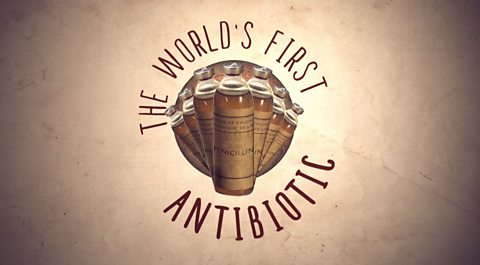
History KS3 / GCSE: Fleming, Florey and Chain. video
An engaging animated look at the work of medical pioneers, Fleming, Florey and Chain.
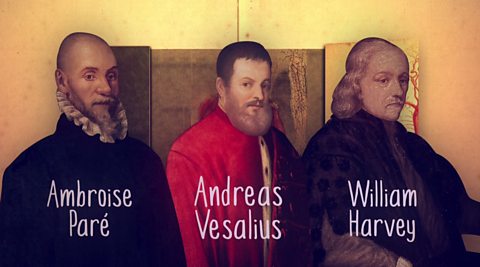
History KS3 / GCSE: Vesalius, Paré and Harvey. video
An engaging animated look at the work of medical pioneers Vesalius, Paré and Harvey
History KS3 / GCSE: Pasteur and Koch. video
An engaging animated look at the work of medical pioneers, Pasteur and Koch.
History KS3 / GCSE: Lister and Simpson. video
An engaging animated look at the work of medical pioneers, Lister and Simpson.

History KS3 / GCSE: Modern Medicine. video
An animated summary of medical progress during the 20th century to the present day.
History KS3 / GCSE: Chadwick and Snow. video
An engaging animated look at the work of medical pioneers, Chadwick and Snow.
History KS3 / GCSE: 16th and 17th Century Medicine. video
An engaging animated summary of medical progress in the 16th and 17th centuries.
History KS3 / GCSE: Medieval Medicine. video
An engaging animated summary of medical progress through the medieval period.
History KS3 / GCSE: 18th Century Medicine. video
An engaging animated summary of medical progress in the 18th century.