Medicine Through Time…
SIMPSON AND LISTER (TITLE)!
Two of the biggest baddies of the medical world have always been pain and infection, and they really took a kicking in the 19th century.
Two men, James Simpson and Joseph Lister, led the charge against these ancient foes.
First up: pain.
It’s not that pain-relief didn’t exist before the 19th century, it’s just it’d never been very effective.
Anaesthetics did exist in herbal forms, but dosages were hard to control and surgery had to be performed quickly due to high pain levels. Ouch.
There was also nitrous oxide – aka laughing gas – which had been used since the 18th century.
And Ether, which was discovered in 1842.
Not only did ether cause vomiting, it was also highly flammable – not ideal when performing surgery by firelight.
It was no laughing matter.
Now, enter the arch-nemesis of pain, Professor James Simpson.
In 1847, Simpson was the first person to demonstrate the anaesthetic properties of chloroform, which was much more effective than anything that’d come before.
How did he do it? Well – the story goes that during one of his many chemical experiments, he knocked over a jar of the stuff… and was later found in a deep sleep next to the jar, like a giant hairy baby.
The Church, still trying to meddle in medical thinking, opposed Simpson’s whole approach to anaesthetic, believing that – for example – pain in childbirth was a punishment from God meted out to sinful women. Charming.
But there were some more rational arguments against chloroform – it could be dangerous, and once killed a 15 year old called Hannah Greener, who died during a toenail operation.
But much-loved Queen Vicky went on to endorse it and so normalised its use as an anaesthetic.
She used it during the birth of her eighth, and youngest, child Prince Leopold in 1850, describing it as “soothing, quieting and delightful beyond measure.”
Next up: that other baddy of the medicine world - infection.
Despite the advancements in pain relief, there was still a huge problem with people‘s wounds getting infected.
After all, feeling numb to pain was all very well and good, but if your leg got badly infected it'd probably need amputating.
Cold comfort I'd say…
Enter Joseph Lister, who made one of the most significant advances in the history of medicine when he invented antiseptic surgery!
Building on Louis Pasteur’s Germ Theory , which hypothesised that infection was caused by microbes getting into broken skin, Lister recommended that doctors use carbolic acid as a chemical barrier against those evil microbes, by rubbing in onto their hands and soaking surgery equipment and wounds in it.
Lister experimented on an 11 year old boy called Jamie Greenlees, who’d had his leg run over by a cart. Awww.
The normal treatment would have been amputation… nice… but instead Lister wrapped the leg with bandages soaked in carbolic acid.
It worked!
And the boy’s wound did not get infected. And proved Lister's carbolic acid chemical barrier idea had legs too!
Result!
Despite its success, Germ Theory had its critics, of course. A chap called John Bennett argued that infection was caused by ‘cell death’; while another chap called Charlton Bastian argued that infection just ‘spontaneously generated.’
Come on guys, wake up and smell the chloroform.
Though his antiseptic would prove revolutionary, Lister himself did not fully understand microbes. He thought there was only one type of microbe, and he even still wore his normal clothes while performing surgery.
He was also a shy fellow who struggled with public speaking – so not best-placed to silence his loud-mouthed critics.
But ultimately, the results of Lister’s theory spoke for themselves, as infection rates in surgery dropped from 50% to 15% in just four years, earning him the biggest ‘I told you so’ in history. Haha!
Thanks to Lister and his antiseptic discovery, surgeons started scrubbing their hands and arms, wearing surgical gowns and gloves, and using sterilised equipment.
This developed into the scrupulously clear aseptic surgery we still – err – enjoy today, which advocates keeping germs out of the operating theatre entirely.
So let’s give a pat on the back to Simpson and Lister, who were hugely influential in moving medicine towards the effective, squeaky clean status it enjoys today.
Video summary
An engaging animated summary of the work of two medical pioneers, Joseph Lister and James Simpson.
Using authentic archival illustrations and images together with stories which perfectly illustrate the process of experimentation of the two scientists, this summary highlights their breakthrough discoveries on treating pain and infection.
Chloroform and carbolic acid are highlighted in context of medical progress whilst recognising their drawbacks and opposition.
Narrated by actor and impressionist Duncan Wisbey, the pace is quick, humorous and tone irreverent.
This is from the series: Medicine through time.
Teacher Notes
This could be used to ask students to discuss the importance of Simpson and Lister’s new techniques, but also understand why they were still challenged.
Why did doctors not like initially using carbolic acid?
This clip will be relevant for teaching KS3 and KS4/GCSE History in England, Wales and Northern Ireland and National 4 History in Scotland.
This topic appears in OCR, AQA, WJEC in England and Wales, CCEA GCSE in Northern Ireland and SQA Scotland.
History KS3 / GCSE: 16th and 17th Century Medicine. video
An engaging animated summary of medical progress in the 16th and 17th centuries.
History KS3 / GCSE: 18th Century Medicine. video
An engaging animated summary of medical progress in the 18th century.

History KS3 / GCSE: 19th Century Medicine. video
An engaging animated summary of medical progress in the 19th century.
History KS3 / GCSE: Medieval Medicine. video
An engaging animated summary of medical progress through the medieval period.
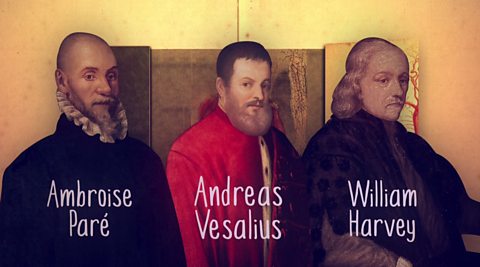
History KS3 / GCSE: Vesalius, Paré and Harvey. video
An engaging animated look at the work of medical pioneers Vesalius, Paré and Harvey
History KS3 / GCSE: Fleming, Florey and Chain. video
An engaging animated look at the work of medical pioneers, Fleming, Florey and Chain.
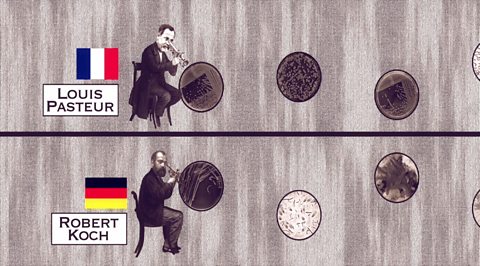
History KS3 / GCSE: Pasteur and Koch. video
An engaging animated look at the work of medical pioneers, Pasteur and Koch.
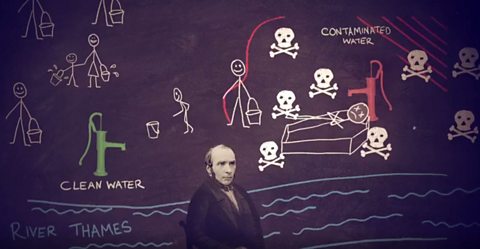
History KS3 / GCSE: Chadwick and Snow. video
An engaging animated look at the work of medical pioneers, Chadwick and Snow.
History KS3 / GCSE: Modern Medicine. video
An animated summary of medical progress during the 20th century to the present day.