Medicine Through Time…
Modern Medicine!
Welcome to the modern era.
A time of huge medical progress, a shifting role for government, and a brand new bevvy of scientific super heroes.
Meet Marie Curie, the first woman to win not one, but two Nobel prizes for science.
She even carried radioactive matter around in her pockets, for goodness sake. So frankly she deserves ten of them.
Anyway, Curie, with her pocketful of glow in the dark goods, made a few epic discoveries, including polonium and radium.
Curie paved the way for radiology, from the first ever X-ray, to modern day cancer treatments. She even coined the term ‘radio-actif’.
So brave was the confident Curie that during the First World War she personally drove to the front line of battle, armed with her rudimentary X-ray machine, to examine wounded soldiers.
Forget ten. She deserves eleven Nobels.
The First World War was, of course, risky biz for everyone involved, but it was also hugely influential in helping push modern medicine forward.
Faced for the first time with grisly shrapnel wounds, doctors were forced to innovate.
Harold Gillies, ‘the father of plastic surgery’ performed the world’s first skin graft during the war in 1917.
Some 25 years later during the Second World War, Harold’s cousin, Doctor Archibald McIndoe, used all manner of early plastic surgery procedures to treat an estimated 645 scarred servicemen.
So experimental and pioneering was maverick McIndoe’s work that his patients called themselves the Guinea Pig club.McIndoe even prescribed his patients trips to the pub - cheers, Doc.
The Scottish biologist, pharmacist and botanist Alexander Fleming witnessed some seriously ghastly infections on the battlefield, and set out to find a better way to treat them.
It was during this time, that Fleming ‘accidentally’ discovered the first type of antibiotic.
It happened by chance when he noticed that penicillin mould had grown in a petri dish, killing off the surrounding staphylococcus bacteria, a common cause of the troublesome boil… But, not realising that he was on the brink of one of biggest breakthroughs in the history of medicine, Fleming didn’t really act on this discovery.
It wasn’t until Doctors Howard Florey and Ernst Chain fought for funding a decade later, that they could elaborate on Fleming's fantastic ‘accident’, developing a stable penicillin that could be mass produced.
And before long, penicillin was flying off production lines quicker than you could say ‘staphylococcus’. 6.8 trillion units of penicillin were produced in 1945 alone, playing a massive role in the allies’ war effort.
As the middle of the 20th century approached, governments were really starting to throw money at medical research. And two doctors that benefited in particular were Crick and Watson.
These chaps, with the help of Maurice Wilkins and Rosalind Franklin discovered a little something called: DeoxyriboNucleic Acid,or more simply, DNA.
This is the tiny, tiny, tiny stuff inside us that pretty much determines everything about our bodies; the building blocks of life, if you will.
Miniscule matter - monumentally HUGE discovery!
Two World Wars had a huge human cost, and the government now felt a duty to protect people.
Not only were the government willing to support medical research financially, they were getting even more concerned with the health of the general public.
Social reform was gaining momentum, and this culminated in the birth of The Welfare State. Ta daaaaa.
A raft of acts were passed to help improve people's lives, and 1948 saw the creation of the glorious N-H-S, thanks to social reformers Aneurin Bevan and William Beveridge.
Cue free medical treatment for everyone, including the eight million people who had never even seen a doctor before. And so ends another 100 years of mighty medical progress.
Thanks to some serious developments in technology, some brilliant individuals like Curie, Crick, Watson, Fleming and Beveridge,and some crucial government intervention, the 20th century saw more medical breakthroughs than any other period in history.
Our present day health system owes so much to these advances, though doctors are facing new challenges, as antibiotic-resistant diseases such as MRSA raise their ugly heads.
Nevertheless, progress continues at a pace, and we now see such medical wonders as heart, liver and even face transplants.So, let’s give a big hand to all our pioneers for paving the way for modern medical science, making our National Health Service the envy of the world.
Video summary
An engaging animated summary of medical progress from the 20th century to the present day, outlining the huge medical breakthroughs that helped develop our understanding of illness today.
Authentic archival photographs and drawings are used to bring these brilliant advancements to life.
The film touches on the pioneering work of Marie Curie, Alexander Fleming, Ernst Chain, Howard Florey, James Watson and Francis Crick.
The summary highlights vital developments in radiology, plastic surgery, the discovery of penicillin, DNA and the formation of the NHS.
Set against the historical context of two world wars, technological advancements, government intervention and the creation of the welfare state this film incorporates the key topics for the syllabus.
It presents the information in a way were pupils are encouraged to find the links between the external factors affecting the population, and the medical breakthroughs it saw.
Narrated by actor and impressionist Duncan Wisbey, the pace is quick and tone irreverent, making it a fun but immersive classroom tool.
This is from the series: Medicine through time.
Teacher Notes
This could be used to ask pupils to discuss key factors that combined to change the health of the population in the modern era.
Looking at key individuals, war, chance, and technology (mass production techniques).
As well as the improvements, pupils could note down what problems the 21st century has encountered within healthcare; such as super-bugs like MRSA.
This clip will be relevant for teaching KS3 and KS4/GCSE History in England, Wales and Northern Ireland and National 4 History in Scotland.
This topic appears in OCR, AQA, WJEC in England and Wales, CCEA GCSE in Northern Ireland and SQA Scotland.
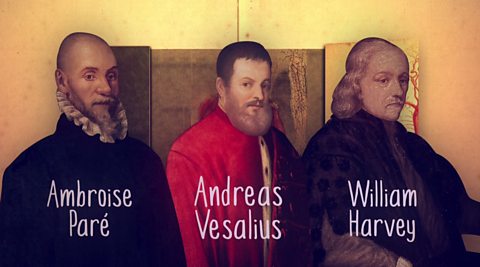
History KS3 / GCSE: Vesalius, Paré and Harvey. video
An engaging animated look at the work of medical pioneers Vesalius, Paré and Harvey
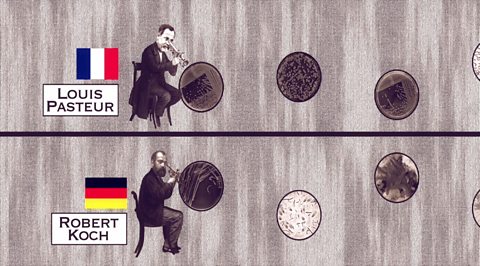
History KS3 / GCSE: Pasteur and Koch. video
An engaging animated look at the work of medical pioneers, Pasteur and Koch.
History KS3 / GCSE: Lister and Simpson. video
An engaging animated look at the work of medical pioneers, Lister and Simpson.

History KS3 / GCSE: Fleming, Florey and Chain. video
An engaging animated look at the work of medical pioneers, Fleming, Florey and Chain.
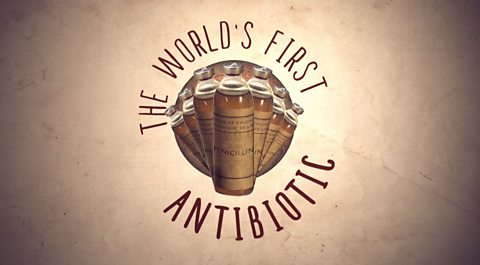
History KS3 / GCSE: 19th Century Medicine. video
An engaging animated summary of medical progress in the 19th century.
History KS3 / GCSE: 16th and 17th Century Medicine. video
An engaging animated summary of medical progress in the 16th and 17th centuries.
History KS3 / GCSE: Medieval Medicine. video
An engaging animated summary of medical progress through the medieval period.
History KS3 / GCSE: 18th Century Medicine. video
An engaging animated summary of medical progress in the 18th century.
History KS3 / GCSE: Chadwick and Snow. video
An engaging animated look at the work of medical pioneers, Chadwick and Snow.