Medicine Through Time…
The medieval period!
The medieval period was famous for disgusting disease, strange superstitions and, of course, massive beards.
This was a time of crafty clergymen and wicked witchdoctors chipping in with bonkers ideas.
But to understand this crazy period, we need to go back even further.
Meet Hippocrates… the father of modern medicine and the owner of a fabulous beard. Unlike other doctors of the time who prayed to the Gods for help, he believed in careful observation and bodily treatments.
Hippocrates thought that to treat people effectively we must first try to understand how the human body worked…
He invented the theory of - ‘The Four Humours’ which hypothesised that the body contained four substances: Black Bile, Yellow Bile, Blood and Phlegm.
He said that if any of the four humours were out of balance, you’d become ill. To bring them back into balance he suggested Purging or even bleeding, which aside from achieving nothing , was, quite frankly gross and, rather messy!
But some of Hippocrates’ less bonkers ideas have stood the test of time and are still used today, nearly 2,500 years later, like the Hippocratic Oath… which says doctors must do their patients no harm…
…or at least not intentionally.
So he was more than just a pretty beard after all.
Let’s give him a jolly loud round of applause!..
Yes, well done!
Another influential beard, sorry [coughs] physician, was Claudius Galen. Galen lived in Rome and made many major breakthroughs in anatomy… which is basically, the study of the inner workings of the body.
And also involves loads of… cutting up animals like pigs, apes and even some humans…. yuck!
Galen’s influence and discoveries such as that arteries carry blood, remained hugely influential and unchallenged for almost fifteen centuries after his death…
So he must have been heading in the right direction…
Fast forward a few hundred years and things got dark. Not literally, but things were ‘dark’ and a bit depressing generally.
The Roman Empire split in two.
War broke out across the whole of Europe, death and destruction was rife and people were suffering. They needed hope from a higher place, and so a supernatural approach to medicine reared it’s head once again…
I’m with you, Hippocrates!
The muddled madness of the supernatural Dark Ages soon gave way to The Middle Ages. But medicine didn’t get much better.
By now the Church held a tight grip over medical ideas, and preached that sickness was divine punishment for Sin.
The Church did allow dissection.
BUT the results would have to support the old ideas of Galen.
Galen’s theories suited the Church’s notion of there being only one God, who created humans and their body parts… for a purpose.
Doctors’ treatments were still based on Hippocrates’ Four Humours and with most people not being able to afford them anyway, they turned instead to apothecaries, monks and wise-men, who had about as much medical knowledge as one of Galen’s apes. (It really was, monkey business.)
Things were bad!
People were sick, getting sicker or just plain dead.
Even the monarchy didn’t want to get involved because they thought public health was beneath them.
So people continued to be treated by untrained surgeons, who, if you were lucky, may have picked up a few tips on the battlefield, or who, if you were unlucky, may have simply got bored of… cutting hair.
Enter the Black Death.
One of the biggest pandemics in history, it wiped out 40% of Britain’s population. Thanks to over-crowding, poor living conditions and terrible public health, the Black Death spread rapidly and was near impossible to control.
The disease caused violent fever, oozing sores and swollen armpits.
At the time, no-one had a clue what caused it.
Most people believed it was a curse from God. And started praying like mad.
Some doctors advised not to overeat or overdrink; others recommended simply chanting spells or lighting candles to ward off evil spirits. Some people even used shaved chickens to try and cure themselves.
And you can just imagine how effective rubbing raw chicken on an open, gaping wound was, can't you…?
So we finish these 450 medieval years, almost where we started.
Galen’s influence still overshadowed medical thought, people believed superstitions and prayer could cure all, medicine was strangled by the over-reaching arms of the Church, barbers were moonlighting as surgeons, doctors were flying the flag for Hippocrates, chickens were getting a raw deal, raw (laughs), sorry, and so progress was as fast as one of Galens’ mutilated pigs running the 100m.
I think you get the picture?
Video summary
An engaging animated summary of medical progress through the medieval period.
Using authentic archival illustrations and diagrams this film brings to life the gruesome and bizarre practices that punctuated medical progress throughout the medieval period.
Narrated by actor and impressionist Duncan Wisbey, the pace is quick and tone irreverent.
After firstly establishing the key figures of Hippocrates and Galen we unpack their theories as well as understanding their impact and legacy.
Key themes that directly affected progress during this period are explored such as the influence of the Church, supernatural thought and early dissection.
These themes, understood in the context of key events; the split of the Roman Empire and the Black Death, immerses students in the GCSE syllabus in an effective and imaginative way.
This is from the series: Medicine through time.
Teacher Notes
This could be used to discuss the theories and influence of Hippocrates and Galen throughout the medieval period..Pupils could investigate the reasons for why the Black Death spread so rapidly.
This clip will be relevant for teaching KS3 and KS4/GCSE History in England, Wales and Northern Ireland and National 4 History in Scotland.
This topic appears in OCR, AQA, WJEC in England and Wales, CCEA GCSE in Northern Ireland and SQA Scotland.
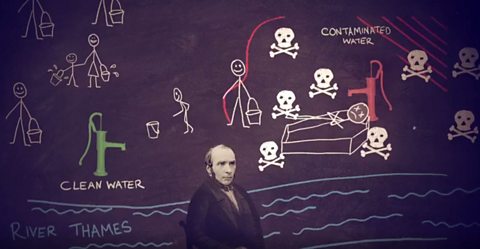
History KS3 / GCSE: 16th and 17th Century Medicine. video
An engaging animated summary of medical progress in the 16th and 17th centuries.
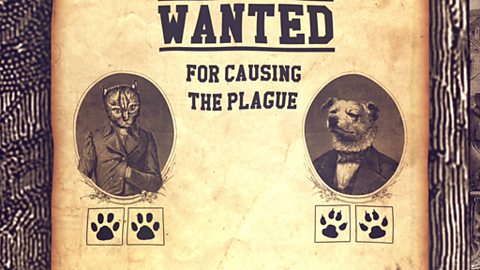
History KS3 / GCSE: 18th Century Medicine. video
An engaging animated summary of medical progress in the 18th century.
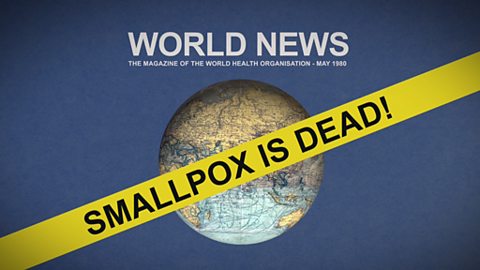
History KS3 / GCSE: 19th Century Medicine. video
An engaging animated summary of medical progress in the 19th century.
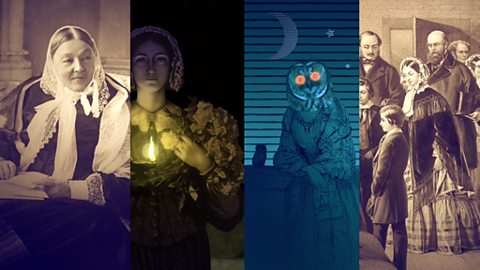
History KS3 / GCSE: Modern Medicine. video
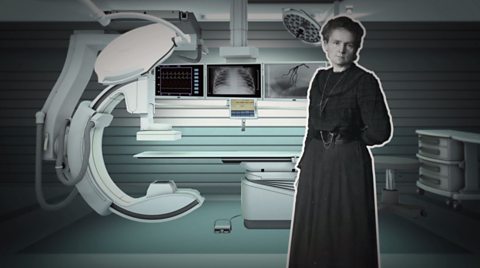
An animated summary of medical progress during the 20th century to the present day.
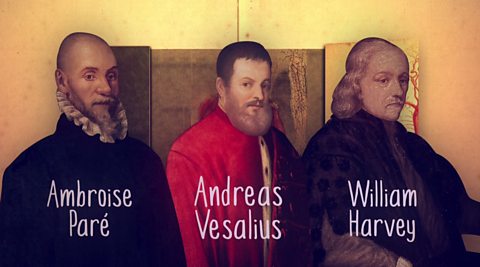
History KS3 / GCSE: Vesalius, Paré and Harvey. video
An engaging animated look at the work of medical pioneers Vesalius, Paré and Harvey
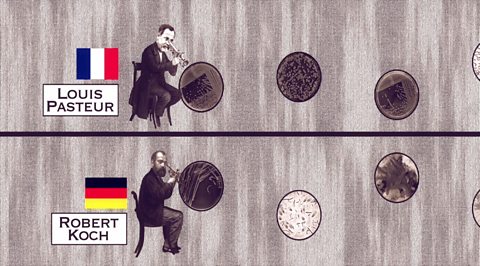
History KS3 / GCSE: Pasteur and Koch. video
An engaging animated look at the work of medical pioneers, Pasteur and Koch.
History KS3 / GCSE: Lister and Simpson. video
An engaging animated look at the work of medical pioneers, Lister and Simpson.

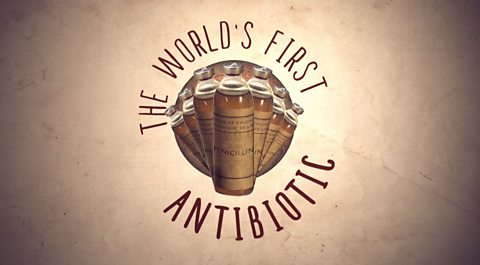
History KS3 / GCSE: Fleming, Florey and Chain. video
An engaging animated look at the work of medical pioneers, Fleming, Florey and Chain.
History KS3 / GCSE: Chadwick and Snow. video
An engaging animated look at the work of medical pioneers, Chadwick and Snow.